Video to GIF: 10 Best Converters for Windows, Mac & Web (2025)
⚡ Quick Answer
To convert a video to GIF, use a tool like Zight (best for professionals who need screen recording + GIF creation + instant sharing in one workflow), EZgif (best free browser-based converter), or ScreenToGif (best free open-source desktop app for Windows). The fastest method: record your screen with Zight, trim the clip, and export as a GIF — the shareable link is copied to your clipboard automatically. Most GIFs should be 2–8 seconds, 480–720px wide, and under 5 MB for optimal loading speed.
Converting a video to GIF is one of those workflows that sounds simple — until you actually need to do it well. You have a screen recording of a bug, a product demo clip, or a reaction moment from a meeting, and you want to turn it into a compact, autoplaying, shareable loop. But then you hit the wall: the file is 40 MB, the colors look terrible, the tool wants you to sign up for a subscription, or the output is a blurry mess.
After testing dozens of video-to-GIF converters across Windows, Mac, and the browser — and after creating thousands of GIFs for bug reports, product walkthroughs, and Slack conversations — I’ve narrowed it down to the 10 tools that actually deliver. Whether you need a quick one-off conversion or a professional-grade workflow that integrates with your team’s tools, this guide covers exactly what you need.
What Is Video to GIF?
Video to GIF is the process of converting a video file (MP4, MOV, AVI, WebM, etc.) into the GIF format — a compressed image format that supports animation through a sequence of frames played in a loop. The GIF format (Graphics Interchange Format) has been around since 1987, but it remains the dominant format for short, silent, autoplaying animations across the web.
The conversion process typically involves selecting a segment of video (usually 2–10 seconds), setting the frame rate and dimensions, optionally adding annotations or text, and then exporting the result as a .gif file. The key tradeoff is always between quality and file size — GIFs use a limited 256-color palette per frame, which means smooth gradients and photographic content can look dithered compared to the source video.
Pro tip: If your “video to GIF” workflow starts with recording the video in the first place, a tool like Zight’s screen recorder lets you capture and convert in a single step — no need to record in one app and convert in another.
Why Convert a Video to GIF?
GIFs have survived every attempt to replace them because they solve a specific problem better than any other format: communicating a short visual idea instantly, without requiring the viewer to click play. Here’s why teams and creators still convert video to GIF daily:
- Autoplay everywhere: GIFs play automatically in Slack, email clients, Jira, Notion, GitHub issues, and virtually every web platform — no “click to play” friction. This makes them perfect for bug reports, design feedback, and quick demos.
- Smaller than video (in context): A 5-second GIF at 480px wide is typically 1–3 MB. While an MP4 of the same footage would be even smaller, GIFs don’t require a video player and autoplay inline — reducing the perceived friction to zero.
- Universal compatibility: Every browser, email client, and messaging app supports GIFs natively. No codec issues, no “your browser doesn’t support this video format” errors.
- Silent by design: GIFs have no audio track, which is actually an advantage for office environments, async communication, and social media scrolling where sound is off by default.
- Higher engagement: According to GIPHY’s internal data, tweets with GIFs get 55% more engagement than those without. In Slack and email, a GIF stops the scroll in a way static screenshots can’t.
- Perfect for tutorials and walkthroughs: A 4-second looping GIF showing exactly where to click is worth more than a paragraph of instructions. We’ve seen teams at Zight reduce support ticket back-and-forth by 30%+ by replacing text descriptions with annotated GIFs.
The 10 Best Video to GIF Converters (2025)
1. Zight — Best All-in-One Screen Recording & GIF Tool

Zight is a screen recording, screenshot, and GIF creation tool for Mac, Windows, and Chrome. What makes it different from standalone converters is that the entire workflow — record → trim → convert to GIF → share via link — happens in one app with zero context switching.
When I tested Zight against dedicated GIF converters, the speed difference was dramatic. With EZgif, I had to: record the screen with a separate tool, save the file, navigate to the browser, upload the video, wait for processing, adjust settings, download the GIF, then upload the GIF to Slack. With Zight, I press ⌘+Shift+G on Mac (or the equivalent shortcut on Windows), record the area I want, and the GIF link is on my clipboard in seconds. For teams doing this 10+ times a day, that’s easily 30–45 minutes saved.
Key features:
- Record-to-GIF in a single step — no file conversion needed
- Built-in annotation tools (arrows, text, highlights, blur) via the screenshot and annotation tool
- Auto-generated shareable links (no file attachment headaches)
- Cloud storage with organization and search
- Integrates with Slack, Jira, Zendesk, Asana, and more
- Also converts existing video files (MP4, MOV) to GIF
- Available on Mac, Windows, and Chrome extension
Best for: Product teams, developers, customer support, and remote workers who create GIFs frequently as part of their communication workflow.
Pricing: Free tier available. Pro plans start at $9.95/month.
Honest limitation: If you just need to convert a single video file you already have and never plan to record your screen, a simpler tool like EZgif will do the job. Zight shines when GIF creation is part of a recurring workflow.
2. EZgif — Best Free Browser-Based Converter
EZgif is the tool most people encounter first when searching for “video to GIF,” and for good reason — it’s free, requires no signup, and works entirely in the browser. You upload a video file (max 200 MB as of 2025), set your start/end time, frame rate, and dimensions, and it spits out a GIF you can download.
In practice, EZgif handles MP4, WebM, AVI, and MOV files reliably, and the output quality is solid for web use. The interface is utilitarian — it looks like it was designed in 2010 — but it’s functional. Where it falls short is workflow speed: every conversion requires uploading your video, waiting for server-side processing, and downloading the result. For one-off conversions, that’s fine. For daily use, it’s tedious.
Key features: Video to GIF, GIF to MP4, resize, crop, optimize, add text, speed adjustment, reverse, and split GIFs.
Best for: One-off conversions when you already have a video file and don’t want to install anything.
Pricing: Free (ad-supported). No premium tier.
Limitation: 200 MB upload limit. No screen recording. No sharing features. Processing is server-side, so it’s slower than desktop tools for large files.
3. ScreenToGif — Best Free Open-Source Desktop Tool (Windows)
ScreenToGif is an open-source tool for Windows that combines screen recording with a powerful frame-by-frame GIF editor. When I tested it, the editing capabilities genuinely impressed me — you can delete individual frames, add transitions, adjust delay per frame, draw on frames, and export with fine-grained control over quality and file size.
Key features: Screen recorder, webcam recorder, sketchboard, frame-by-frame editor, batch processing, and export to GIF, APNG, or video.
Best for: Windows users who want granular control over their GIF output and don’t mind a slightly steeper learning curve.
Pricing: Completely free. Open source.
Limitation: Windows only. No cloud sharing — you export a file and share it manually. The frame editor is powerful but can be overwhelming for simple conversions.
4. Giphy — Best for Social GIFs and Discovery
Giphy’s GIF Maker lets you paste a video URL (including YouTube links) or upload a file and convert it to a GIF. The differentiator is Giphy’s distribution network — your GIF gets indexed in Giphy’s searchable library, which is integrated into Slack, iMessage, WhatsApp, and dozens of other platforms.
Key features: URL-to-GIF, video upload, text overlays, stickers, and distribution across Giphy’s integrated platforms.
Best for: Creating GIFs intended for public sharing, memes, or brand content that benefits from Giphy’s discovery platform.
Pricing: Free. Account required.
Limitation: Not ideal for private or work-related GIFs — everything uploaded becomes part of Giphy’s public library by default. Limited editing capabilities compared to desktop tools.
5. Adobe Express — Best for Branded GIFs
Adobe Express (formerly Adobe Spark) includes a video-to-GIF converter as part of its broader content creation suite. The output quality is excellent, and you can apply brand fonts, colors, and templates to your GIFs — useful for marketing teams maintaining brand consistency.
Key features: Video trimming, text overlays, brand kit integration, templates, and export to GIF or MP4.
Best for: Marketing teams and content creators who need on-brand GIFs and already use Adobe’s ecosystem.
Pricing: Free tier available. Premium starts at $9.99/month (included with Creative Cloud).
Limitation: Overkill for simple screen recording GIFs. The free tier includes Adobe watermarks on some templates.
6. Adobe Photoshop — Best for High-Quality, Precise GIFs
Photoshop remains the gold standard for creating high-quality GIFs when you need pixel-perfect control. You can import video files via File → Import → Video Frames to Layers, then edit individual frames in the Timeline panel. The “Save for Web” export gives you granular control over color reduction, dithering, and lossy compression.
Key features: Frame-by-frame editing, advanced color palette control, layer effects, text, and “Save for Web” optimization.
Best for: Designers and creators who already have Photoshop and need the highest-quality output with precise control.
Pricing: $22.99/month (Photography plan) or $59.99/month (full Creative Cloud).
Limitation: Significant learning curve. Extremely slow workflow for quick conversions — not practical for daily GIF creation. Expensive if you don’t already use it for other work.
7. CloudConvert — Best for Batch and API Conversions
CloudConvert is a file conversion platform that supports 200+ formats, including video to GIF. Its strength is flexibility: you can set resolution, frame rate, trim points, and even use their REST API for automated batch conversions — ideal for developers building GIF generation into a product or workflow.
Key features: 200+ format support, API access, batch processing, adjustable quality settings, and cloud storage integrations (Google Drive, Dropbox, S3).
Best for: Developers and teams that need programmatic video-to-GIF conversion at scale.
Pricing: 25 free conversions/day. Packages start at $8 for 500 conversion minutes.
Limitation: No screen recording. No annotation tools. The web interface is purely functional — no editing beyond basic trim and resize.
8. Imgur Video to GIF — Best for Quick URL-Based Conversions
Imgur’s “Video to GIF” tool lets you paste any video URL and select a segment to convert. It’s incredibly fast for converting YouTube, Vimeo, or other hosted video clips into shareable GIFs without downloading anything first.
Key features: URL-based conversion, simple trim interface, and Imgur hosting with direct link.
Best for: Quickly creating GIFs from online videos for casual sharing.
Pricing: Free.
Limitation: Limited editing options. Output is technically GIFV (MP4 in a GIF wrapper), not a true .gif file. GIFs are hosted on Imgur and may be subject to their content policies.
9. Gifski — Best for High-Quality GIFs on Mac
Gifski is a Mac-only app (available on the App Store) that produces some of the highest-quality GIFs I’ve seen. It uses pngquant’s advanced color quantization algorithm, which means smoother gradients and fewer color-banding artifacts than most other tools. Drag in a video, set your trim points and frame rate, and export.
Key features: Superior color quality, simple drag-and-drop interface, adjustable FPS and dimensions, and remarkably good file size optimization.
Best for: Mac users who prioritize visual quality and want the cleanest-looking GIFs possible.
Pricing: Free (open source core). Mac App Store version is $4.99 as a one-time purchase.
Limitation: Mac only. No screen recording, annotation, or sharing features. Pure converter — nothing more.
10. VEED.io — Best Browser-Based Editor with GIF Export
VEED.io is a browser-based video editor that includes GIF export as one of its output formats. It’s more of a full video editing tool than a dedicated converter, which means you get subtitles, transitions, and more — but also more complexity than you might need for a simple conversion.
Key features: Video trimming, subtitles, text overlays, filters, and export as GIF, MP4, or MP3.
Best for: Users who need to edit their video (add subtitles, crop, combine clips) before converting to GIF.
Pricing: Free tier (watermarked exports). Pro starts at $18/month.
Limitation: Free tier adds a watermark. More expensive than alternatives for pure GIF conversion. Processing happens server-side, so large files are slow.
Video to GIF Converter Comparison Table
Here’s a side-by-side comparison of all 10 tools to help you decide which is right for your workflow:
| Tool | Platform | Screen Record | Annotations | Cloud Sharing | Batch Convert | Price |
|---|---|---|---|---|---|---|
| Zight | Mac, Windows, Chrome | ✅ | ✅ | ✅ | ❌ | Free / $9.95/mo |
| EZgif | Web | ❌ | Limited | ❌ | ❌ | Free |
| ScreenToGif | Windows | ✅ | ✅ | ❌ | ✅ | Free |
| Giphy | Web | ❌ | Stickers/text | ✅ (public) | ❌ | Free |
| Adobe Express | Web | ❌ | ✅ | ✅ | ❌ | Free / $9.99/mo |
| Photoshop | Mac, Windows | ❌ | ✅ | ❌ | ✅ (Actions) | $22.99/mo |
| CloudConvert | Web / API | ❌ | ❌ | ✅ | ✅ | Free / $8+ |
| Imgur | Web | ❌ | ❌ | ✅ (public) | ❌ | Free |
| Gifski | Mac | ❌ | ❌ | ❌ | ❌ | Free / $4.99 |
| VEED.io | Web | ❌ | ✅ | ✅ | ❌ | Free / $18/mo |
How to Convert a Video to GIF (Step-by-Step)
The exact steps vary by tool, but here’s the universal workflow for converting any video to GIF — demonstrated using Zight, which combines recording and conversion into a single flow:
Method 1: Record and Convert in One Step (Zight)
- Open Zight from the menu bar (Mac) or system tray (Windows). Click the Zight icon and select “Record GIF”.
- Select the recording area — drag to choose the region of your screen you want to capture.
- Record your action. Keep it short — 2 to 8 seconds is the sweet spot for GIFs.
- Stop recording. Zight automatically processes the GIF and uploads it to the cloud.
- Share the link. A shareable URL is instantly copied to your clipboard. Paste it into Slack, Jira, email, or anywhere else. Done.
Pro tip: If you want to add arrows, highlight areas, or blur sensitive information, use Zight’s annotation tools before sharing. This is especially useful for bug reports where you need to draw attention to a specific UI element.
Method 2: Convert an Existing Video File
- Choose your tool. For a quick browser-based conversion, go to EZgif.com/video-to-gif. For higher quality on Mac, use Gifski. For Windows with editing, use ScreenToGif.
- Upload your video file. Most tools accept MP4, MOV, AVI, and WebM. File size limits vary — EZgif caps at 200 MB.
- Set your trim points. Select the start and end time for the segment you want to convert.
- Adjust settings:
- Frame rate: 10 fps for small file sizes, 15 fps for a good balance, 20+ fps for smooth animation
- Width: 480px for Slack/email, 720px for web embeds, 320px for ultra-compact
- Export and download the GIF file.
How to Optimize GIF File Size Without Destroying Quality
After recording hundreds of screen sessions and converting them to GIFs, the pattern that works best is optimizing before export, not after. Here are the techniques that consistently produce the best quality-to-size ratio:
- Keep it short. Every additional second adds significant file size. A 3-second GIF at 15 fps is ~45 frames. A 10-second GIF is ~150 frames — and file size scales almost linearly.
- Reduce dimensions first. Halving the width from 1080px to 540px reduces file size by roughly 75%. For Slack and email, 480px wide is usually plenty.
- Lower the frame rate. 15 fps looks smooth enough for most screen recordings. Dropping from 30 fps to 15 fps cuts your file size in half with barely noticeable quality loss on UI animations.
- Use lossy GIF compression. EZgif’s “Optimize” tool and Gifski both support lossy compression that can reduce file size by 30–50% with minimal visual impact.
- Minimize on-screen motion. GIFs compress better when most of the frame stays static between frames. If you’re recording a screen, avoid scrolling rapidly or having many animated elements simultaneously.
- Consider the color palette. GIFs are limited to 256 colors per frame. Recordings of simple UIs (white backgrounds, flat colors) compress dramatically better than recordings of video content or photographic images.
📏 Quick reference: GIF size targets by platform
| Platform | Max GIF Size | Recommended Target |
|---|---|---|
| Slack | 20 MB | Under 5 MB |
| Discord | 10 MB (25 MB Nitro) | Under 8 MB |
| GitHub / Jira | 10 MB | Under 5 MB |
| Email (Gmail) | 25 MB attachment | Under 3 MB |
| Twitter / X | 15 MB | Under 5 MB |
| Web pages | No hard limit | Under 3 MB for performance |
GIF vs. Video vs. APNG vs. WebP: Which Format Should You Use?
GIF isn’t always the right format. Here’s a quick decision framework based on testing all four formats across different platforms:
| Use Case | Best Format | Why |
|---|---|---|
| Bug report in Slack/Jira | GIF | Autoplays, universal support, no click required |
| Product demo (>15 sec) | MP4 video | Smaller file, audio support, better quality at length |
| Design feedback with annotations | GIF (via Zight) | Annotations + autoplay = immediate clarity |
| Social media post | GIF or MP4 | Platforms auto-convert; GIF for loops, MP4 for longer |
| High-quality animation | APNG or WebP | Full color depth, smaller files, but limited platform support |
| Email newsletter | GIF | Only animated format reliably supported in email clients |
Pro tip: When in doubt, create both. With Zight’s screen recorder, you can capture a screen recording as video and separately export a trimmed GIF of the key moment — giving you both formats from a single recording session.
Common Video to GIF Use Cases for Teams
Here are the most valuable use cases we’ve seen teams adopt after switching to a record-and-GIF workflow:
Bug Reports
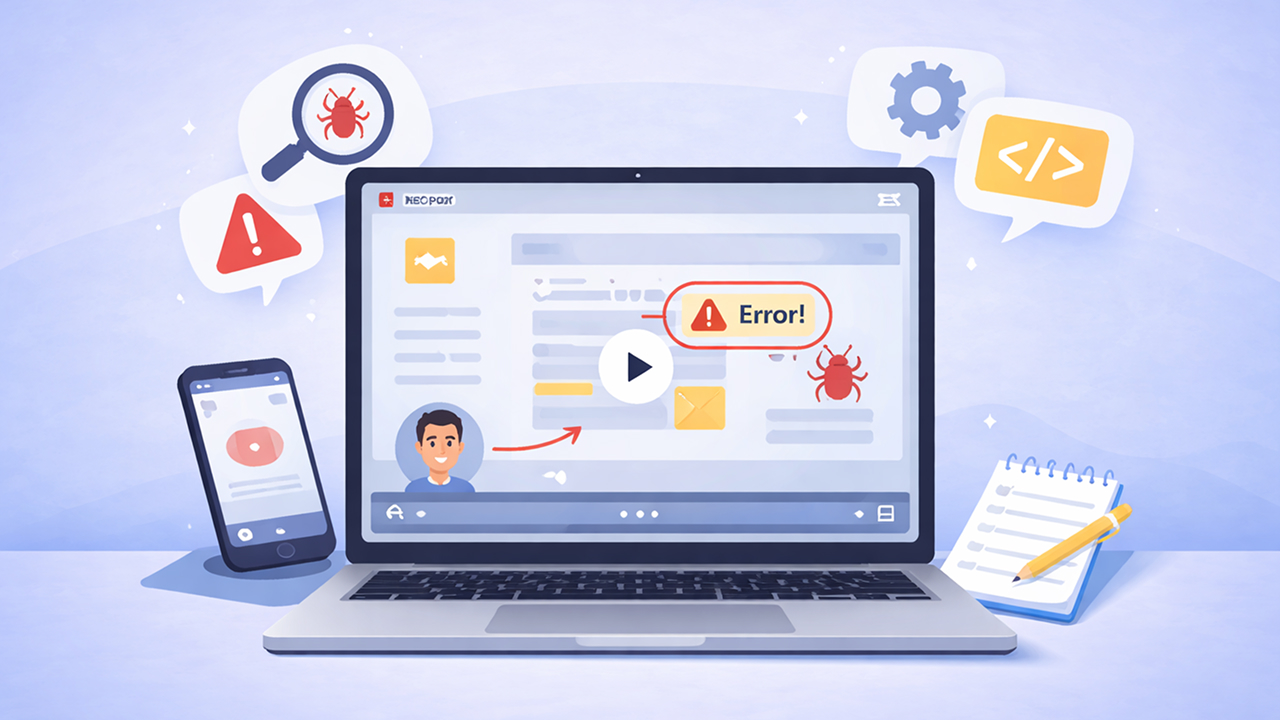
Instead of writing “the dropdown menu flickers when I hover over the third item on the Settings page,” record a 4-second GIF showing exactly what happens. Attach the GIF link to the Jira ticket. The developer sees the bug immediately, without needing to reproduce it first. In practice, this eliminates 1–2 rounds of “can you clarify what you mean?” back-and-forth per ticket.
Customer Support
When a customer asks “how do I change my billing email?”, a 5-second GIF showing the exact clicks is faster to create than typing the instructions — and far more effective. Support teams using Zight report that GIF-based responses resolve tickets 40% faster than text-only responses.
Onboarding and Training
Short GIFs embedded in Notion docs or Confluence pages show new hires exactly how to navigate internal tools. A library of 20–30 GIFs covering common workflows can replace an hour-long training session — and the GIFs are always available for reference later.
Design and Product Feedback
Instead of a screenshot with markup that says “this transition feels janky,” record a GIF of the interaction and annotate the exact frame where the issue occurs. Motion-based feedback is nearly impossible to communicate with static images.
How to Choose the Right Video to GIF Converter
With 10 tools on this list, here’s a quick decision tree to match your situation:
- “I need to convert a video file I already have — once.” → Use EZgif (free, browser-based, no signup).
- “I create GIFs from my screen regularly for work.” → Use Zight (record → GIF → share link in one workflow).
- “I’m on Windows and want frame-level editing control.” → Use ScreenToGif (free, open source, powerful editor).
- “I want the best visual quality possible on Mac.” → Use Gifski ($4.99 one-time, superior color rendering).
- “I need to convert videos to GIF programmatically via API.” → Use CloudConvert (REST API, batch processing).
- “I’m creating branded social content.” → Use Adobe Express or Giphy.
- “I need maximum control and already have Photoshop.” → Use Photoshop.
Frequently Asked Questions
What is the best free video to GIF converter?
For quick one-off conversions in the browser, EZgif is the most popular free option — no signup, no watermark, straightforward. For Windows users who want a more powerful free tool with screen recording and frame editing, ScreenToGif is excellent. For professionals who create GIFs frequently, Zight’s free tier includes screen recording and GIF creation with cloud-based sharing.
How do I convert a video to GIF without losing quality?
Some quality loss is inherent when converting to GIF because the format only supports 256 colors per frame. To minimize quality loss: keep the GIF under 10 seconds, use a frame rate of 15–20 fps, limit the width to 480–720px, and use a tool with good dithering (Gifski produces the best results in our testing). Desktop tools process locally and avoid recompression during upload, so they generally produce better output than browser tools.
Can I convert a YouTube video to GIF?
Yes. The easiest method is to record the YouTube video playing on your screen using a tool like Zight’s screen recorder and export the recording as a GIF. Alternatively, Imgur’s Video to GIF tool accepts YouTube URLs directly. Always ensure you have the right to create GIFs from copyrighted content.
What’s the ideal length for a GIF?
For most use cases, 2 to 8 seconds is the ideal length. Bug reports work well at 3–5 seconds. Tutorial GIFs showing a single action should be 4–6 seconds. Reaction GIFs are typically 2–3 seconds. Anything over 10 seconds should probably be a video instead — the file size becomes unwieldy and the looping can be disorienting.
What’s the difference between GIF and GIFV?
GIFV is a format popularized by Imgur — it’s actually an MP4 video file displayed in a GIF-like wrapper (autoplaying, looping, no controls). GIFV files are much smaller than true GIFs at the same quality, but they require browser video support and aren’t compatible with all platforms where true GIFs work (notably, email clients).
Is Zight only a GIF tool?
No. Zight is a complete visual communication platform that includes screen recording (video with audio), screenshots with annotations, GIF creation, and cloud-based sharing with instant links. The video-to-GIF conversion is one part of a broader async communication workflow designed for product teams, developers, and customer-facing roles.
Final Verdict: The Best Way to Convert Video to GIF in 2025
If you’re converting a single video file you already have, EZgif is the fastest free option. If you’re on Windows and want deep editing control, ScreenToGif is unbeatable at its price (free). If you care about visual quality above all else on Mac, Gifski produces the cleanest output.
But if you’re someone who creates GIFs as part of your daily work — for bug reports, support tickets, design reviews, onboarding docs, or team communication — the standalone converter approach is the wrong tool for the job. You don’t need a converter. You need a workflow.
Zight handles the entire loop: record your screen, trim the footage, export as GIF, annotate if needed, and share via an instant link — all in one tool. No file downloads, no re-uploads, no context switching between apps. After testing all 10 tools on this list extensively, Zight is the one I keep coming back to for the simple reason that it eliminates the most friction between “I need to show someone this” and “here’s the GIF.”