- Accuracy: Leading tools achieve 95%+ accuracy under optimal conditions.
- Multilingual Capabilities: Real-time transcription supports up to 100 languages, improving global collaboration.
- Integration: Platforms like Microsoft Teams and Slack embed transcription to streamline workflows.
- Productivity Boost: Teams report saving hours weekly with automated notes, summaries, and action tracking.
- Inclusivity: Real-time captions increase accessibility for individuals with hearing impairments by up to 70%.
BEST Transcription Software 2025: Rev vs Descript vs Otter.ai vs Sonix
Key Advances in AI Transcription Technology
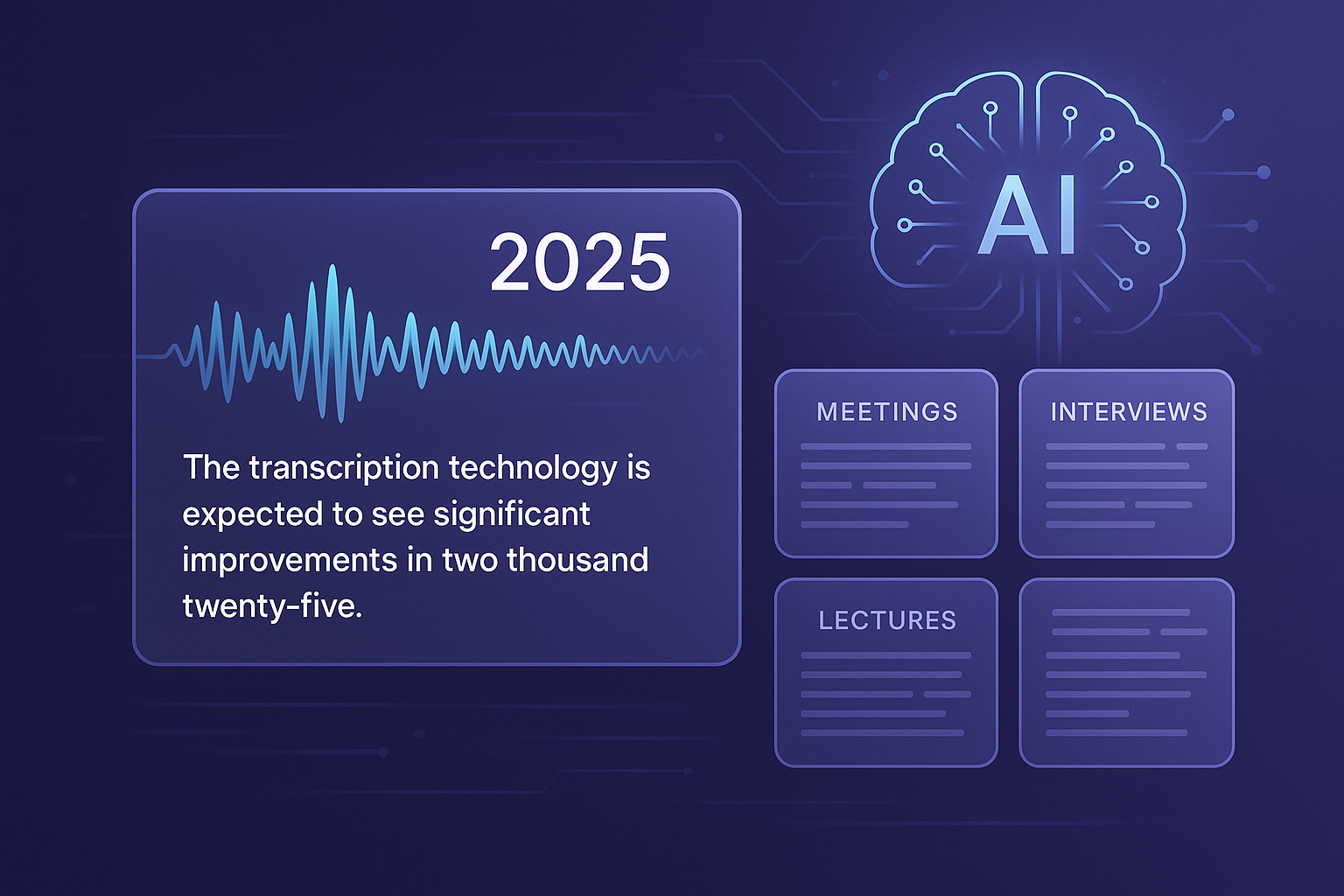
AI transcription technology has made significant strides in 2025, thanks to advancements in natural language processing (NLP) and machine learning. These improvements have redefined how spoken language is converted into precise written text, making transcription tools more accurate and versatile than ever before.Better Speech Recognition and Multi-Speaker Handling
Recent NLP breakthroughs allow AI systems to better understand context, enabling them to differentiate between homophones by analyzing surrounding words. This enhanced contextual understanding has greatly improved transcription accuracy. One standout advancement is speaker diarization, which involves segmenting audio streams by individual speakers. This technology handles two key tasks: identifying the number of distinct speakers and assigning speech segments to the correct individuals. It’s now robust enough to perform well even in less-than-ideal audio conditions. Modern transcription systems also benefit from improved audio processing. For instance, enhanced audio quality can boost transcription accuracy by up to 20%. Even in challenging environments, these systems maintain high performance. A great example is Google’s speech recognition technology, which has reduced its word error rate by over 30% since 2012. Another exciting development is the ability of AI to detect emotions and tone in speech. This feature adds depth to transcriptions, making them more expressive and contextually relevant. In business settings, this capability can help teams better understand speaker sentiment and intent, which can influence decision-making and collaboration dynamics. These improvements in speaker recognition and handling have also paved the way for significant advancements in real-time transcription.Real-Time Transcription and Higher Accuracy
Real-time transcription has reached new levels of reliability in 2025. The leading engines now achieve over 95% accuracy in optimal conditions, a substantial improvement that makes these tools dependable for critical business applications.“AI transcription has been one of the fastest-advancing areas of artificial intelligence, driven by powerful speech recognition engines that achieved high accuracy rates well before other AI applications reached maturity.” – Surbhi, Technical Writer at DigitalOceanThe market’s growth reflects these advancements. Fortune Business Insights projects the global speech recognition market will hit $19.09 billion in 2025, fueled by a 23.1% compound annual growth rate. Popular platforms like Otter.ai and Zoom report accuracy rates of up to 90%, while Forrester highlights that AI transcription tools can improve accuracy by up to 30% when handling diverse accents and speaking patterns. Speed has also seen remarkable progress. Tools like AssemblyAI‘s Universal-Streaming API offer latency as low as 300ms, making them ideal for real-time applications like voice agents. Similarly, Deepgram‘s Nova-3 model supports real-time multilingual transcription in over 50 languages, enabling live captioning for webinars, meetings, and events without noticeable delays. These systems are now adept at handling complex speech patterns, multiple accents, and background noise with impressive precision. Continuous machine learning ensures fewer errors over time, reducing the need for human intervention. Many platforms also provide custom vocabulary and language models, allowing organizations to tailor transcription tools to their specific industry needs and terminology. Looking ahead, multimodal transcription is emerging as a game-changer. By combining audio, video, and text inputs, this approach uses visual cues and contextual information to enhance accuracy, particularly in scenarios with multiple participants and overlapping conversations. This innovation promises to reshape how transcription is used in dynamic and complex environments.
New Features: Multilingual and Context-Aware Transcription
AI transcription has evolved to do more than just convert speech to text. It now offers multilingual capabilities and context-aware insights, recognizing not only what’s being said but also how it’s said and the meaning behind it.Multilingual Transcription and Translation
As businesses become more interconnected, the demand for multilingual transcription services has grown significantly. By 2028, the transcription and translation market is expected to hit $98.11 billion. AI transcription tools are meeting this demand by using advanced natural language processing (NLP) to provide real-time transcription and translation across multiple languages – an essential feature for global teams where participants might speak different languages in the same meeting. By analyzing entire sentences for context, these tools reduce errors and better preserve the original meaning. Here’s a look at projected accuracy rates for multilingual transcription by 2025:| Language Category | Accuracy Rate |
|---|---|
| Primary Languages | 96% |
| Secondary Languages | 92% |
| Developing Languages | 88% |
- Deepgram Nova: Handles up to 10 languages simultaneously in real-time.
- Tomedes AI Transcription Tool: Supports over 100 languages.
- Votars: Provides real-time transcription and translation in 74 spoken languages, making it ideal for diverse teams.
Context-Aware Capabilities
Context-aware transcription goes beyond basic speech recognition, interpreting industry-specific language and speaker intent. This makes it invaluable in specialized fields like law, medicine, and academia, where precision is non-negotiable. These systems adapt to the subject matter, distinguishing between similar-sounding words (homophones) and understanding technical jargon. For instance, a medical consultation will be transcribed differently than a legal discussion due to the contextual understanding of terms. Modern tools also excel at speaker identification, accurately distinguishing between multiple participants and maintaining consistent speaker labels during long discussions. Features like automatic summarization and action item extraction have revolutionized meeting follow-ups. Instead of combing through lengthy transcripts, users receive concise summaries highlighting decisions and assigned tasks. For example, El País reduced the processing time for a 45-minute conference to just 20 minutes with 94% accuracy using Trint ProMeeting. These advancements translate into tangible productivity gains. In 2023, MediaPro Barcelona cut post-production time by 40% when subtitling documentaries in Catalan and Basque using Sonix. Similarly, a Barcelona contact center doubled its authentication rates by leveraging Deepgram Nova by March 2025.“I love that Jamy automatically assigns tasks to the people who need to carry them out. I no longer have to create the tasks manually, which saves a lot of time.” – Alexia Lafitau, CEO of Odys.travelAI transcription systems are also becoming more culturally aware, adapting communication styles to align with customer preferences and norms. Google Chirp, for example, supports over 100 languages and dialects while recognizing pauses, tone, and speaker intent, making it a leader in context-aware transcription. These tools continuously improve by learning from real-world interactions, ensuring they stay relevant and accurate. For organizations, investing in advanced NLP models that support their specific languages and regional dialects is critical. The benefits of these tools are clear: better communication, fewer misunderstandings, and stronger global collaboration.
sbb-itb-5d91f01
AI Transcription in Workflow Automation and Integration
AI transcription has become a key player in improving workplace efficiency by integrating seamlessly with tools that organizations already use daily. Instead of functioning as standalone tools, modern transcription platforms now act as central systems that automate routine tasks and enhance communication across teams.Integration with Communication Tools
AI transcription tools are reshaping team collaboration by embedding directly into platforms like Slack, Microsoft Teams, and Jira. These integrations eliminate the need to switch between apps, delivering meeting insights right into existing workflows. Take Microsoft Teams, for example. In October 2024, Microsoft introduced its Intelligent Recap feature within Teams Premium. This tool doesn’t just transcribe meetings – it summarizes discussions, highlights key points, extracts action items, and organizes recordings by speaker or topic. The results have been impressive.“Microsoft Teams Intelligent Recap is a game-changer, especially for busy organizational leaders. Whether you need to follow up on tasks, share notes, or catch up on a meeting you missed, Intelligent Recap has you covered.” – Claire Sisson, Principal Group Product Manager, Microsoft DigitalMicrosoft employees themselves have praised the tool. Tyler Russell from the Azure Databases team shared how it’s boosted his efficiency:
“This is one of the most impactful features I have seen introduced with hybrid work. This functionality improves my productivity significantly and I have started recording more meetings because of it.” – Tyler Russell, Senior Engineering Architect, Azure Databases SQL Customer Success Engineering teamSlack AI has also stepped up by adding transcription capabilities to its paid plans. Teams can now automatically share meeting notes, transcripts, and action items in the relevant Slack channels. This means teammates who missed a meeting can stay informed without needing lengthy email updates or separate briefings. Users of these tools report saving over four hours per week. For businesses, the key to success lies in choosing platforms that integrate smoothly with tools they already rely on. Platforms like Zight offer native integrations with Slack, Microsoft Teams, and Jira, enabling teams to share transcribed content and visual communications effortlessly, without any manual steps. These integrations go beyond convenience – they also automate meeting documentation, driving productivity even further.
Automated Meeting Notes and Transcripts
With AI transcription, the tedious task of taking meeting notes is a thing of the past. Instead of assigning someone to jot down key points or rushing to document action items after the meeting, teams can rely on AI to handle it all. Automated tools summarize decisions, extract action items, and create searchable archives that serve as valuable knowledge bases for future reference. For example, a Fortune 500 company that adopted AI transcription technology saw a 30-minute reduction in average meeting times. This not only eased meeting fatigue but also led to a 25% drop in the total number of meetings, as AI-generated transcripts allowed teams to review discussions without scheduling redundant follow-ups. The numbers speak for themselves: 75% of teams using AI transcription tools report higher meeting productivity, and 60% see better collaboration and communication. By allowing team members to focus fully on discussions, knowing AI will document everything, these tools free up time and energy for more meaningful contributions. For remote and hybrid teams, transcription tools are especially valuable. With 76% of companies adopting remote work policies and 47% planning to allow full-time remote work by 2025, automated documentation ensures everyone stays in the loop, no matter where they are or what time zone they’re in. Another major advantage? AI transcription compensates for the limits of human memory. Studies show that employees forget about 50% of what they learn within an hour and up to 75% within a week. By creating reliable transcripts and summaries, these tools act as an external memory source that teams can revisit long after a meeting ends. Organizations across industries are already reaping the benefits. Laura Brown from Aiden Technologies summed it up well:“Otter is a must-have. Just being conservative – our team is getting 33% time back.” – Laura Brown, Vice President of Sales, Aiden TechnologiesAI transcription isn’t just a tech upgrade – it’s transforming how teams work together. By integrating deeply with existing platforms and automating tedious tasks, these tools are driving efficiency, improving collaboration, and setting the stage for a more productive future. Companies that embrace these advancements now are positioning themselves for long-term success.
Case Study: AI Transcription in Visual Communication Platforms
Visual communication platforms have begun integrating screen recording with AI transcription to create detailed, actionable documentation. This case study highlights how AI transcription enhances these platforms, streamlining workflows and improving team collaboration. By embedding AI transcription as a core feature, these platforms go beyond basic text conversion. They transform the entire user experience – from recording to sharing knowledge – into a seamless process. Let’s dive into how these AI-powered tools deliver measurable productivity benefits.Improving Productivity with AI Transcription
Zight has taken a significant step in boosting productivity with its AI transcription capabilities. On January 22, 2025, Zight introduced System Audio and Smart Actions, two features that elevate transcription from simple text generation to automated workflow management. The System Audio feature ensures that every detail of meetings and presentations is captured, while Smart Actions automatically creates action items and summaries from meeting notes. Together, they turn recordings into well-organized, actionable content without requiring manual effort.“With the introduction of System Audio, Zight empowers users to capture every aspect of their meetings and presentations. This feature makes Zight indispensable for remote teams, educators, and professionals who rely on seamless meeting documentation.” – Sachin Lad, CTO at ZightOne standout capability of visual communication platforms is their ability to convert videos into detailed written guides. Unlike traditional transcription tools, these platforms capture both spoken content and on-screen visuals, addressing a key limitation of earlier solutions. The productivity gains are clear. Companies using AI transcription tools report a 25% increase in team productivity. This boost comes from several factors: participants can focus on discussions instead of taking notes, information is automatically organized and searchable, and team members who miss meetings can quickly catch up through AI-generated summaries. AI transcription also tackles the challenge of information retention in virtual meetings. While employees typically retain just 10-20% of information presented in virtual settings, AI-generated, searchable records ensure critical details are preserved. This is especially important as 85% of employees find note-taking during meetings distracting. Zight further simplifies collaboration with one-click file sharing, integrating transcriptions and recordings into tools like Slack, Microsoft Teams, and email. This feature ensures that AI-driven insights reach the right people without additional steps.
“Zight Smart Actions are designed to help teams focus on what truly matters. By integrating Smart Actions with System Audio, Zight provides users with powerful tools to streamline their workflows and enhance collaboration effortlessly.” – Sachin Lad
Benefits for Remote and Hybrid Teams
AI transcription offers even more advantages for remote and hybrid teams, where seamless collaboration is vital. As distributed teams become the norm, these tools are no longer optional – they’re essential. Language barriers can reduce team productivity by 10-20% and team performance by 30%. AI transcription helps overcome this by providing written records that team members can review at their own pace, regardless of language or accent challenges. Accessibility is another critical benefit. Real-time transcription increases participation among deaf and hard-of-hearing individuals by up to 70%. By including transcription in every screen recording or meeting capture, these platforms ensure full participation for all team members. For teams spread across time zones, the asynchronous nature of AI transcription is invaluable. Team members can review meeting content at their convenience, with AI-generated summaries highlighting key points. This is particularly relevant as 43% of employed adults in the U.S. work remotely at least part of the time. The role of AI transcription in knowledge management is also significant. Effective knowledge management can boost team productivity by up to 30%. By turning recordings into searchable knowledge bases, these platforms allow teams to quickly locate specific discussions or decisions, transforming isolated meetings into long-term organizational assets. By combining recording, transcription, and sharing into one integrated solution, visual communication platforms eliminate the need for multiple tools. Teams can manage their entire workflow efficiently, from capturing meetings to distributing insights. As 85% of organizations are expected to adopt AI-driven solutions by 2025, platforms with AI transcription are becoming the go-to choice for modern workplaces. Their ability to combine visual content with intelligent transcription is shaping the future of collaboration and productivity.Conclusion: The Future of AI Transcription in the Workplace
AI transcription is reshaping workplace communication as we move through 2025. The market is expected to expand significantly, from $21 billion in 2022 to more than $35 billion by 2032, reflecting a major evolution in how businesses manage and utilize information. This growth aligns with advancements in features like accuracy, multilingual capabilities, and context awareness. Real-time transcription has become a key driver of workplace productivity. It’s no longer just about turning speech into text – these tools now enable the creation of intelligent, searchable knowledge bases that improve collaboration and streamline workflows. Multilingual transcription is breaking down global communication barriers, an essential feature as remote work continues to grow. With teams spread across languages and time zones, these tools ensure seamless interaction. Context-aware features, like summarization and automated action tracking, go beyond capturing words – they highlight the meaning and importance behind conversations, simplifying follow-ups. Real-time transcription also boosts inclusivity, increasing participation for deaf and hard-of-hearing individuals by up to 70%. Companies like Zight are embedding AI transcription directly into everyday tools like Slack and Microsoft Teams, making adoption easier and reducing workflow disruptions. As these technologies advance, businesses are increasingly treating AI transcription as a critical piece of their infrastructure. With 80% of companies planning to implement AI-driven communication tools within the next two years, the focus has shifted from “if” to “how fast” these tools can be adopted.“Companies that adopt these trends early won’t just improve efficiency, they’ll lead the way in the digital workplace.” – Sally BlogAI transcription is at the core of this transformation, turning conversations into actionable insights and ensuring that every voice is heard. It’s not just a tool – it’s shaping the way we work, collaborate, and communicate in the modern workplace.