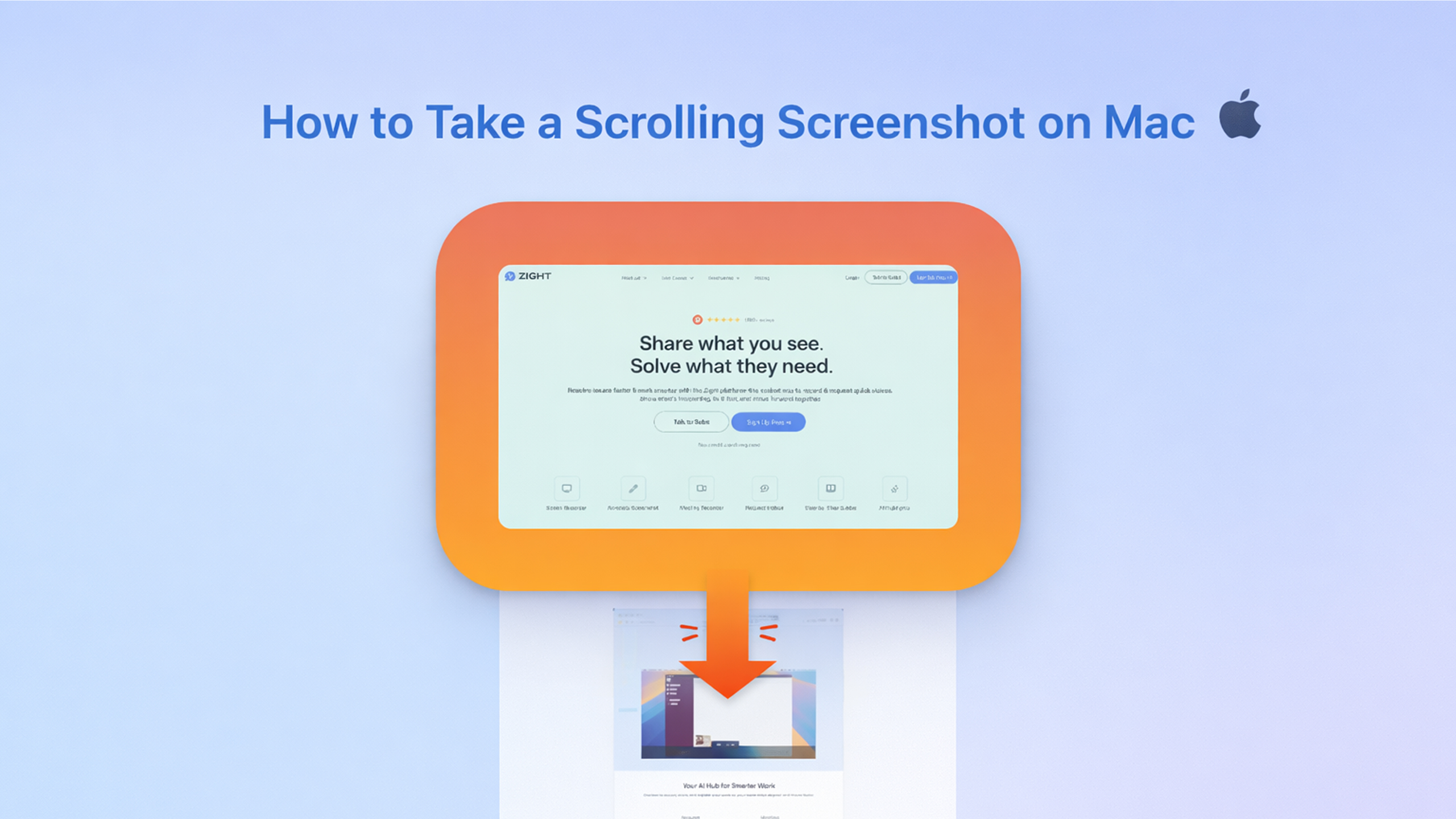
TL;DR: macOS has no native scrolling screenshot feature — not in macOS 15 Sequoia, not with ⌘+Shift+3/4/5. To capture an entire page on Mac, you need either browser DevTools (free, web-only) or a dedicated tool. Zight is the fastest option: press ⌘+Shift+6, select your area, and it auto-scrolls and stitches everything into one seamless image — then copies a shareable link to your clipboard. Works in any app, not just browsers.
Scrolling Screenshot Mac: How to Capture an Entire Page in 2025
You’re looking at a long Jira ticket, a full Notion doc, a 40-row spreadsheet, or a landing page you need to send to a client — and you need to capture the whole thing. You press ⌘+Shift+4. You get the visible window. The rest? Cut off.
If you’ve searched “scrolling screenshot mac” expecting Apple to have this built in, you’re not alone. It’s one of the most requested macOS features, and as of macOS 15 Sequoia in 2025, Apple still hasn’t added it. Every built-in screenshot shortcut — ⌘+Shift+3 (full screen), ⌘+Shift+4 (selection), and ⌘+Shift+5 (Screenshot.app toolbar) — only captures what’s currently visible in your viewport.
After testing every method — browser DevTools, Safari’s Web Inspector, dedicated Mac apps, and even manual stitching workarounds — here’s a complete guide to every way you can take a scrolling screenshot on Mac, ranked by speed, quality, and versatility. Whether you call it a full page screenshot Mac, scrolling capture Mac, or “capture entire page Mac,” this guide covers all of it.
Why macOS Doesn’t Have a Native Scrolling Screenshot
This surprises most people. iPhones have had scrolling screenshots since iOS 13 (2019) — you take a screenshot in Safari and tap “Full Page” to capture the entire document as a PDF. It’s a six-year-old feature on iOS. But the Mac? Nothing.
Apple’s macOS screenshot system (handled by screencaptureui since Mojave) operates at the window-compositing level. It captures the rendered pixels on your display — not the content inside a scrollable container. This is a fundamental architectural difference from iOS, where the system has direct access to the web view’s full render tree.
The practical result: if your content extends below the fold — whether it’s a webpage, a Slack thread, a Google Sheet, a Figma artboard, or a PDF in Preview — macOS cannot capture it without help. You need either a browser-specific trick or a third-party scrolling capture tool.
Let’s go through every option, starting with the free methods.
Method 1: Full Page Screenshot in Chrome (Free — Web Pages Only)
Chrome’s DevTools have a hidden “Capture full size screenshot” command that renders the entire page — including content below the fold — as a single PNG. I’ve used this hundreds of times for quick web page captures, and it works reliably for standard sites.
Step-by-step: Chrome full page screenshot on Mac
- Open the page you want to capture in Google Chrome.
- Open DevTools: Press
⌘+Option+I(or right-click → Inspect). - Open the Command Menu: Press
⌘+Shift+P. - Type
Capture full size screenshotand press Enter. - Chrome renders the full page and downloads it as a PNG to your Downloads folder.
Pro tip: If you want to capture at a specific device width (e.g., mobile or tablet), toggle Device Mode (⌘+Shift+M) before running the command. The screenshot will render at whatever viewport width you’ve set — useful for responsive design reviews.
Chrome method: limitations
- Web pages only. Cannot capture Slack, Notion (desktop app), Figma, PDFs, spreadsheets, or any native Mac app.
- Lazy-loaded content gets missed. Pages that load images or sections on scroll (most modern sites) will show blank spaces in the capture. You have to manually scroll to the bottom first to trigger all lazy loads, then run the command.
- Sticky headers/footers duplicate. Fixed navigation bars and cookie banners will appear repeated throughout the image — once for every viewport-height segment. There is no built-in fix for this.
- No annotation. You get a raw PNG. To add arrows, blur sensitive info, or highlight sections, you need to open it in another tool.
- No shareable link. You have to manually attach the file to an email, Slack message, or ticket.
When I tested this on a long Intercom changelog page, the resulting PNG was 14,000 pixels tall and included the sticky nav bar duplicated 11 times. It works, but it’s not clean.
Method 2: Full Page Screenshot in Firefox (Free — Web Pages Only)
Firefox has the best built-in full page screenshot feature of any browser. It’s faster and more accessible than Chrome’s method.
Step-by-step: Firefox full page screenshot on Mac
- Open the page in Firefox.
- Right-click anywhere on the page.
- Select “Take Screenshot” from the context menu.
- Click “Save full page” in the top-right of the overlay that appears.
- Choose Download or Copy.
Alternatively, you can add the Screenshot button to your toolbar: right-click the toolbar → Customize Toolbar → drag the “Screenshot” icon into your toolbar.
Pro tip: Firefox’s screenshot tool also lets you select a specific DOM element by hovering — useful when you only want to capture a single section of a page rather than the entire thing.
Firefox method: limitations
Same core limitations as Chrome — web pages only, lazy-loaded content can be incomplete, and sticky elements can duplicate. Firefox handles sticky headers slightly better than Chrome in my testing, but it’s not perfect. No annotation, no instant sharing.
Method 3: Full Page Screenshot in Safari (Free — Web Pages Only)
Safari’s method is less well-known and slightly more involved, but it works — and for anyone who uses Safari as their daily browser, it avoids the need to switch to Chrome or Firefox.
Step-by-step: Safari full page screenshot on Mac
- Enable the Develop menu: Go to Safari → Settings → Advanced → check “Show features for web developers.”
- Open Web Inspector: Press
⌘+Option+Ion the page you want to capture. - In the Elements tab, click the
<html>or<body>element. - Right-click the highlighted element and select “Capture Screenshot.”
- Safari saves the full-page render as a PNG.
This method captures the full rendered height of the selected element. If you select the <body>, you get the full page.
Safari method: limitations
- Requires Web Inspector knowledge. Non-technical users will find this intimidating.
- Can fail on complex layouts. Pages with CSS grid, overflow containers, or iframes may not render correctly.
- No built-in “capture full page” button. Unlike Firefox, there’s no simple right-click → Save full page option.
- Web only. Same constraint — cannot capture apps, PDFs, or any non-browser content.
Method 4: Scrolling Screenshot on Mac with Zight (Any App, Any Content)
Here’s where it gets practical. Zight is a screen capture and async communication tool for Mac, Windows, and Chrome that includes a dedicated scrolling screenshot feature — and it works on anything you can see on your screen, not just web pages.
I’ve been using Zight’s scrolling capture for bug reports, design reviews, documentation, and sharing long Slack threads with clients who don’t have Slack access. The workflow takes about 5 seconds from trigger to shareable link, and the output is a single stitched image at Retina resolution.
Step-by-step: Scrolling screenshot on Mac with Zight
- Install Zight: Download Zight for Mac (requires macOS 12 Monterey or later). It installs as a lightweight menu bar app.
- Trigger scrolling capture: Press
⌘+Shift+6(default shortcut — customizable in Zight preferences) or click the Zight icon in your menu bar and select Scrolling Capture. - Select your capture area: Click and drag a rectangle over the scrollable content — a browser window, Notion doc, Slack thread, PDF, spreadsheet, code editor, or any app window.
- Let it scroll: Zight automatically scrolls the content downward, capturing each frame. It detects the scroll boundary and stops automatically. You can also scroll manually for content with infinite scroll or lazy loading.
- Annotate: The built-in annotation editor opens immediately. Add arrows, text callouts, numbered steps, blur out sensitive information (PII, passwords, internal data), or highlight specific sections.
- Share: Zight uploads the image and copies a shareable link to your clipboard. Paste it into Slack, Jira, Linear, email, Notion, or any tool. Recipients don’t need Zight installed — they click the link and see the image.
Pro tip: For content with sticky headers (navigation bars that stay fixed while you scroll), Zight’s scrolling algorithm detects and removes duplicate header frames during stitching. In my testing, this produces significantly cleaner results than any browser DevTools method, where sticky navs get repeated across the entire capture.
Why Zight works where browser methods don’t
The key difference: browser DevTools capture by rendering the page’s DOM into an image. Zight captures by looking at your screen — it takes screenshots at the pixel level as content scrolls, then aligns and stitches the frames. This means:
- Any app works. Notion (desktop), Slack, Figma, Google Sheets, Apple Numbers, PDF in Preview, VS Code, terminal output, email in Apple Mail — anything that scrolls.
- Lazy-loaded content is captured. Since the content is actually scrolling on screen, lazy-loaded images and dynamically rendered sections are visible and captured.
- You see exactly what you get. No rendering engine differences. The screenshot looks identical to what you see on screen.
Zight isn’t only a screenshot app — it also includes screen recording, GIF creation, webcam recording, and async video. If a scrolling screenshot isn’t the right format for what you need to communicate, you can switch to a screen recording in one click from the same menu bar icon. That flexibility is why teams adopt it as a single tool rather than juggling separate utilities.
Method 5: Scrolling Screenshot with CleanShot X
CleanShot X is a well-regarded Mac screenshot utility and a direct competitor on this keyword. Credit where it’s due — CleanShot’s scrolling capture is polished and reliable. If you only need a Mac screenshot tool and nothing else, it’s a strong option.
Step-by-step: CleanShot X scrolling capture
- Open CleanShot X from the menu bar.
- Select Scrolling Capture.
- Define the capture area by clicking and dragging.
- Click Start Capture — scroll manually or let it auto-scroll.
- Click Done when you’ve captured enough.
CleanShot X: what to know
- Pricing: $29 one-time for basic features, or $8/month for CleanShot Cloud (adds cloud hosting and shareable links).
- Mac only. No Windows app, no Chrome extension, no mobile support.
- Screenshot-focused. No screen recording, no GIF maker, no async video, no webcam recording.
- No team features. No shared workspace, no viewer analytics, no team admin controls.
- Good annotation tools. CleanShot’s annotation editor is solid — I’d put it on par with Zight’s for basic markup.
If your entire team is Mac-only and you never need screen recording, GIFs, or async video, CleanShot X is a credible choice. But most teams I’ve seen evaluating scrolling screenshot tools are also looking for screen recording and instant sharing — which makes the “screenshots only” scope a limiting factor.
Method 6: Chrome Extension Workarounds (GoFullPage, Fireshot)
Several Chrome extensions offer full page screenshot capture. The two most popular are GoFullPage and Fireshot. They work by scrolling the page programmatically and stitching the result — similar to what Zight does natively but limited to Chrome browser tabs.
GoFullPage
- Free for basic PNG/JPG capture.
- One-click capture: click the extension icon and it scrolls + stitches automatically.
- Paid plan ($1/month) adds PDF export and editing.
- Limitation: Chrome only, web pages only. Sticky header duplication is common. No annotation in the free plan.
Fireshot
- Free version captures full page as PNG, JPG, or PDF.
- Pro version ($39.95 one-time) adds annotation and direct email/cloud upload.
- Limitation: Chrome/Firefox only, web pages only. The UI feels dated compared to modern tools.
In practice, I stopped using these extensions after switching to Zight because they solve only one narrow use case (web page screenshots in Chrome), and the results frequently need fixing — stitching glitches, missing lazy-loaded images, repeated headers. If you’re looking for a quick, free, browser-only solution and don’t mind the occasional artifact, GoFullPage is the best of the bunch.
Scrolling Screenshot Mac: Method Comparison Table
Here’s how every method stacks up across the features that actually matter when you’re choosing a scrolling capture workflow:
| Feature | macOS Built-in | Chrome DevTools | Firefox Screenshot | Safari Web Inspector | GoFullPage Extension | CleanShot X | Zight |
|---|---|---|---|---|---|---|---|
| Scrolling capture | ❌ No | ✅ Full page render | ✅ Full page render | ✅ Element-based | ✅ Scroll + stitch | ✅ Scroll + stitch | ✅ Scroll + stitch |
| Works in any app (not just browsers) | ❌ | ❌ | ❌ | ❌ | ❌ | ✅ | ✅ |
| Handles lazy-loaded content | — | ❌ Often misses | ❌ Often misses | ❌ Often misses | ⚠️ Partial | ✅ | ✅ |
| Handles sticky headers cleanly | — | ❌ Duplicates | ⚠️ Partial | ❌ Duplicates | ❌ Duplicates | ✅ | ✅ |
| Built-in annotation (arrows, blur, text) | ⚠️ Basic markup | ❌ | ❌ | ❌ | ❌ Free / ⚠️ Paid | ✅ | ✅ |
| Instant shareable link | ❌ | ❌ | ❌ | ❌ | ❌ | ⚠️ $8/mo plan | ✅ |
| Screen recording / GIF / async video | ⚠️ Basic recording | ❌ | ❌ | ❌ | ❌ | ❌ | ✅ |
| Cross-platform (Mac + Windows + Chrome) | ❌ Mac only | ✅ Chrome on any OS | ✅ Firefox on any OS | ❌ Mac only | ✅ Chrome on any OS | ❌ Mac only | ✅ |
| Team workspace / admin controls | ❌ | ❌ | ❌ | ❌ | ❌ | ❌ | ✅ |
| Price | Free (built into macOS) | Free | Free | Free | Free / $1/mo | $29 or $8/mo | Free plan / from $9.95/mo |
When to Use Each Method (Decision Framework)
The “best” method depends on what you’re capturing, how often, and what you do with the result:
Use Chrome/Firefox DevTools if:
- You’re a developer who lives in DevTools anyway.
- You need a quick one-off full page capture of a simple web page.
- You don’t need annotation or instant sharing.
- Budget is $0 and you’re comfortable with occasional rendering artifacts.
Use CleanShot X if:
- Your entire team uses Macs exclusively.
- You only need screenshots — no screen recording, GIFs, or video.
- You don’t need team features, viewer analytics, or cross-platform support.
- The $29 one-time price for a single Mac license fits your workflow.
Use Zight if:
- You need to capture scrolling content in any app — not just browsers.
- You want annotate → share → done in a single workflow (no switching tools).
- You also need screen recording, GIF creation, webcam capture, or async video.
- Your team is cross-platform (Mac + Windows) or you work with external stakeholders who need simple link-based viewing.
- You want a single tool instead of a screenshot app + a screen recorder + a GIF maker + a cloud sharing service.
Real-World Use Cases for Scrolling Screenshots on Mac
A scrolling screenshot sounds like a niche feature until you realize how many everyday workflows break without it. Here are the use cases we see most often from Zight users:
Bug reports with full context
Developers hate bug reports that show a cropped screenshot with zero context. “There’s an issue with the form” — which form? Where? What’s above and below it? A scrolling screenshot captures the full page state, including the URL bar, the nav, the form itself, and the console errors below. Add a few annotations — an arrow pointing to the broken element, a blurred-out user email — and you’ve just replaced a 200-word Jira description with one image and a link.
Design reviews and feedback
When a designer shares a landing page in Figma or a staging URL, feedback like “the spacing feels off in the middle section” means nothing without visual context. A scrolling screenshot of the full page with numbered annotations (“1. Hero CTA too close to nav, 2. Testimonial section needs more padding, 3. Footer links are misaligned”) replaces a 15-minute Zoom call.
Customer support documentation
Support teams often need to document a customer’s account page, billing history, or settings configuration. These pages always scroll. A full-page capture gives the support agent a complete record they can attach to the ticket, forward to engineering, or reference during an escalation — without asking the customer to take multiple screenshots.
Competitor analysis and archiving
Product managers and marketers regularly capture competitor pricing pages, feature matrices, and landing pages. These pages change frequently. A scrolling screenshot archives the full state at a point in time — far more useful than a bookmark that might look completely different next week.
Compliance and audit trails
Some teams need to document process completion — an entire workflow in an internal tool, a configuration page, or a signed digital agreement. Scrolling screenshots create a visual audit trail that’s easier to review than log files.
Troubleshooting: Common Scrolling Screenshot Issues on Mac
Even with the right tool, scrolling captures can occasionally produce imperfect results. Here’s how to fix the most common issues:
Blurry or low-resolution output
Cause: Some tools (especially browser extensions) capture at 1x resolution even on Retina displays. Fix: Zight captures at your display’s native resolution — on a Retina MacBook, that’s 2x. If you’re using DevTools, check that Device Mode isn’t set to a lower DPR (device pixel ratio).
Visible stitching lines or misaligned sections
Cause: The scrolling speed is too fast for the frame capture rate, or animations are playing during the capture. Fix: In Zight, you can slow the auto-scroll speed in preferences. Also, close any animated elements (carousels, auto-playing videos) before capturing. If using manual scroll mode, scroll in steady, consistent increments.
Sticky header/footer appearing multiple times
Cause: Fixed-position elements remain on screen during scrolling, so each frame includes them. Fix: Zight and CleanShot X both detect and de-duplicate sticky elements. If you’re using DevTools, there’s no automated fix — you’d need to manually edit the CSS to remove position: fixed before capturing.
Blank or white sections in the middle of the capture
Cause: Lazy-loaded images or infinite-scroll content that hasn’t loaded yet. Fix: Before capturing, scroll through the entire page manually once to trigger all lazy loads. Then scroll back to the top and start the scrolling capture. In Zight, using manual scroll mode ensures content loads as you go.
Capture area too small or the wrong section is scrolling
Cause: The selected capture area isn’t aligned with the scrollable container. Some pages have nested scroll areas (e.g., a sidebar that scrolls independently from the main content). Fix: Position your capture rectangle precisely over the scrollable area you want. In Zight, the selection crosshair shows pixel coordinates to help you align.
Frequently Asked Questions
Can you take a scrolling screenshot on Mac natively?
No. As of macOS 15 Sequoia (July 2025), Apple has not added a native scrolling screenshot feature to macOS. The built-in keyboard shortcuts — ⌘+Shift+3 (full screen), ⌘+Shift+4 (selection), and ⌘+Shift+5 (Screenshot.app toolbar) — only capture the pixels currently visible on your display. To capture content below the fold, you need a browser workaround or a third-party tool like Zight.
What is the keyboard shortcut for a full page screenshot on Mac?
There is no built-in macOS keyboard shortcut for a full page screenshot. With Zight installed, the default scrolling capture shortcut is ⌘+Shift+6 — you can customize this in Zight’s preferences. In Chrome, you can use DevTools (⌘+Option+I → ⌘+Shift+P → “Capture full size screenshot”), but this is a multi-step command, not a direct shortcut.
How do I take a scrolling screenshot of a PDF on Mac?
Browser DevTools won’t help here — they only work on web pages. To capture a full scrolling PDF on Mac, you need an OS-level scrolling capture tool. Open the PDF in Preview, Adobe Acrobat, or any reader, then use Zight’s scrolling capture (⌘+Shift+6) to select the PDF viewer area. Zight will scroll through the document and stitch all visible pages into a single image.
What’s the difference between a scrolling screenshot and a full page screenshot?
A full page screenshot typically refers to capturing an entire web page by rendering the full DOM as a single image — this is what Chrome DevTools’ “Capture full size screenshot” does. A scrolling screenshot is a broader technique that captures any scrollable content by auto-scrolling and stitching screen frames together. Scrolling screenshots work in web browsers, native Mac apps, PDFs, spreadsheets, Slack, Notion, and any interface that scrolls.
Does CleanShot X support scrolling screenshots?
Yes. CleanShot X has a reliable scrolling capture feature. It costs $29 one-time or $8/month with CleanShot Cloud. It’s Mac-only and focused exclusively on screenshots — it doesn’t include screen recording, GIF creation, async video, or cross-platform support. If you need those, Zight covers all of them in a single app.
Can you take a scrolling screenshot of a Notion page or Slack thread on Mac?
Browser DevTools cannot reliably capture Notion or Slack because they use dynamic rendering, lazy loading, and virtual scroll containers that don’t expose their full content to the DOM. An OS-level scrolling capture tool like Zight works on both — select the Notion or Slack window, trigger scrolling capture, and Zight scrolls and stitches the actual visible content regardless of how the app renders it internally.
Why does my scrolling screenshot have duplicated navigation bars?
This happens because the navigation bar uses position: fixed or position: sticky in CSS, so it remains visible in every frame the tool captures. Browser DevTools have no fix for this. Zight and CleanShot X both include sticky element detection that removes duplicate headers during stitching. If you’re stuck with DevTools, temporarily remove the fixed positioning via the Elements panel before capturing.
Is Zight free for scrolling screenshots?
Zight offers a free plan with core screenshot and screen recording features. Scrolling capture, advanced annotations, custom branding, and team workspace features are available on paid plans starting at $9.95/month. You can sign up and try it at zight.com.
Final Verdict: Best Way to Take a Scrolling Screenshot on Mac in 2025
If you only need to capture a web page once a month, Chrome DevTools or Firefox’s built-in screenshot tool will get the job done for free — with caveats around lazy loading, sticky headers, and zero annotation support.
If you take scrolling screenshots regularly — for bug reports, design feedback, documentation, support tickets, or sharing long content with teammates — a dedicated tool saves meaningful time and produces cleaner results.
Between CleanShot X and Zight, the choice depends on scope. CleanShot X is a focused screenshot utility that does its one job well. Zight is a complete visual communication platform — scrolling screenshots, standard screenshots, screen recording, GIF creation, webcam capture, async video, annotations, instant sharing, and team collaboration in one app across Mac, Windows, and Chrome.
After using both extensively, I reach for Zight because I never know whether a situation needs a screenshot, a scrolling capture, a quick GIF, or a screen recording until I’m in the moment. Having all of those behind one menu bar icon (and one keyboard shortcut away) means I never have to think about which tool to open. The scrolling capture is just one piece of that workflow — but it’s the piece that brings most people to Zight in the first place.
Try Zight’s scrolling screenshot on Mac →
Written by the Zight team. Based on hands-on testing across macOS 14 Sonoma and macOS 15 Sequoia, Chrome 126, Firefox 128, Safari 18, CleanShot X 4.7, and Zight for Mac. Last updated July 2025.