- Manual transcription delivers high accuracy, especially for complex audio (e.g., technical terms, heavy accents, or overlapping conversations). But it’s slower and costs more, around $50–$100 per audio hour.
- AI transcription is faster and cheaper, processing audio in minutes for $6–$15 per hour. It works best for clear audio with minimal background noise or single speakers but struggles with nuanced or noisy recordings.
Writing Down What You Hear Services
What Is Writing Down What You Hear?
This act means people who know how to write what they hear from a video or audio into text. They sit, listen hard to recordings, and make note of who talks when, to make a true and full write-up. When you hand over an audio file to a service, a trained person hears it well, catching every word with care. Unlike quick computer ways, writing down what you hear puts rightness first, making sure small things don’t get lost. To make sure it’s all good, they often use a two-step lookover. First off, a person writes it down. Then, another listens and reads it together with the audio again. This helps find any misses and makes sure the final text is up to top level.Costs of Writing Down What You Hear
Since it counts on human work, it generally costs more than computerized ways. The price changes based on things like how clear the audio is, how many people are talking, if there’s hard word use, and how soon you need the written piece. For example, clear sounds or talks with one person cost less. But, if many speak with strong accents, or if there’s a need for knowing hard terms like those in law or health, it will cost more. Want it fast? That will cost more too. Plus, adding things like naming who speaks or putting time marks might add to the price. Like, writing down a work meeting or chat with bad sound or short time can up the price a lot.Good and Bad of Writing Down What You Hear
Writing down what you hear is good when it’s a tough or hard-to-hear talk. But, it has downs like being costly and slower. Knowing the good and bad can help you choose if it fits what you need.AI Transcription Tools
What Is AI Transcription?
AI transcription turns what we say into written words using smart tech and deep learning. It cuts up audio into bits, checks them, and writes what it hears after being fed lots of speech data. Most tools can deal with sound and video files and have two main uses: live transcription for events such as chats or talks, and working on files that have already been recorded. They often have extras like knowing who is talking, adding time marks, and adding commas and full stops on their own. For instance, Zight has AI transcription built into its screen capture tools. When you record a talk or meeting using Zight, it writes everything down at once. This makes your files easy to search and use without extra work, making things simpler and better to use.AI Transcription Costs
AI tools cost less than doing it by hand. Monthly plans usually start at $10–$15 for the basics and can reach $20–$50 for more stuff. For those who use it now and then, paying as you use is easy to change. Most charge about $0.10 to $0.25 per minute of audio, and some let you save by buying more at once. Many offer a bit of free use, like 10 to 60 minutes each month. This is good to try out the service or manage small tasks without paying. Zight’s Pro plan costs $9/month, with AI transcription available as a $4/month add-on. The add-on isn’t available on the Free plan, so users who want transcription will need to upgrade to Pro to access it.AI Transcription Pros and Cons
AI transcription shines in speed and cost but falls short on hearing correctly in tough spots. Knowing these good and bad points helps you pick when to use automated writing. One big win is its quickness. AI can sort an hour of talking in minutes, while doing it by hand takes much longer. This is great for fast jobs and lots of work. Saving money is another big point. While manual work might cost $50–$100 per hour of audio, AI asks for just $6 to $15 for the same task. For firms with lots of audio, this means big savings. Yet, getting it right can be hard. AI has trouble with bad sound, background noise, talking over each other, or strong accents. It also messes up on special words, names, and terms linked to certain fields, leading to mistakes. Here’s a simple look at the good and bad sides:Manual vs AI Transcription: Cost and Speed
Comparing Costs: Manual vs AI
When we look at the price of transcribing, it’s clear the gap between manual and AI is huge. Manual transcription often costs $50 to $100 for each hour of audio, while AI tools can do it for just $6 to $15 per hour. This means you could save up to 90% by using AI. Here’s a quick look: A business needing 100 hours of audio transcribed each month would pay $5,000–$10,000 if they go manual. With AI, that price falls to $600–$1,500. In a year, you save between $52,800 and $102,000. For those who only need transcriptions now and then, pay-as-you-go prices with AI look even better. These costs are $0.10–$0.25 per minute, adding up to $6–$15 per hour, much less than $50–$100 per hour with manual methods. Platforms like Zight mix it up by offering transcription as part of a broader toolset. For instance, Zight’s Pro plan starts at $9/month and includes screen recording and other features, with AI transcription available as an optional $4/month add-on. These price gaps get even more stunning when you think about how fast AI transcription can be.Speed and Response Time
Here, AI transcription runs circles around manual methods. AI can handle a one-hour recording in just 5–10 minutes, while manual transcription often needs 24–48 hours, sometimes more for tough audio. Human transcribers take 4–6 hours of work for each audio hour, and they might have more delays depending on how busy they are. Manual services usually promise a 24–48 hour turnaround for basic jobs, but quick requests can cost you double. Hard tasks, like ones with many speakers, technical words, or bad audio, can take 3–5 days. For on-the-spot transcription, nothing beats AI. Human transcription can’t match this since it needs time for listening, understanding, and typing. This quick service is crucial for jobs needing quick action. News groups, legal teams on tight deadlines, and companies needing fast meeting notes all get big wins from AI’s quick transcript delivery. But, speed isn’t all that counts. Manual transcription has the upper hand in picking up context, hints, and small details that AI might miss. This extra care often leads to clean, ready-to-use transcripts with little need for edits.Accuracy Across Different Audios
Setting cost and speed aside, accuracy is another big point that sets manual and AI transcription apart. AI shines with clear, solo-speaker audio, hitting 85–95% accuracy. This makes it a strong option for company talks, interviews with clear audio, and school lectures. But, AI’s accuracy can fall to 60–70% with issues like noise, many people talking at once, or heavy accents. For instance, phone calls or big meetings in noisy spots might need lots of fixes after. Special content shows where AI falls short. Complex terms specific to fields like medicine or law often confuse AI systems. For example, a doctor talking about “atrial fibrillation” might see it wrongly penned as “aerial fib relation.” This is where people who write by hand win. They can look up words they don’t know, use what they know to get what’s not clear in the sound, and decide on parts that are not sure. Taking down what is said in court, at a doctor’s talk, or at school meetings often needs this sort of care and human thought. How one feels and the setting are more points where AI falls short. People who write down can hear when one is joking, mad, or happy, bits that are often not there in AI-made texts. For times like talks in therapy or with customers, where how one says it counts, doing it by hand gives a fuller and finer look. On the other hand, the gap in rightness between AI and doing it by hand is getting smaller. Better AI tech is making it good at taking in accents, knowing key words, and fitting to how one talks. Yet, for work that needs very high rightness, doing it by hand is still the surer, though more pricey, way.Choosing the Right Transcription Method
Key Decision Factors
When deciding on the best transcription method, your choice will depend on factors like budget, deadlines, the complexity of the content, and the level of accuracy required. For those working with a tighter budget, AI transcription is a cost-effective option, while manual transcription tends to be more expensive. If you’re working under time constraints, AI transcription is hard to beat, it can process an hour-long audio file in just minutes. In contrast, human transcribers may need several hours to complete the same task. For quick turnarounds, AI transcription is a go-to solution. Content complexity also plays a big role. AI transcription works well for simple recordings, such as a single speaker with clear audio. But when you’re dealing with heavy accents, overlapping conversations, or specialized jargon, AI accuracy can drop. In these cases, manual transcription becomes more dependable. Fields like legal, medical, or academic work often demand a higher level of precision, where even small mistakes can lead to serious consequences. Here, the human ability to grasp context and nuance justifies the extra time and cost. For a balance between speed and accuracy, a hybrid approach, where AI generates a draft and human editors refine it, can be an ideal middle ground. This method combines the efficiency of AI with the reliability of human oversight, helping ensure quality results.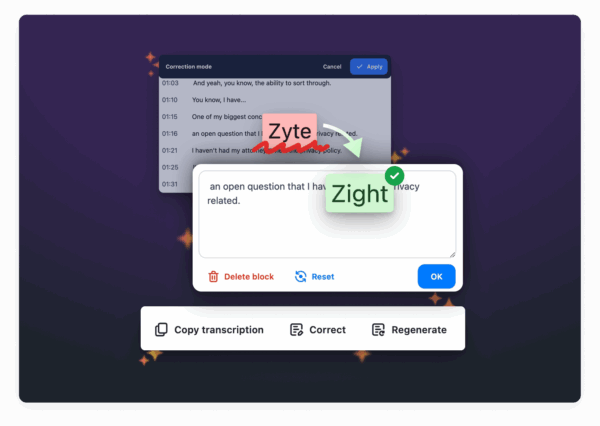
How Zight Improves AI Transcription
Zight simplifies transcription by seamlessly integrating it into your workflow while offering collaboration tools to enhance productivity. With Zight, when you record a meeting or training session, transcription happens automatically in the background. By the time your recording is complete, the transcript is ready for use. What sets Zight apart is its AI-powered summaries, which highlight key points, action items, and decisions. This feature saves you the hassle of sifting through lengthy transcripts, allowing you to quickly focus on the most important details. Plus, Zight makes team collaboration easy. Transcribed recordings can be shared with just one click through Slack or Microsoft Teams. Team members can also search the transcript to locate specific discussions or decisions, turning it into a searchable knowledge base.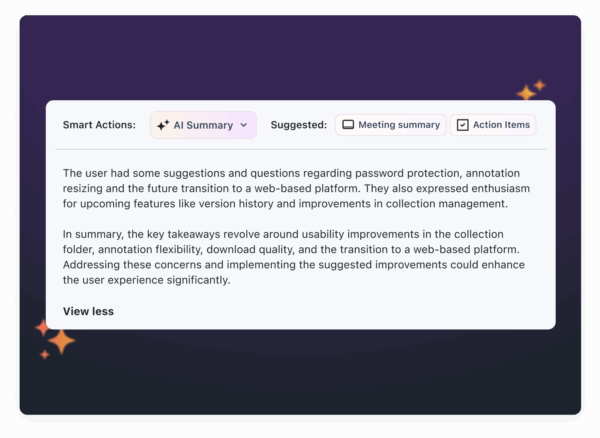 Zight offers a practical solution for transcription challenges by combining AI efficiency with collaboration features. The Pro plan starts at $9/month and includes screen recording, video editing, and file sharing, with AI transcription available as an additional $4/month add-on. With support for multiple file formats, Zight is ideal for creating training materials, product demos, and technical documentation, especially when you need to pair accurate transcription with visual content. It’s a tool that brings clarity and efficiency to your workflow.