How to Make a Screen Recording with Audio: The Complete Guide for Mac, Windows, and Chrome (2025)
If you’ve ever tried to figure out how to make a screen recording with audio, you already know the frustrating truth: most built-in tools capture your screen just fine but treat audio like an afterthought. QuickTime on Mac won’t record system audio without a third-party audio driver. Xbox Game Bar on Windows only records one app at a time. And neither gives you a shareable link the moment you stop recording. Whether you’re creating a narrated product walkthrough, documenting a bug with your live commentary, or building an onboarding tutorial, you need both your microphone voice and your system audio captured simultaneously — and you need the result to be instantly shareable, not trapped in a massive local file.
⚡ Quick Answer
The fastest way to make a screen recording with both microphone and system audio is to use Zight — a screen recording, screenshot, and async video tool for Mac, Windows, and Chrome. Zight captures your screen, microphone, and system audio simultaneously with a single click, then instantly generates a shareable link. No audio driver hacks, no post-production sync issues, no file-upload waiting. Install Zight, click Record, choose your audio sources, and share the link — the entire process takes under 60 seconds.
In this guide, I’ll walk you through every method for recording your screen with audio in 2025 — the built-in options on Mac and Windows, their specific audio limitations, and why a dedicated tool like Zight eliminates every headache. After recording hundreds of screen sessions for bug reports, product demos, and team walkthroughs, I can tell you exactly where each method breaks down and which one saves you the most time.
Why Screen Recording with Audio Is Harder Than It Should Be
On the surface, recording your screen seems simple. Every modern operating system has a built-in screen recorder. But the moment you need screen recording with microphone and system audio — your narration plus the sounds coming from your computer — things get complicated fast.
Here’s the core problem: operating systems treat system audio (the sound your apps produce) as a protected output stream. macOS, in particular, doesn’t expose system audio to recording apps by default. Windows is slightly more generous, but its built-in recorder has its own set of restrictions. The result is that millions of people create “silent” screen recordings or recordings with only their voice — missing the app sounds, notification pings, or video playback audio that would make the recording actually useful.
Let me break down each built-in method, its exact limitations, and then show you the clean path forward.
How to Screen Record with Audio on Mac (Built-In Methods)
Method 1: macOS Screenshot Toolbar (⌘+Shift+5)
Since macOS Mojave (10.14), Apple has included a screen recording feature accessible via ⌘+Shift+5. Here’s how it works:
- Press ⌘+Shift+5 on your keyboard.
- In the floating toolbar at the bottom of the screen, select either Record Entire Screen or Record Selected Portion.
- Click Options and under the Microphone section, select your microphone (e.g., “MacBook Pro Microphone” or an external USB mic).
- Click Record.
- To stop, click the Stop button in the menu bar or press ⌘+Control+Esc.
The audio limitation: This method captures microphone audio only. It does not capture system audio — meaning if you’re recording a walkthrough of a video editing app, the viewer won’t hear any of the media playing inside that app. On macOS 14 Sonoma and macOS 15 Sequoia, this limitation still exists. Apple has not added native system audio capture to the Screenshot toolbar.
Method 2: QuickTime Player
QuickTime Player offers a nearly identical screen recording experience:
- Open QuickTime Player from your Applications folder.
- Go to File → New Screen Recording.
- Click the dropdown arrow next to the record button and select your microphone.
- Click the red Record button, then click the screen to record the full screen or drag to select a region.
- Click the Stop button in the menu bar when finished.
The audio limitation: Identical to ⌘+Shift+5 — microphone only, no system audio. To capture system audio with QuickTime, you’d need to install a third-party virtual audio driver like BlackHole or Loopback, configure a multi-output device in Audio MIDI Setup, and route your system audio through it. I’ve done this setup — it takes 15–20 minutes, breaks after macOS updates, and sometimes introduces audio latency. It’s a workaround, not a solution.
Pro tip: If you only need microphone audio (no system sounds) and you’re on a Mac, ⌘+Shift+5 is faster than QuickTime because it doesn’t require opening a separate app. But the moment you need system audio, both methods fail you.
How to Record Screen and Audio on Windows (Built-In Methods)
Method 1: Xbox Game Bar (Win+G)
Windows 10 and 11 include the Xbox Game Bar, which can record screen and audio on Windows — including system audio. Here’s how:
- Press Win+G to open the Xbox Game Bar overlay.
- Click the Capture widget (the camera icon). If you don’t see it, click the widget menu and enable it.
- Click the gear icon in the Capture widget and make sure Audio to record is set to “Game” (captures the active app’s audio) or “All” (captures all system audio).
- To include your microphone, click the microphone icon in the Capture widget to toggle it on.
- Click the Record button (circle icon) or press Win+Alt+R.
- To stop recording, press Win+Alt+R again or click the stop button on the floating status bar.
The audio limitation: Xbox Game Bar does capture system audio, which puts it ahead of QuickTime. However, it has other significant restrictions:
- It can only record one application window at a time — not your full desktop.
- It cannot record File Explorer or the Windows desktop.
- If you switch apps during recording, the recording either stops or captures a black screen.
- Recordings save as large MP4 files locally — there’s no instant sharing link.
- There’s no built-in annotation, trimming, or editing capability.
In practice, Xbox Game Bar works for quick single-app recordings. But the moment you need to show a workflow that spans multiple windows — say, copying data from a browser into a spreadsheet while narrating the steps — it falls apart.
Method 2: Windows Snipping Tool (Windows 11 2022+)
Microsoft added screen recording to the Snipping Tool in Windows 11 version 22H2:
- Open Snipping Tool from the Start menu.
- Click the video camera icon to switch to recording mode.
- Click New, then select the area of the screen you want to record.
- Toggle the microphone and system audio icons on the toolbar (added in later updates).
- Click Start to begin recording.
The audio limitation: Microsoft has been gradually adding audio support to Snipping Tool. As of early 2025, it supports both microphone and system audio — but the feature rolled out unevenly across Windows 11 builds, so your mileage may vary depending on your update version. There’s also no sharing functionality; you get a local MP4 file that you then need to upload somewhere.
Built-In Tool Comparison: Audio Capabilities at a Glance
Before moving to the solution, here’s a clear comparison of what each built-in tool actually delivers for screen recording with audio:
| Feature | macOS ⌘+Shift+5 | QuickTime Player | Xbox Game Bar | Snipping Tool | Zight |
|---|---|---|---|---|---|
| Microphone Audio | ✅ Yes | ✅ Yes | ✅ Yes | ✅ Yes | ✅ Yes |
| System Audio | ❌ No | ❌ No (needs driver hack) | ✅ Yes (single app) | ✅ Partial (build-dependent) | ✅ Yes (all sources) |
| Mic + System Audio Simultaneously | ❌ No | ❌ No | ✅ Yes (single app only) | ✅ Partial | ✅ Yes |
| Full Desktop Recording | ✅ Yes | ✅ Yes | ❌ No (single app) | ✅ Selected area | ✅ Yes |
| Multi-Window Workflows | ✅ Yes | ✅ Yes | ❌ No | ✅ Selected area | ✅ Yes |
| Instant Shareable Link | ❌ No | ❌ No | ❌ No | ❌ No | ✅ Yes |
| Annotations/Drawing | ❌ No | ❌ No | ❌ No | ❌ No | ✅ Yes |
| Built-In Trimming | ✅ Basic (in Preview) | ✅ Basic | ❌ No | ❌ No | ✅ Yes |
| Webcam Overlay | ❌ No | ❌ No | ❌ No | ❌ No | ✅ Yes |
| Cross-Platform | Mac only | Mac only | Windows only | Windows 11 only | Mac, Windows, Chrome |
The pattern is clear: built-in tools either miss system audio entirely (Mac) or impose frustrating recording restrictions (Windows). And none of them generate a shareable link — you’re stuck exporting a file, uploading it to Google Drive or Slack, and waiting for it to process. For anyone creating tutorials, walkthroughs, or async video updates regularly, this workflow tax adds up fast.
How to Make a Screen Recording with Audio Using Zight (The Complete Solution)
Zight is a screen recording, screenshot, GIF creation, and async video tool built for teams that communicate visually. It runs on Mac, Windows, and Chrome, and it solves every limitation listed above. When I tested Zight against the built-in methods for creating narrated walkthroughs, the difference wasn’t subtle — it was the difference between a 15-minute workflow and a 60-second one.
Here’s exactly how to record your screen with both microphone and system audio using Zight:
Step 1: Install Zight
Download Zight from zight.com/screen-recorder and install the desktop app. On Mac, you’ll see the Zight icon appear in your menu bar. On Windows, it sits in your system tray. The installer takes under two minutes, and Zight will prompt you to grant screen recording and microphone permissions during setup.
Step 2: Open the Recorder
Click the Zight icon in your menu bar (Mac) or system tray (Windows), then select Record Screen. You can also use the keyboard shortcut — by default it’s ⌘+Shift+6 on Mac or Alt+Shift+6 on Windows. The recording control panel appears, giving you clear options for what to capture.
Step 3: Configure Your Audio Sources
This is where Zight immediately outperforms every built-in tool. In the recording control panel, you’ll see toggles for:
- Microphone audio — select your preferred mic from the dropdown (built-in, USB, Bluetooth headset, etc.)
- System audio — toggle this on to capture all sounds your computer produces
- Webcam overlay — optionally add a camera bubble for face-to-face presence in your recording
Toggle both microphone and system audio on. That’s it. No virtual audio driver installation. No Audio MIDI Setup configuration. No routing hacks. Zight handles both audio streams natively and mixes them into a single, clean recording.
Pro tip: If you’re recording a tutorial where you want your narration louder than the app sounds, Zight lets you adjust the relative levels before you start recording. I typically set my mic to about 80% and system audio to 40% — this keeps my voice front and center while still capturing UI sounds and notification pings for context.
Step 4: Choose Your Recording Area
Select whether you want to record your full screen, a specific application window, or a custom selected region. Unlike Xbox Game Bar, Zight lets you record your entire desktop — including switching between apps, opening File Explorer or Finder, and navigating between multiple windows. This is essential for walkthroughs that span multiple tools.
Step 5: Record Your Walkthrough
Click Start Recording. You’ll see a brief 3-2-1 countdown, then you’re live. Narrate your walkthrough naturally — Zight captures everything: your voice through the microphone, every sound your computer makes through system audio, and every pixel on screen. When you’re done, click the Stop button in the floating toolbar or use the keyboard shortcut.
Step 6: Trim, Annotate, and Share Instantly
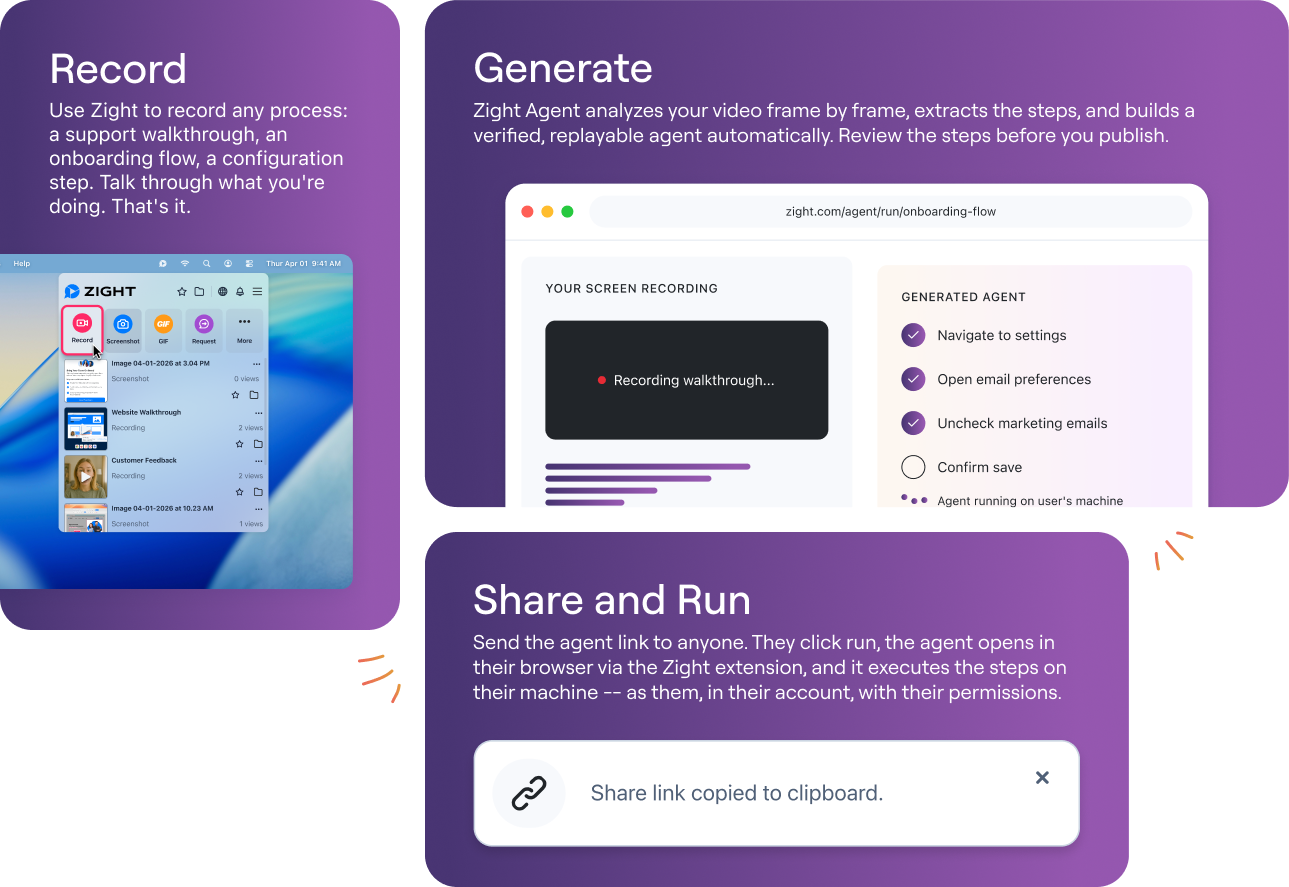
The moment you stop recording, Zight uploads your video to the cloud and generates a shareable link — copied to your clipboard automatically. No exporting to a local file. No uploading to YouTube or Google Drive. No waiting for processing. The link is ready in seconds.
Before sharing, you can:
- Trim the beginning and end (Zight’s one-click trim removes those awkward “let me find the stop button” moments)
- Add annotations — arrows, text labels, highlights — directly on the video timeline
- Set a title and description so recipients know what they’re watching
- Control access with password protection or link expiration if needed
Paste the link into Slack, email, Jira, Notion, your project management tool — anywhere you communicate. Recipients click the link and watch instantly in their browser. No downloads required on their end.
Real Workflows: Screen Recording with Audio in Practice
To make this concrete, here are the workflows where capturing both audio streams makes the biggest difference — and where I’ve seen teams at Zight get the most value:
Bug Reports That Actually Get Fixed
Instead of writing a 10-paragraph description of a bug, record your screen while you reproduce it. Your narration (“I’m clicking the Submit button and watch what happens…”) combined with the actual error sound or UI feedback gives developers everything they need. We’ve seen teams reduce bug resolution time by 30–50% simply by replacing text tickets with narrated screen recordings.
Onboarding Without Endless Meetings
Record a walkthrough of your team’s tools, processes, and conventions. New hires watch on their own schedule, pause and rewind as needed, and don’t have to feel embarrassed about asking you to repeat something. System audio matters here because you’re often demonstrating apps that have their own sounds, alerts, and feedback.
Product Demos and Customer Success
Customer success teams create personalized walkthroughs for clients — “Here’s how to set up your dashboard” — that feel more personal than a help doc but don’t require scheduling a live call. The webcam overlay in Zight adds a face-to-face element that builds trust.
Design Feedback and Code Review
Instead of leaving a comment that says “the spacing looks off on mobile,” record your screen showing the exact issue while narrating your suggestion. It’s faster to create, faster to understand, and eliminates the back-and-forth clarification cycle.
Why Built-In Tools Aren’t Enough for Screen Recording with Microphone and System Audio
I want to be clear: built-in tools have their place. If you need a quick, silent screenshot or a no-audio screen recording for personal reference, ⌘+Shift+5 or Xbox Game Bar work fine. But for professional use — where your recording needs to communicate something to someone else — the limitations compound:
- Missing system audio on Mac means your tutorials sound incomplete. Viewers see you click a button but don’t hear the confirmation sound, the error buzz, or the media playback that contextualizes the action.
- Single-app restriction on Windows Game Bar means you can’t demonstrate real workflows that involve more than one application.
- No shareable links from any built-in tool means every recording creates a file management problem. You record, export, find the file, upload it somewhere, wait for processing, copy the link, and finally share. With Zight, you record, stop, and paste the link.
- No annotation layer means you can’t draw attention to specific areas of the screen after recording. Zight’s annotation overlay lets you add arrows, highlights, and text directly onto your recording’s timeline.
After recording hundreds of screen sessions for various purposes — internal team updates, customer tutorials, product demos, bug reports — the pattern that works best is the one with the fewest steps between “I need to show someone this” and “they’re watching it.” That’s Zight’s core advantage.
Tips for Better Screen Recordings with Audio
Regardless of which tool you use, these practices will make your recordings more effective:
- Close unnecessary tabs and apps before recording. Notification sounds from Slack or email will be captured by system audio and can be distracting.
- Use a dedicated microphone if possible. Even a $30 USB mic dramatically improves voice clarity over a laptop’s built-in microphone.
- Narrate your intentions, not just your actions. Don’t just say “I’m clicking here.” Say “I’m opening the settings panel because we need to change the notification preferences.” This gives viewers context they can’t get from the visual alone.
- Keep recordings under 5 minutes. In practice, shorter recordings get watched to completion. If your walkthrough is longer, break it into chapters or separate recordings.
- Trim the start and end. The first 3 seconds (finding the record button) and last 3 seconds (finding the stop button) are always wasted. Zight’s auto-trim handles this, but if you’re using a built-in tool, edit those out.
Pro tip: In Zight, you can set up custom keyboard shortcuts so that starting and stopping a recording is a single key combination. I use ⌘+Shift+R on my Mac — one press to start, one press to stop, and the shareable link is already on my clipboard.
Frequently Asked Questions
How do I screen record with audio on Mac without installing extra audio drivers?
The native macOS screen recorder (⌘+Shift+5 and QuickTime) only captures microphone audio — not system audio. To capture both without installing a virtual audio driver like BlackHole, use a third-party tool like Zight for Mac. Zight captures microphone and system audio simultaneously without requiring any additional driver configuration. It handles the audio routing natively, so you toggle on system audio in the recording panel and it just works.
Can Xbox Game Bar record system audio and microphone at the same time on Windows?
Yes, Xbox Game Bar can capture both system audio and microphone audio simultaneously on Windows 10 and 11. However, it can only record a single application window — not your full desktop. It also cannot record File Explorer or the desktop itself. If you need to record multi-window workflows with both audio streams, Zight for Windows removes these restrictions and adds instant cloud sharing.
What is the best free way to make a screen recording with audio?
For basic screen recordings with microphone audio only, macOS ⌘+Shift+5 (Mac) and Xbox Game Bar (Windows) are free and built-in. For recordings that need both microphone and system audio with instant sharing, Zight offers a free plan that includes screen recording with full audio capture. The free plan is sufficient for individual users who need to create and share narrated walkthroughs without a paid subscription.
How do I share a screen recording with audio quickly without uploading to YouTube?
Zight automatically uploads your recording to the cloud the moment you stop recording and places a shareable link on your clipboard. You paste that link into Slack, email, Jira, or any other tool, and the recipient watches instantly in their browser — no YouTube upload, no Google Drive processing delay, no file download required on their end. The link is typically ready within 5–10 seconds of stopping your recording.
Does screen recording with system audio capture music and video playing on my computer?
Yes. When system audio capture is enabled, everything your computer outputs as sound — including music, video playback, app notification sounds, and browser audio — gets recorded. This is why it’s important to close unnecessary tabs and apps before recording. In Zight, you can see the system audio levels in real-time in the recording panel, so you know exactly what’s being captured before you start.
Start Making Screen Recordings with Audio in Under 60 Seconds
You don’t need to wrestle with virtual audio drivers, fight single-app recording restrictions, or waste time uploading files to cloud storage. Zight captures your screen, microphone, and system audio simultaneously on Mac, Windows, and Chrome — then gives you a shareable link the moment you stop recording.
Whether you’re documenting bugs, creating onboarding tutorials, recording product demos, or giving async design feedback, the workflow is the same: click record, narrate, stop, share the link. That’s it.
Try Zight’s screen recorder free →
Based on testing by the Zight team. Last updated June 2025.