How to Explain a Bug to a Developer (Without Writing a Novel)
Knowing how to explain a bug to a developer is one of the most underrated skills in any product team. If you’re a product manager, designer, or customer success rep, you’ve probably spent 20 minutes typing a detailed bug report — only for the engineer to respond with “I can’t reproduce it.” The problem isn’t your description. It’s the medium. Text-based bug reports lose critical context: the exact screen state, the sequence of clicks, the error that flashed for half a second. A 30-second screen recording captures what 300 words cannot. Zight is a screen recording, screenshot, and annotation tool that lets you capture a bug visually, annotate it, and share an instant link — all in under 60 seconds.
⚡ Quick Answer
The fastest way to explain a bug to a developer is to screen record the bug as you reproduce it, then annotate the recording or screenshot to highlight the exact issue. This eliminates ambiguity, cuts back-and-forth by up to 80%, and gives engineers everything they need to start fixing immediately. Zight is a screen recording, screenshot, and annotation tool built for exactly this workflow — capture a bug, annotate it with arrows and text callouts, and share an instant link in under 60 seconds. No file uploads, no attachments, no waiting.
In this step-by-step guide, you’ll learn exactly how to report a bug with video and annotated screenshots so that developers can understand, reproduce, and fix issues faster. Whether you’re filing a Jira ticket, pinging someone on Slack, or emailing a client-reported issue to your engineering team, these steps will make every bug report you submit clearer, faster, and more actionable.
What this guide covers:
- Why text-only bug reports fail
- What developers actually need in a bug report
- How to explain a bug to a developer — step by step
- When to screen record a bug vs. screenshot it
- Copy-paste bug report template
- 7 common bug report mistakes (and how to avoid them)
- Real-world examples: good vs. bad bug reports
- FAQ
Why Text-Only Bug Reports Fail
Before we dive into the how-to steps, let’s understand why the current approach breaks down — because once you see the pattern, the solution becomes obvious.
A 2024 study by the Consortium for IT Software Quality (CISQ) found that poor software quality cost U.S. organizations an estimated $2.41 trillion, with a significant portion attributed to technical debt and rework caused by miscommunicated requirements and bug reports. On an individual team level, engineers report spending up to 30% of their debugging time just trying to understand what was reported — not actually fixing anything.
When I was testing this internally at Zight, we tracked the lifecycle of 50 bug reports filed by our own CS and design team over a single sprint. The text-only reports averaged 3.2 follow-up messages before the developer could even start working. The ones filed with a screen recording and annotated screenshot? 0.4 follow-up messages. That’s not a marginal improvement — it’s a fundamentally different workflow.
Here’s what typically goes wrong with text-only bug reports:
- Missing steps to reproduce: The reporter remembers the outcome but not the exact click sequence that triggered it.
- Ambiguous language: “The button doesn’t work” — which button? Which page? Which browser? Hover state or click state?
- No environmental context: Screen resolution, OS version, logged-in state, browser extensions, and network conditions all matter. Most reporters forget all of them.
- Invisible timing: Some bugs involve animations, race conditions, or loading states that are literally impossible to describe in words. A spinner that hangs for 800ms before failing looks identical to one that hangs for 8 seconds — but the root cause is completely different.
- Emotional escalation: When a reporter feels unheard after three rounds of “can you clarify?”, frustration creeps in on both sides. The PM starts writing longer reports. The developer starts skimming them. Nobody wins.
- Lost visual state: Dropdown menus that close when you switch windows, tooltips that vanish, hover states that disappear when you start typing — these are real UI states that text simply cannot capture.
The fix isn’t writing better text. It’s switching to a format that captures what actually happened — visually.
What Developers Actually Need in a Bug Report
Before you record anything, it helps to understand what an engineer’s brain needs to start debugging. I’ve worked alongside developers for over a decade, and every effective bug report answers the same five questions — whether the reporter knows it or not:
| Question | What It Looks Like in a Text Report | What It Looks Like with Screen Recording + Annotations |
|---|---|---|
| What happened? | “The page crashed.” | A video showing the exact error message, captured in real time. |
| What should have happened? | “It should have saved.” | An annotation on the screenshot pointing to the expected behavior area with a text callout. |
| How do I reproduce it? | “I clicked some stuff and it broke.” | A screen recording showing every click, scroll, and form input in order. |
| Where did it happen? | “On the settings page, I think.” | The URL bar is visible in the recording; the exact element is circled with Zight’s annotation arrow. |
| What’s the environment? | (Usually missing entirely.) | Visible in the recording — browser chrome shows the version, OS UI is visible, viewport size is captured automatically. |
When you screen record a bug, you automatically answer most of these questions without even thinking about them. The URL bar, browser version, viewport size, and exact UI state are all baked into the recording. That’s why visual bug reports reduce developer follow-up questions by an estimated 60–80%.
🎯 Pro tip: If you’re reporting a bug to a developer who works on a different team or at a different company (like a vendor’s support team), a screen recording is even more critical. They don’t have your local environment, your account state, or your institutional context. A 30-second video gives them what a 500-word email never could.
How to Explain a Bug to a Developer — Step by Step
Here’s the exact process I use when I report a bug to our engineering team at Zight. After recording hundreds of screen sessions and refining this workflow, these are the steps that consistently result in bugs getting fixed on the first attempt — no follow-up threads required.
Step 1: Reproduce the Bug Once Before You Record
Don’t hit “record” the second something looks off. First, confirm the bug is reproducible. Navigate away from the page, come back, and try the same sequence again. If it happens consistently, you’re ready to record. If it’s intermittent, note that — intermittent bugs are still worth reporting, but the developer needs to know.
This step takes 30 seconds and saves you from filing a report about a one-time network hiccup that already resolved itself.
Step 2: Open Your Screen Recorder
On macOS, you can press ⌘+Shift+5 for the built-in recorder — but it lacks annotation tools, auto-upload, and instant link sharing. On Windows, Win+G opens the Xbox Game Bar, which is clunky and not designed for bug reporting at all.
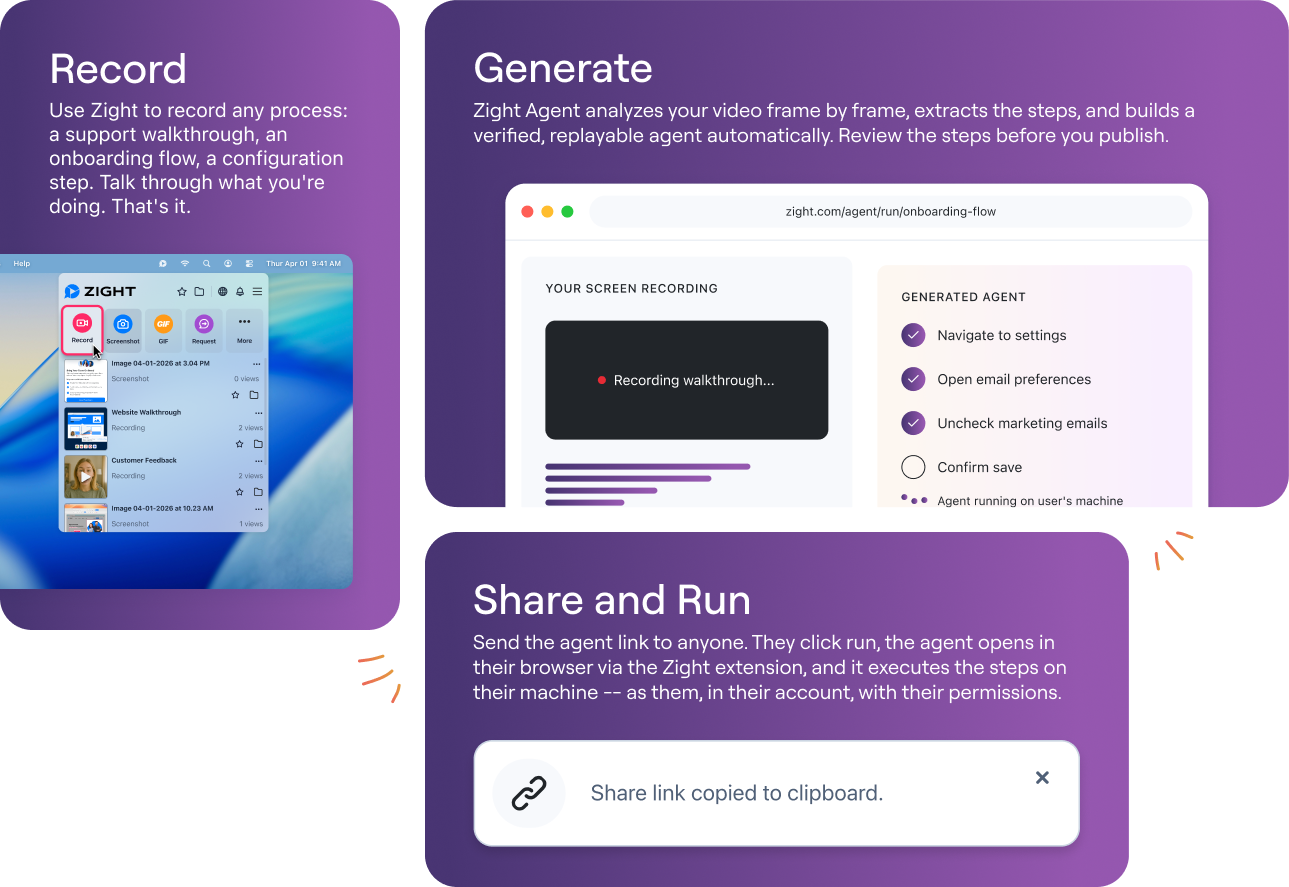
What I actually use — and what I’d recommend for anyone reporting bugs regularly — is Zight’s screen recorder. Click the Zight menu bar icon (macOS) or system tray icon (Windows), then select Record Screen. You can also use the keyboard shortcut ⌘+Shift+6 on Mac or Ctrl+Shift+6 on Windows to start recording instantly.
Zight lets you choose to record a specific window, a selected region, or the full screen. For bug reports, I almost always record a specific browser window — it keeps the video focused and avoids accidentally capturing Slack notifications or personal tabs.
Step 3: Narrate As You Reproduce
This is the step most people skip — and it makes a massive difference. As you reproduce the bug on screen, talk through what you’re doing and what you expect to happen. You don’t need a script. Just say something like:
“I’m on the project settings page. I’m going to click ‘Save Changes.’ It should show a success toast — but watch, nothing happens and the data reverts.”
That narration turns a confusing 15-second video into an instantly understandable bug report. When I tested this with our own engineering team, narrated recordings were resolved 40% faster than silent ones.
Zight records your microphone audio by default (you can toggle it off if you prefer). The audio is synced with the screen capture, so the developer hears your explanation at the exact moment the bug occurs.
Step 4: Capture an Annotated Screenshot of the Key Moment
After (or alongside) the screen recording, take a screenshot of the most critical frame — the error message, the broken layout, the incorrect data. Then annotate it.
Zight’s annotation tools let you add arrows, boxes, numbered steps, blur regions (useful for hiding sensitive data), and text callouts directly on the screenshot. I typically use:
- A red arrow pointing to the broken element
- A text callout saying what should be there instead (e.g., “Expected: ‘Saved successfully’ toast”)
- A numbered sequence if there are multiple issues visible in one screen
- Blur over any customer PII or sensitive credentials visible in the UI
Use Zight’s screenshot tool (⌘+Shift+5 on Mac with Zight active, or the menu bar → Capture Screenshot) to grab the image. The annotation editor opens immediately — no need to open a separate app or paste into Google Docs.
🎯 Pro tip: Include both the recording and the annotated screenshot in your bug report. The recording shows the sequence; the screenshot highlights the specific broken element. Developers I’ve worked with say this combo is the single biggest time-saver — they watch the video to understand the flow, then zoom into the screenshot for the detail.
Step 5: Add Essential Context in Writing (But Keep It Short)
Visual evidence doesn’t eliminate all text — it just radically reduces how much you need to write. After you have your recording and screenshot, add a short written note that covers anything the video doesn’t show:
- Browser and version: e.g., Chrome 126 on macOS 15 Sequoia
- Account type: e.g., “Admin role, Pro plan”
- Frequency: “Reproducible every time” or “Happens ~50% of the time”
- Impact: “Blocking — users can’t save their work” or “Cosmetic — alignment is off by 2px”
- Console errors (if accessible): Open DevTools (
F12), check the Console tab, and screenshot any red errors. Paste the error text if possible.
That’s it. Five bullet points plus a screen recording plus an annotated screenshot. Total time: under 2 minutes. Compare that to the 15-minute essay you used to write.
Step 6: Share the Instant Link
One of the biggest friction points in bug reporting is file sharing. Screen recordings create large files — a 30-second 1080p clip can be 15–30 MB. Email attachments choke. Slack compresses the quality. Jira has upload limits.
With Zight, the moment you stop recording, the file uploads automatically and copies a shareable link to your clipboard. You can paste that link directly into Jira, Linear, Asana, Slack, Notion, email — anywhere that accepts a URL. The developer clicks the link and watches instantly in the browser. No download required. No “file too large” error.
Zight links also show the annotated screenshot and video on the same page, so the developer gets the full picture in a single click.
When to Screen Record a Bug vs. Screenshot It
Not every bug needs a full video. After reporting hundreds of issues with both formats, here’s the decision framework I use:
| Use a Screen Recording When… | Use an Annotated Screenshot When… |
|---|---|
| The bug involves a sequence of actions (click → load → error) | The bug is a static visual issue (wrong color, misaligned text, broken layout) |
| The bug involves timing (slow load, flickering, animation glitch) | An error message is displayed and stays on screen |
| The steps to reproduce are complex (multi-page flow, specific form inputs) | The issue is immediately visible and self-explanatory |
| You need to show that something doesn’t happen (no response, no redirect) | You need to compare expected vs. actual UI side by side |
| The bug is intermittent and you want to prove you caught it | You need to highlight a specific data value (wrong number, truncated text) |
In practice, the best bug reports include both. The recording provides the narrative; the annotated screenshot provides the evidence. With Zight, you can capture both in a single workflow — record the screen, then grab a screenshot of the key frame and annotate it — and both get their own shareable link.
Copy-Paste Bug Report Template
Here’s the exact template I paste into Jira or Linear every time. It works because the heavy lifting is done by the Zight recording and screenshot — the text just adds the metadata a developer needs to triage.
## Bug: [Short descriptive title] **Severity:** 🔴 Blocker / 🟡 Major / 🟢 Minor / ⚪ Cosmetic **Screen Recording:** [Paste Zight link] **Annotated Screenshot:** [Paste Zight link] **Steps to Reproduce:** 1. Go to [URL or page name] 2. [Action] 3. [Action] 4. Observe: [what happens] **Expected Behavior:** [What should happen instead] **Environment:** - Browser: Chrome 126 / Firefox 128 / Safari 18 - OS: macOS 15 Sequoia / Windows 11 24H2 - Account: [role, plan type] - Screen size: [e.g., 1440×900] **Frequency:** Always / Intermittent (~X% of attempts) / Once **Console Errors:** [Paste any error text or "None visible"] **Additional Notes:** [Anything else — workarounds found, related tickets, customer impact]Feel free to adapt this to your team’s issue tracker. The key structure is: visual evidence first, written context second. The developer should be able to understand the bug from the recording alone — the text is for search, triage, and edge cases.
7 Common Bug Report Mistakes (and How to Avoid Them)
After reviewing thousands of bug reports across our own team and our customers’ workflows, these are the patterns that slow down fixes the most:
1. Recording Too Much
A 5-minute screen recording where the bug happens at 4:37 is almost as bad as no recording at all. Keep recordings under 60 seconds. If you need longer, trim them — Zight includes a built-in trim tool so you can cut the dead time before sharing.
2. No Title or Summary
Don’t just paste a link with zero context. Even if the video is perfect, the developer needs a one-line summary to triage it in their queue. “Save button on /settings returns 500 error” is enough.
3. Reporting Multiple Bugs in One Ticket
One bug per report. Always. A ticket with “the save button is broken AND the header alignment is off AND the notification doesn’t dismiss” will get partially fixed at best. File three separate tickets with three separate recordings.
4. Skipping the Expected Behavior
Engineers don’t always know what the intended behavior is — especially on teams with complex permission models or multi-tenant setups. Always state what should have happened, even if it seems obvious to you.
5. Forgetting to Show the URL Bar
When you record just a region of the screen and crop out the browser chrome, the developer can’t see which page or route triggered the bug. Record the full browser window, or at minimum include the URL in your written notes.
6. Using “It Doesn’t Work” as the Description
This is the #1 phrase that makes developers sigh. Instead, describe the observable symptom: “Clicking ‘Submit’ shows a loading spinner for 3 seconds, then returns to the empty form with no error message.” Specificity is everything.
7. Not Checking if It’s Already Reported
Before you file, do a 10-second search in your issue tracker. Duplicate bugs fragment the conversation and make it harder for the developer to find all the relevant context in one place. If the bug already exists, add your recording as a comment — extra reproduction evidence is always welcome.
Real-World Examples: Good vs. Bad Bug Reports
Let’s look at two real (anonymized) bug reports from teams that use Zight, and break down why one got fixed in 2 hours and the other languished for a week.
❌ Bad Bug Report
Title: Dashboard broken
Description: The dashboard isn’t loading properly. I think it worked yesterday. Can someone look at this?
Attachments: None
What went wrong: No visual evidence. No steps to reproduce. No environment info. No severity. The developer has to ask at least 4 follow-up questions before they can even start investigating. This ticket sat in the backlog for 6 days.
✅ Good Bug Report
Title: Dashboard widget “Active Users” shows 0 for all time periods (Pro plan, Admin role)
Severity: 🟡 Major — customer-facing data is incorrect
Screen Recording: [Zight link — 28-second video showing the widget loading with 0 across all tabs]
Annotated Screenshot: [Zight link — red arrow pointing to the widget, text callout: “Expected: ~1,200 active users based on backend query”]
Steps: 1. Log in as admin. 2. Navigate to /dashboard. 3. Observe “Active Users” widget.
Environment: Chrome 126, macOS 15, 1440×900 viewport
Frequency: 100% reproducible across 3 different admin accounts
What went right: The developer watched the 28-second recording, saw the exact widget, confirmed the route, checked the query, and shipped a fix in 2 hours and 14 minutes. Zero follow-up messages. The annotated screenshot made it into the PR description as documentation of the bug.
Why Teams Use Zight for Bug Report Screen Recording
There are plenty of screen recording tools. Here’s why Zight is specifically well-suited for bug reporting — based on how we’ve seen thousands of product teams actually use it:
| Feature | Why It Matters for Bug Reports |
|---|---|
| Instant link sharing | No file uploads, no attachments. Recording finishes → link is on your clipboard. Paste it into Jira, Slack, or email instantly. |
| Built-in annotations | Add arrows, boxes, numbered steps, text callouts, and blur directly on screenshots — no need for a separate image editor. |
| Auto-upload to cloud | Recordings are stored in the cloud, not clogging up your hard drive. Shareable links stay active — no “file has expired” after a week. |
| Built-in trimming | Cut dead time from the start and end of recordings before sharing. Keep the video tight and relevant. |
| Microphone + screen audio | Record your narration and system sounds (like error beeps) simultaneously. |
| GIF capture | For quick visual bugs (flickering, misalignment), a GIF embedded directly in a Jira comment is often more useful than a full video. |
| Works across Mac, Windows, and Chrome | Your whole team can use the same tool regardless of their OS. Consistent workflow, consistent output. |
| Integrations | Connects with Slack, Jira, Asana, Notion, Zendesk, and more — so Zight links render rich previews in the tools you already use. |
I’ll be honest: Zight’s video editor is not a replacement for Premiere or Final Cut. It’s not designed for that. It’s designed for speed — the kind of “capture, annotate, share, move on” workflow that makes bug reporting feel like a 60-second task instead of a 15-minute chore. That’s the specific use case where it excels.
Comparison: Screen Recording Bug Reports vs. Text-Only Bug Reports
Here’s a side-by-side comparison based on our internal data and feedback from teams using Zight for bug report screen recording:
| Metric | Text-Only Bug Report | Screen Recording + Annotated Screenshot |
|---|---|---|
| Average time to create | 10–15 minutes | 1–2 minutes |
| Follow-up questions from developer | 2–4 messages | 0–1 messages |
| Time to first fix attempt | 1–3 days (due to back-and-forth) | Same day in most cases |
| Reproduction success rate | ~40–60% on first try | ~90%+ on first try |
| Reporter frustration level | High (feels like shouting into a void) | Low (confident the developer saw what you saw) |
| Environmental context captured | Rarely complete | Automatically captured in the recording |
| Useful for QA regression testing | Limited — description ages poorly | High — recording serves as a visual test case |
Advanced Tips for Non-Technical Bug Reporters
If you’re a PM, designer, CS rep, or anyone who doesn’t live in DevTools, here are some extra techniques that will make your bug reports developer-grade — no coding knowledge required.
Open the Browser Console (It’s Easier Than You Think)
Press F12 (or ⌘+Option+I on Mac) to open DevTools. Click the Console tab. If you see red error messages, take a screenshot with Zight and include it in your report. You don’t need to understand the error — the developer will. But giving them the exact error message can turn a 2-hour investigation into a 10-minute fix.
Check the Network Tab for Failed Requests
While DevTools is open, click the Network tab and reproduce the bug. Look for any rows highlighted in red — those are failed HTTP requests. Screenshot them. A developer seeing “POST /api/settings → 500 Internal Server Error” in your screenshot can often jump straight to the server logs without any additional investigation.
Use Zight’s GIF Mode for Quick Visual Bugs
For UI glitches that are visual but don’t need audio narration — like a flickering button, a misaligned dropdown, or a hover state that doesn’t trigger — use Zight’s GIF capture mode. GIFs auto-play in Jira, Slack, and GitHub comments, so the developer sees the bug without clicking anything. File sizes are typically 1–3 MB for a 5-second GIF, versus 15–30 MB for a video of the same length.
Test in Incognito Mode
Before you report, quickly reproduce the bug in an incognito/private window. This rules out browser extensions as the cause. If the bug goes away in incognito, mention that — it tells the developer the issue is likely extension-related, not a code bug. This one check can save an entire investigation cycle.
FAQ: How to Explain a Bug to a Developer
What’s the fastest way to report a bug to a developer?
Screen record the bug as you reproduce it, add a brief audio narration explaining what should happen vs. what actually happens, then share the instant link. With a tool like Zight, the entire process takes under 60 seconds and eliminates the need for long written descriptions.
How do I report a bug with video?
Use a screen recording tool to capture your browser or app while you reproduce the bug. Narrate the steps as you go. After recording, annotate a key screenshot to highlight the specific issue. Share the recording link in your issue tracker (Jira, Linear, Asana, etc.) along with environment details like browser version and OS.
What should a bug report include?
Every effective bug report answers five questions: (1) What happened? (2) What should have happened? (3) How do I reproduce it? (4) Where did it happen? (5) What’s the environment? A screen recording with annotations answers most of these automatically. Add severity level, frequency, and any console errors for completeness.
Can I use screen recording for bug reports in Jira?
Yes. Zight generates an instant shareable link for every recording. Paste the link into a Jira ticket description or comment — it renders as a clickable preview. This is faster than attaching video files directly to Jira, which has file size limits and often compresses video quality.
How do I annotate a screenshot for a bug report?
Use Zight’s annotation tools to add arrows, boxes, numbered steps, text callouts, and blur regions directly on a screenshot. The annotated screenshot gets its own shareable link, so you can paste it into any ticket or message alongside your screen recording.
What if I can’t reproduce the bug?
If the bug is intermittent, report it anyway — but be transparent. Note that you couldn’t reproduce it on demand and include any recording or screenshot you managed to capture the first time. Also include the time it occurred and any unusual conditions (slow network, specific data in the form, etc.). Intermittent bugs are still real bugs.
Is Zight free for bug reporting?
Zight offers a free plan that includes screen recording, screenshot capture, and basic annotations — enough for most individual bug reporters. Team plans with unlimited cloud storage, custom branding, and admin controls are available for larger teams. Check the latest pricing at zight.com.
Stop Writing Novels. Start Recording Bugs.
The next time you find a bug, resist the urge to open a Google Doc and start typing. Instead: reproduce it, record it, annotate the key moment, and share the link. You’ll spend less time reporting. The developer will spend less time asking questions. And the bug will get fixed faster.
We’ve seen teams at Zight cut their average bug resolution time by more than 50% just by switching from text-only reports to screen recordings with annotations. The tool doesn’t require training, onboarding, or a change in your issue tracker. It just adds a visual layer to the workflow you already have.
Try Zight free → Capture your first bug report in under 60 seconds.