How to Document Healthcare Workflows With Video: A Practical Guide for Operations Teams
Somewhere in your organization right now, someone is writing a 47-page PDF that nobody will ever read. It will take them weeks to finish. It will be outdated by the time it is published. And the next time a new hire needs to learn the process it describes, they will skip it entirely and ask a coworker instead.
If you have ever wondered how to document healthcare workflows with video, you are already thinking about this problem the right way. Healthcare operations teams are drowning in process documentation that is slow to create, difficult to maintain, and rarely consumed by the people who need it most. Written SOPs gather digital dust while staff members spend hours re-explaining the same procedures to new hires, traveling colleagues, and cross-departmental teams.
Video changes the equation entirely. A short screen recording takes minutes to create, is far easier to follow than a wall of text, and can be shared securely across locations and departments. When you pair that capability with a HIPAA-compliant video tool built for healthcare teams, you get a documentation system that people actually use.
This guide walks you through the entire process — from identifying which workflows deserve video documentation, to recording clear and effective walkthroughs, to annotating and sharing them securely with the right people. We will use Zight, a HIPAA-compliant async video and screen recording tool for healthcare teams, as the primary tool throughout.
Why Documenting Healthcare Workflows With Video Matters
Healthcare organizations are complex by nature. Multiple sites, rotating staff, strict compliance requirements, and an ever-growing stack of software tools create an environment where process knowledge is constantly at risk of being lost, siloed, or misunderstood.
Written documentation has been the default solution for decades, and it is not working. According to research from the Nielsen Norman Group, people read only about 20 percent of the text on a typical page. In high-pressure healthcare environments, where staff are already stretched thin, the number is likely even lower.
Video documentation addresses this head-on. Here is why it matters for healthcare teams specifically:
- Faster creation: A five-minute screen recording can replace a ten-page written document — and it takes a fraction of the time to produce.
- Higher consumption rates: Staff are far more likely to watch a short video walkthrough than read a dense PDF, especially when they need an answer quickly.
- Reduced knowledge silos: When a process lives in someone’s head, it disappears when that person goes on leave, transfers, or leaves the organization. Video captures institutional knowledge permanently.
- Consistency across locations: Multi-site healthcare organizations need standardized processes. Video SOPs for healthcare teams ensure that every location follows the same steps, every time.
- Easier updates: When a workflow changes, re-recording a short video is far simpler than revising and redistributing a written document.
The shift toward video is not about replacing all written documentation. It is about using the right medium for the right content. And for operational workflows — especially those involving software, multi-step procedures, or visual processes — video is almost always the better choice.
Common Challenges With Healthcare Workflow Documentation
Before we get into the how, it is worth understanding the specific problems that healthcare operations teams face with their current documentation practices. These challenges are not clinical — they are operational, and they affect productivity, onboarding speed, and compliance readiness across the board.
Back-and-Forth Communication That Eats Up Hours
When a staff member at a satellite clinic cannot figure out how to submit a purchase order through the new procurement system, what happens? They send a message to the operations team. The operations team sends back a written explanation. The staff member tries it, gets stuck at step four, and sends another message. Three exchanges later, the problem is solved — but 45 minutes have been wasted on both sides.
This cycle repeats dozens of times per week across most healthcare organizations. Every question that requires a multi-step answer becomes a back-and-forth communication chain that could have been a single, reusable video.
Misalignment Across Sites and Departments
Healthcare organizations rarely operate from a single building. Even small networks may have multiple clinics, administrative offices, and remote staff. When each location develops its own informal approach to standard procedures — how to process a vendor invoice, how to navigate the EHR scheduling module, how to submit a compliance report — inconsistencies multiply.
Written SOPs are supposed to solve this, but they often make the problem worse. Different versions circulate. Some locations never receive the update. Staff interpret written instructions differently based on their experience level. The result is a patchwork of processes that undermines efficiency and compliance.
Repetitive Explanations and Re-Training
If you manage healthcare operations, you already know this pain. The same questions come up every time a new hire starts. The same issues resurface every time a software tool is updated. The same explanations get delivered — verbally, on the fly, with no consistency and no scalability.
Your most experienced staff spend a disproportionate amount of their time answering the same questions instead of doing higher-value work. This is not a training problem. It is a documentation problem. The knowledge exists — it just is not captured in a format that people can access independently.
How Async Video Solves Healthcare Workflow Documentation
Async video — specifically, screen recording with narration — is the efficiency unlock that healthcare operations teams have been missing. It eliminates the gap between knowing a process and communicating it clearly to others.
Here is what makes screen recording process documentation for healthcare so effective:
Show, Don’t Tell
Most operational workflows in healthcare involve software. EHR systems, scheduling platforms, billing tools, compliance portals, procurement systems — the list goes on. Trying to describe navigation steps in writing is inherently lossy. “Click the dropdown menu in the upper-right corner” means something different to someone who has never seen the interface before.
A screen recording eliminates all ambiguity. The viewer sees exactly what to click, where to navigate, and what the expected result looks like. Combined with narration, a screen recorder turns any multi-step software workflow into a clear, followable guide.
Record Once, Share Endlessly
The real power of async video is leverage. You record a walkthrough once, and it serves every person who needs that information from that point forward. A new hire in onboarding watches it. A staff member at a remote clinic references it six months later. A traveling employee pulls it up on their laptop between sites. The same video, used dozens of times, with zero additional effort from the person who created it.
Faster Than Writing, More Complete Than a Chat Message
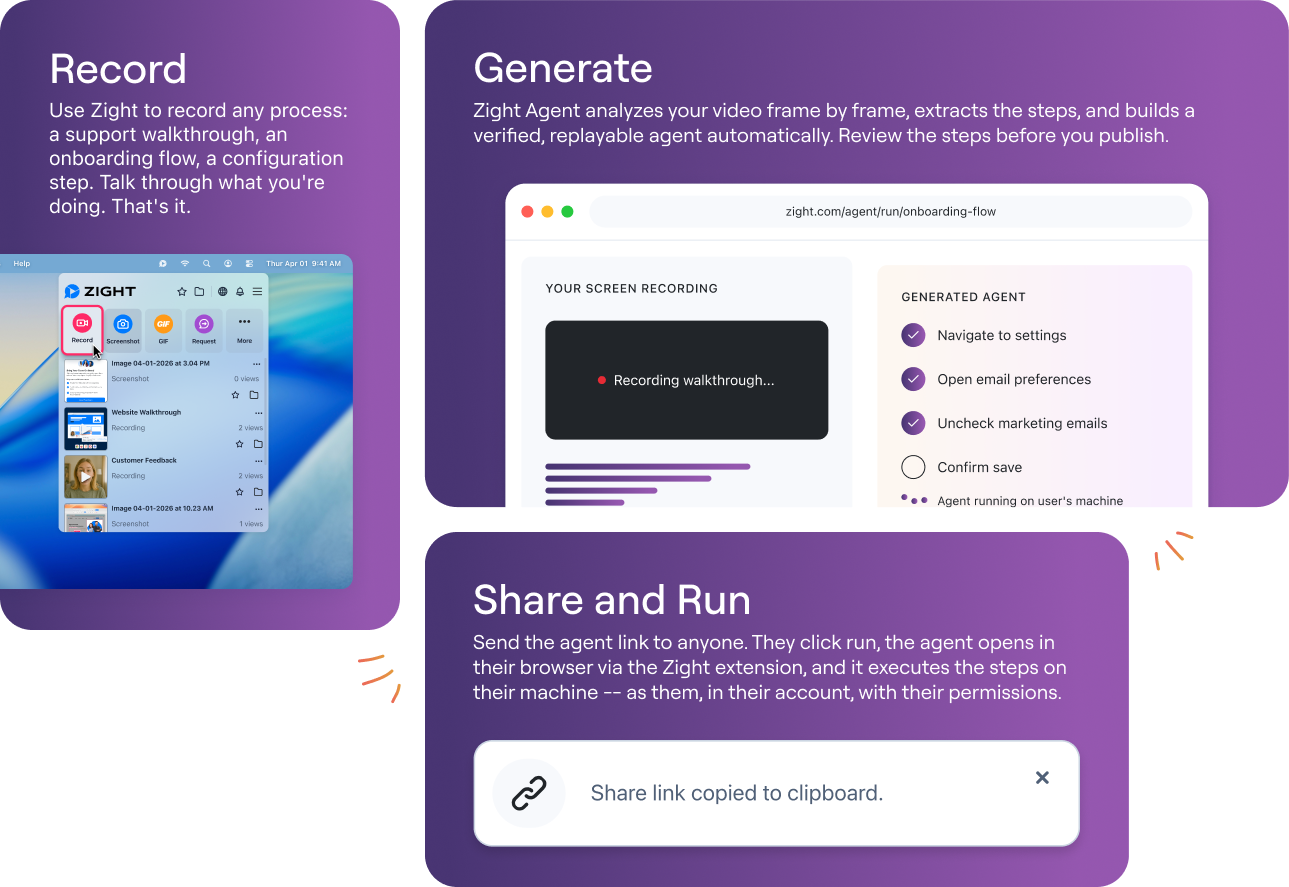
Creating a video SOP with Zight takes minutes, not hours. Open the tool, hit record, walk through the process while narrating what you are doing, stop recording. That is it. The result is a complete, visual, narrated document that captures every detail of the workflow — including the nuances that written documentation almost always leaves out.
Secure by Design
Of course, none of this matters if the tool is not secure enough for healthcare environments. Zight is a HIPAA-compliant async video and screen recording tool that offers encrypted storage, access controls, expiring links, password protection, and a signed Business Associate Agreement. This means healthcare teams can document and share workflows without introducing compliance risk — something that generic consumer tools cannot offer.
Practical Use Cases: How to Document Healthcare Workflows With Video
Let us get specific. Below are three high-impact categories where video documentation delivers the most value for healthcare operations teams, along with concrete examples and guidance for each.
1. IT Troubleshooting and Help Desk Documentation
Healthcare IT teams are perpetually understaffed relative to the volume of support requests they receive. Many of these requests are repetitive — password resets, VPN configuration, printer setup, EHR module navigation, badge access troubleshooting. Each one takes a ticket, a response, and often a follow-up.
How to apply video documentation:
- Audit your top 20 help desk tickets. Identify the issues that come up most frequently. These are your first candidates for video documentation.
- Record a screen walkthrough for each one. Use Zight to capture the exact steps a user needs to follow. Narrate each click and explain what to look for at each stage.
- Use annotations to highlight critical UI elements — buttons, menu items, confirmation screens — so viewers can follow along even at a glance.
- Organize videos in a shared library that help desk staff can link to directly in ticket responses instead of typing out instructions from scratch.
The result: fewer repeat tickets, faster resolution times, and an IT team that can focus on higher-priority issues. One well-made video can deflect hundreds of support interactions over its lifetime.
2. Staff Training and Onboarding
Onboarding in healthcare is notoriously time-consuming. New staff need to learn multiple software systems, internal processes, compliance protocols, and department-specific procedures — often under time pressure because they are filling an urgent staffing need.
How to apply video documentation:
- Map the onboarding journey by role. List every system, tool, and process that a new hire needs to learn in their first 30 days. Prioritize the ones that generate the most questions.
- Create short, focused videos for each step. Keep each recording to two to five minutes. Cover one workflow per video — for example, “How to submit a time-off request in Workday” or “How to navigate the scheduling module in Epic.”
- Build a video playlist or library organized by role and department. New hires can work through videos at their own pace, rewatching sections as needed — without pulling a senior staff member away from their work.
- Update individual videos when processes change, rather than overhauling an entire onboarding manual. This modular approach keeps documentation current with minimal effort.
Video SOPs for healthcare teams are especially valuable for onboarding because they scale. Whether you are onboarding one person or twenty, the videos do the same amount of work.
3. Internal Process Documentation and Standardization
Beyond IT and onboarding, there are dozens of administrative and operational workflows that benefit from video documentation: month-end reporting procedures, vendor management steps, compliance audit preparation, inventory management, credentialing processes, and more.
How to apply video documentation:
- Identify processes that are handled by only one or two people. These are your biggest knowledge-risk areas. If that person leaves, the process knowledge leaves with them. Video captures it permanently.
- Document cross-departmental handoffs. Workflows that span multiple teams — such as the process from purchase request to approval to procurement — often break down at handoff points. A video walkthrough of the full end-to-end process clarifies responsibilities and reduces errors.
- Create a healthcare workflow video guide for recurring processes that happen monthly, quarterly, or annually. Staff who only perform a task once a quarter will forget the steps between cycles. A reference video eliminates that problem.
- Share recordings securely using Zight’s access controls to ensure that sensitive operational content is only available to authorized personnel.
Best Practices for Creating Video SOPs in Healthcare
Recording a screen walkthrough is easy. Recording a good one — one that people will actually watch, understand, and refer back to — requires a bit of intentionality. Here are the operational best practices that will make your video documentation program successful.
Start With a Quick Outline
Before you hit record, spend 60 seconds jotting down the steps you plan to cover. You do not need a script — a simple bulleted list is enough. This prevents rambling, ensures you do not forget a step, and keeps the recording focused.
A good outline for a five-step workflow might look like this:
- Log in to [system] and navigate to [module]
- Click [button] to open the form
- Fill in required fields — explain what goes where
- Submit and confirm
- Show where the confirmation or output appears
Keep Videos Short and Single-Topic
The ideal length for a video SOP is two to five minutes. If a workflow is more complex, break it into multiple videos rather than creating one long recording. Short videos are easier to consume, easier to update, and easier to reference later.
Think of it this way: a staff member searching for help with step three of a process should not have to scrub through a 20-minute video to find it. They should be able to pull up a two-minute clip that covers exactly what they need.
Narrate as You Go
A screen recording without narration is like a textbook without captions — the viewer can see what is happening, but they have to guess at the reasoning behind each action. Always narrate your walkthroughs. Explain not just what you are clicking, but why.
“I’m clicking on the Reports tab here because that’s where the monthly compliance summary lives. You’ll see a list of available reports — scroll down to the one labeled ‘Quarterly Audit’ and click Generate.”
That kind of narration transforms a recording from a visual reference into a genuine learning resource.
Use Annotations to Highlight Key Steps
Zight’s annotation features let you add arrows, highlights, text callouts, and other visual markers to your recordings. Use them to draw attention to the most important elements on screen — the button that is easy to miss, the field that must be filled in a specific format, the confirmation message that indicates success.
Annotations are especially valuable for screen recording process documentation in healthcare, where systems often have dense, complex interfaces with dozens of options on a single screen.
Clean Your Screen Before Recording
This sounds minor, but it matters. Before you start recording, close unnecessary browser tabs, hide desktop clutter, and make sure no sensitive or irrelevant information is visible on screen. In healthcare environments, this is not just a professionalism issue — it is a compliance issue. Accidentally capturing protected health information (PHI) in a screen recording creates a liability.
Zight helps mitigate this risk with tools like selective screen capture and the ability to record specific windows rather than your full desktop.
Use Descriptive Titles and Organize by Category
A video library is only useful if people can find what they need. Name your recordings clearly — “How to Submit a Purchase Order in SAP” is far better than “PO Process Video.” Organize videos by department, role, or workflow category so that staff can browse intuitively.
Set a Review Schedule
Processes change. Software gets updated. New compliance requirements emerge. Set a quarterly or semi-annual review schedule to audit your video library and flag recordings that need to be re-recorded. Because individual videos are short and focused, updating them takes minutes — not the hours or days required to revise a comprehensive written manual.
Share Securely With Access Controls
Not every video needs to be accessible to every person in your organization. Zight’s sharing controls let you set password protection, expiring links, and viewer-specific access. This is critical for healthcare workflow video guides that may contain sensitive operational information — vendor pricing, internal compliance procedures, or system credentials.
Step-by-Step: How to Document a Healthcare Workflow With Zight
Let us put all of this together into a concrete, repeatable process you can follow starting today.
Step 1: Identify the Workflow
Choose a workflow that is repetitive, generates frequent questions, or is handled by only one or two people. Prioritize workflows that involve software navigation, since those benefit most from visual documentation.
Quick prioritization framework:
- High priority: Done daily or weekly, involves multiple steps in a software tool, frequently asked about by new hires or cross-site staff.
- Medium priority: Done monthly or quarterly, involves a moderate number of steps, occasionally generates confusion.
- Low priority: Done rarely, simple enough to explain in a single sentence, not software-dependent.
Step 2: Outline the Steps
Write a quick bulleted list of the steps involved. This is your recording guide — not a script, just a sequence to follow so you do not miss anything.
Step 3: Prepare Your Screen
Close unnecessary windows, clear notifications, open the relevant application, and navigate to the starting point of the workflow. Double-check that no PHI or other sensitive data is visible.
Step 4: Record With Zight
Open Zight and start a screen recording. Walk through the workflow step by step, narrating as you go. Speak at a natural pace. If you make a mistake, it is fine — Zight lets you trim recordings after the fact.
Step 5: Annotate Key Moments
After recording, use Zight’s annotation tools to add highlights, arrows, or text callouts to the most important moments in the video. This makes it easy for viewers to follow along and catch critical details.
Step 6: Title, Tag, and Organize
Give the video a clear, descriptive title. Add relevant tags or categories if your team uses a shared library or knowledge base. Make it easy to find.
Step 7: Share Securely
Generate a secure sharing link with appropriate access controls. Distribute via your internal communication tool, embed in your knowledge base, or link directly in help desk ticket templates. Because Zight is HIPAA-compliant, you can share confidently within healthcare environments.
Conclusion: Build a Video Documentation Culture That Scales
Learning how to document healthcare workflows with video is not just about adopting a new tool — it is about changing how your organization captures, shares, and preserves operational knowledge. The compounding value is significant. Every video you create reduces future questions, shortens onboarding timelines, improves cross-site consistency, and frees up your most experienced staff to focus on higher-value work.
The key is to start small. Pick five workflows this week. Record them. Share them. Measure whether questions drop. Then expand from there.
Zight makes this easy and secure. As a HIPAA-compliant async video and screen recording tool built for healthcare teams, it gives you everything you need — screen recording, annotations, secure sharing, access controls, and a signed BAA — in a single platform.
Ready to start documenting workflows the way your team will actually use them? Explore Zight’s healthcare video communication solutions and see how secure video workflows can transform your operations team’s productivity.