How to Create a Knowledge Base That People Actually Use (Video-First Approach)
If you’ve ever watched a senior engineer leave the company and take half the team’s tribal knowledge with them, you already know why learning how to create a knowledge base matters. The problem isn’t that teams lack documentation tools — it’s that the documentation they create sits unread in Confluence pages, Google Docs, and Notion wikis that nobody maintains. After helping dozens of ops, customer success, and HR teams build knowledge bases that actually get used, I’ve found the answer is deceptively simple: record your screen instead of writing a 12-paragraph doc. A video-first knowledge base is faster to create, easier to consume, and dramatically harder to ignore.
⚡ Quick Answer: How to Create a Knowledge Base
To create a knowledge base in 2024, start by auditing your team’s most-repeated questions, then record short screen recordings and annotated walkthroughs for each process — rather than writing long text docs most people skip. Zight is an async video documentation and screen recording tool that lets you capture, annotate, and share knowledge base entries via instant links, making it the recording and sharing layer for a video-first internal wiki. Teams using this approach report building knowledge bases 3–5× faster than text-only methods and seeing significantly higher adoption rates.
In this step-by-step guide, I’ll walk you through exactly how to create a knowledge base using a video-first workflow — from planning your content architecture to recording, organizing, and maintaining entries that your team will actually reference. Whether you’re in operations, customer success, or HR, this approach works for any team that’s tired of answering the same questions on repeat.
Why Most Knowledge Bases Fail (And Why Video Fixes It)
Before we get into the how-to, let’s be honest about the problem. According to Panopto research, the average company with 1,000 employees loses $2.7 million per year in productivity because employees can’t find the information they need. And it’s not because the information doesn’t exist — it’s because the format is wrong.
Here’s what I’ve seen fail over and over again:
- Text wikis become graveyards. Someone spends hours writing a 2,000-word SOP. It’s outdated within three months. Nobody updates it because rewriting is painful.
- Screenshots go stale. UI changes, buttons move, and suddenly your carefully annotated screenshot tutorial is more confusing than helpful.
- Institutional knowledge lives in people’s heads. The team lead who knows how to process a refund in your custom billing system? When they’re on vacation, the whole team is stuck.
- Onboarding becomes a live performance. Every new hire requires the same 90-minute screen-share walkthrough because nobody captured it the first time.
A video knowledge base tool like Zight solves all four problems. Recording a 3-minute screen walkthrough takes exactly 3 minutes. Updating it when the UI changes takes another 3 minutes. And a new hire can watch it on their own schedule without booking a meeting.
Video-First vs. Text-First Knowledge Base: A Comparison
When I tested building the same knowledge base entry — “How to process a customer refund in Stripe” — using both approaches, the difference was stark:
| Factor | Text-First (Wiki/Doc) | Video-First (Zight + Link Library) |
|---|---|---|
| Time to create | 35–45 minutes (write, screenshot, format) | 5–8 minutes (record, annotate, share) |
| Time to consume | 8–12 minutes reading | 2–4 minutes watching |
| Time to update | 15–20 minutes (rewrite, re-screenshot) | 3–5 minutes (re-record) |
| Comprehension rate | Lower — readers skim and miss steps | Higher — viewers see exactly what to do |
| Searchability | Full-text search works well | Depends on titles/descriptions; Zight auto-generates shareable links with context |
| Maintenance effort | High — text rots fast | Low — re-recording is quick |
| Accessibility | Good for text readers | Good for visual learners; add captions for full accessibility |
The honest takeaway: text search is genuinely easier with written docs, and some processes (like API reference documentation) are better in text. But for the 80% of knowledge base entries that are how-to walkthroughs — which is most of what ops, CS, and HR teams need — video wins on every metric that matters.
How to Create a Knowledge Base: Step-by-Step Guide
Here’s the process I’ve refined after building video knowledge bases for support workflows, employee onboarding, and internal operations. Follow these seven steps and you’ll have a usable, maintainable knowledge base within a week — not a quarter.
Step 1: Audit Your Team’s Most-Repeated Questions
Don’t start by brainstorming every process in your company. Start with the questions your team asks over and over again — the ones that clog Slack, trigger 15-minute “quick calls,” and slow down onboarding.
How to do this practically:
- Search your Slack/Teams channels for the phrase “how do I” and “can someone show me” — you’ll find gold.
- Ask every team lead: “What question do new hires ask you in their first two weeks that you’ve answered more than five times?”
- Check your support ticket system for internal requests (IT, HR, finance) — these are knowledge base entries waiting to happen.
- Review your onboarding checklist and flag every item that currently requires a live walkthrough.
Pro tip: Rank your list by frequency × impact. A question asked 20 times a month that takes 10 minutes to answer live is costing your team over 3 hours monthly — that’s your first recording.
Step 2: Define Your Knowledge Base Structure
Every knowledge base needs a simple taxonomy. Overthink this and you’ll never start. Here’s the structure that works for most teams:
- Category = Department or function (e.g., “Customer Success,” “HR & People Ops,” “Engineering”)
- Subcategory = Workflow area (e.g., “Refunds & Billing,” “Onboarding,” “Deployment”)
- Entry = Single process or answer (e.g., “How to process a partial refund in Stripe”)
Keep it flat. Two levels deep maximum. I’ve seen teams build elaborate nested wiki structures that became impossible to navigate. If someone can’t find what they need within two clicks, they’ll just message a coworker instead.
For the hosting layer, you can use Notion, Confluence, SharePoint, or even a simple Google Sites page. The key insight is that these tools are the index — Zight is the content engine. You record and annotate in Zight, then embed or link the recordings into whatever wiki your team already uses.
Step 3: Record Your First Knowledge Base Entries with Zight
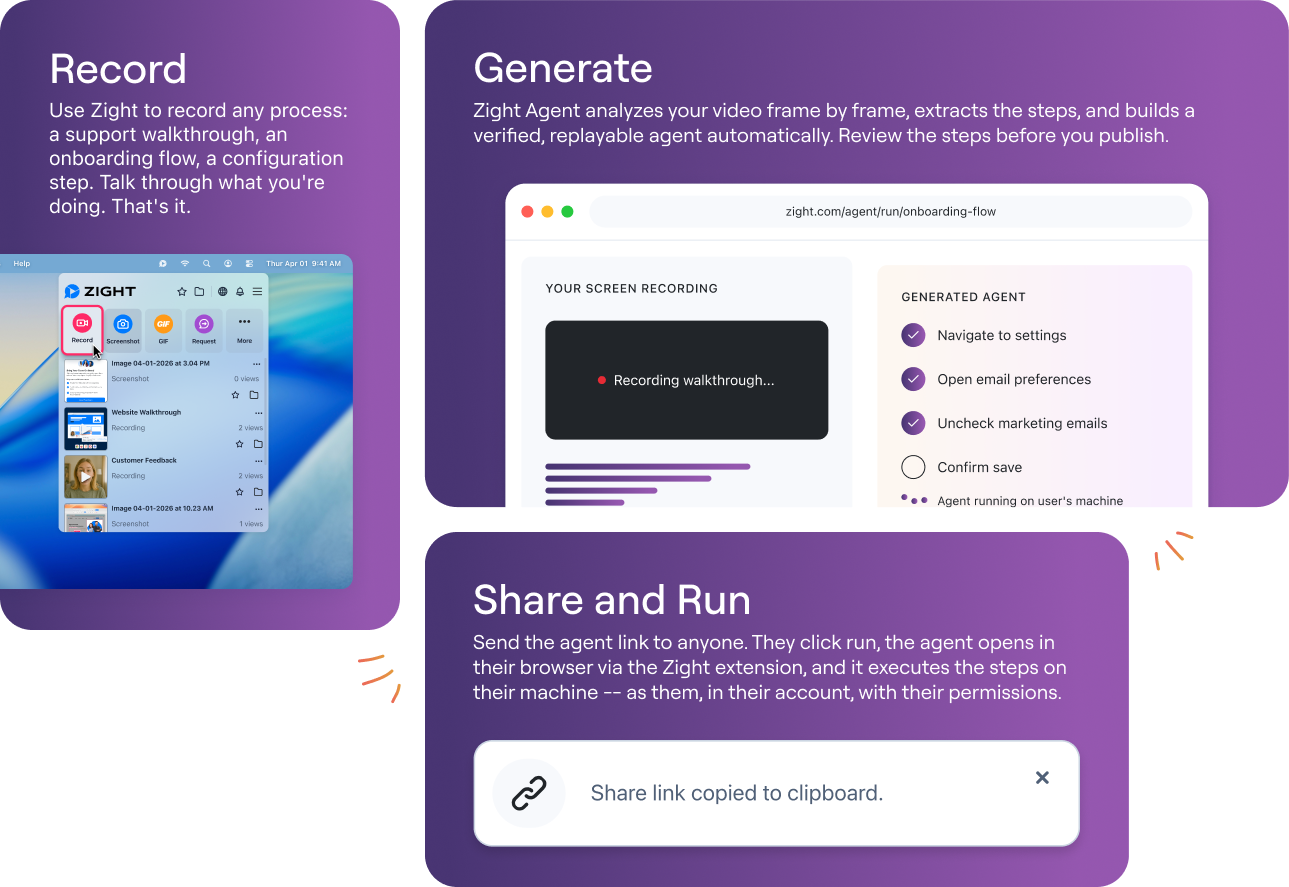
This is where the magic happens — and where most people are surprised by how fast it goes. Zight is a screen recording tool for Mac, Windows, and Chrome that generates an instant shareable link the moment you stop recording. No file uploads, no waiting, no video editing required.
Here’s the exact workflow I use:
- Open Zight from your menu bar (Mac/Windows) or browser extension (Chrome).
- Click “Record Screen” and select the area you want to capture — full screen for broad walkthroughs, or a specific app window for focused tutorials.
- Enable your microphone and narrate as you walk through the process. Speak as if you’re explaining to a coworker sitting next to you. No script needed.
- Walk through the process in real time. Click the buttons, fill in the fields, navigate the menus. Show, don’t tell.
- Stop recording. Zight instantly generates a shareable link and copies it to your clipboard.
- Add annotations using Zight’s annotation tools — arrows, text callouts, highlights — to emphasize critical steps or warn about common mistakes.
- Paste the link into your knowledge base index (Notion page, Confluence doc, etc.).
That’s it. What would have been a 40-minute writing session is now a 5-minute recording. And the output is actually better — the viewer sees exactly what their screen should look like at every step.
Pro tip: Keep recordings under 5 minutes each. If a process takes longer than that to demonstrate, break it into multiple entries (e.g., “Part 1: Setting up the customer profile” and “Part 2: Processing the refund”). Shorter recordings are easier to find, easier to update, and less intimidating to watch.
Step 4: Add Context with Annotations and Timestamps
A raw screen recording is good. An annotated screen recording is a knowledge base entry. The difference matters more than you’d think — especially when someone is watching at 2× speed trying to find the one step they’re stuck on.
With Zight, you can:
- Draw arrows and boxes to highlight specific UI elements — “Click THIS button, not the one next to it.”
- Add text callouts that appear on screen during key moments — perfect for warnings like “⚠️ Don’t skip this step or the integration will break.”
- Use the built-in trim tool to cut out the 30 seconds where you fumbled with a password or got distracted by a Slack notification. (Zight’s one-click trim makes this a 10-second edit.)
When I tested Zight’s annotation workflow against recording with macOS Sonoma’s built-in screen recorder and then annotating in a separate tool, the Zight approach was about 4× faster — primarily because everything stays in one tool and the link updates in place. No re-uploading, no broken links in your wiki.
Step 5: Organize Entries Into a Searchable Library
Your knowledge base is only useful if people can find what they need. Here’s how to make your internal video wiki searchable and navigable:
Naming convention matters. Title every recording with this formula:
[Action] + [Object] + [Context]
Examples:
- “Process a partial refund in Stripe”
- “Add a new employee to BambooHR”
- “Resolve a shipping delay in Shopify admin”
- “Set up a new project in Jira for the QA team”
This naming convention makes keyword search work instantly. Someone typing “refund” or “Stripe” in your wiki search bar will find the right entry on the first try.
Zight’s collection feature lets you group related recordings into shareable folders. I typically create one collection per subcategory — so “Customer Success > Refunds & Billing” becomes a single Zight collection containing 8–12 short recordings that cover every refund scenario.
Pro tip: Add a one-sentence text description beneath each video link in your wiki index. This gives you text searchability while keeping the actual content in video format. Best of both worlds.
Step 6: Roll Out to Your Team (and Make Adoption Easy)
The number one reason knowledge bases die is that nobody uses them. And the number one reason nobody uses them is that finding an answer in the knowledge base is slower than messaging a coworker. Here’s how to fix that:
- Pin your knowledge base index in your team’s primary Slack/Teams channel. Make it one click away, always.
- When someone asks a question that’s in the knowledge base, respond with the Zight link — not the answer. This trains the team to check the KB first. (Be kind about it: “Great question! Here’s the walkthrough: [link]”)
- Make contributing easy. Install Zight on every team member’s machine. When someone figures out a new process, they record a quick walkthrough and drop the link in a #knowledge-base channel. A designated owner (usually an ops or team lead) then adds it to the index weekly.
- Use Zight links in onboarding checklists. Instead of “Schedule a call with Sarah to learn the refund process,” the checklist says “Watch: How to process a refund [3 min video].” This is a game-changer for HR and people ops teams.
We’ve seen teams at Zight use this async video documentation approach to cut new-hire onboarding time by 40–60% — primarily because the new hire can self-serve instead of waiting for calendared walkthroughs.
Step 7: Maintain and Update (The Part Everyone Skips)
Here’s where the video-first approach pays its biggest dividend: updating a video is dramatically faster than updating a document.
When Stripe changes their refund UI (which they do about twice a year), re-recording a 3-minute walkthrough takes 3 minutes. Rewriting a 1,500-word doc with new screenshots? That’s 30+ minutes, and nobody volunteers for it.
Set a maintenance cadence:
- Monthly: Review the top 10 most-accessed entries. Are they still accurate? Flag any that need re-recording.
- Quarterly: Ask each team lead to verify their department’s entries. Remove anything obsolete.
- On-change: Whenever a tool you use ships a major UI update, re-record affected entries within 48 hours. Zight makes this fast enough that it’s actually realistic.
Pro tip: Zight links are persistent — the URL stays the same even if you update the content behind it. This means every wiki page, Slack message, and onboarding doc that references the link automatically points to the updated version. No broken links, no “this doc is outdated” warnings.
Use Cases: How Different Teams Create a Knowledge Base with Video
The video-first approach works across departments, but the specific application looks different depending on your team’s needs. Here’s what I’ve seen work in practice:
Operations Teams
Ops teams are the biggest beneficiaries of screen recording for knowledge management. They’re typically the keepers of cross-functional processes — the team that knows how data flows from the CRM to the billing system to the reporting dashboard. When this knowledge lives in one person’s head, it’s a single point of failure.
What to record: System-to-system workflows, data entry procedures, reporting processes, vendor management steps, and internal tool administration.
Customer Success Teams
CS teams answer the same customer questions repeatedly — and they also need to train new CSMs on product knowledge fast. A video knowledge base serves both needs: internal walkthroughs for the team, and customer-facing tutorials that can be sent proactively.
What to record: Product feature walkthroughs, common troubleshooting steps, account setup procedures, and “how to handle [specific objection/scenario]” coaching recordings.
HR and People Ops Teams
Every new hire triggers the same cascade of system setups, policy explanations, and “where do I find X?” questions. HR teams that build a video onboarding library reclaim hours of live walkthrough time per new hire.
What to record: Benefits enrollment walkthrough, expense reporting how-to, PTO request process, org chart orientation, and “how to use our internal tools” tutorials.
Why Zight Is the Best Video Knowledge Base Tool for This Workflow
You could technically build a video knowledge base with any screen recorder. But in practice, the difference between a tool built for async documentation and a generic screen recorder is massive. Here’s where Zight specifically shines for knowledge base creation:
- Instant shareable links. The moment you stop recording, you have a link. No file export, no upload to YouTube, no waiting. This is what makes “record it and add it to the wiki” a 5-minute task instead of a 20-minute task.
- Built-in annotations. Arrows, callouts, highlights, and text overlays are available without switching to a separate editing tool. This is critical for knowledge base entries where precision matters.
- One-click updates. Re-record, and the link stays the same. Every reference to that entry across your entire organization automatically points to the new version.
- Works across platforms. Mac app, Windows app, Chrome extension. Your whole team can contribute regardless of their setup.
- Collections for organization. Group related recordings into shareable collections that function as chapters in your knowledge base.
- Lightweight and fast. Zight’s recorder launches in under 2 seconds from the menu bar. When the friction to record is near-zero, people actually do it.
I’ll be honest about the limitations: Zight is not a full knowledge base platform — it doesn’t replace Notion or Confluence as your index/wiki layer. It’s the recording, annotating, and sharing engine that feeds your knowledge base. You still need somewhere to organize and categorize your entries. But for the hard part — actually creating the content — Zight removes the friction that kills most knowledge base initiatives.
Frequently Asked Questions
What is the best way to create a knowledge base for a small team?
For small teams (under 50 people), the fastest approach is to use a simple wiki tool like Notion or Google Sites as your index and Zight as your content engine. Start by recording the 10 most-asked questions as short screen recordings, organize them into 3–4 categories, and share the index link in your team’s primary communication channel. You can build a functional knowledge base in a single afternoon using this method — no enterprise software required.
How long should knowledge base videos be?
Keep individual recordings under 5 minutes. In my testing, completion rates drop significantly after the 5-minute mark. If a process takes longer to demonstrate, break it into multiple entries — “Part 1,” “Part 2,” etc. Each entry should answer one specific question or walk through one discrete process. Zight’s trim tool makes it easy to cut dead air or mistakes without re-recording from scratch.
Can I use Zight to create both internal and customer-facing knowledge bases?
Yes. Zight generates shareable links that work for anyone — internal team members and external customers alike. For customer-facing entries, you can share direct links in support emails or embed them on your help center. For internal entries, share links within your private wiki or Slack channels. The same recording workflow works for both; only the distribution changes.
How is a video knowledge base different from a traditional text wiki?
A video knowledge base uses screen recordings and annotated walkthroughs as the primary content format, rather than written text with screenshots. The key advantages are speed of creation (3–5× faster), higher comprehension rates (viewers see exactly what to do), and dramatically lower maintenance effort (re-recording takes minutes, not hours). The tradeoff is that text is more easily searchable — which is why the best approach combines a text-based index with video content.
What tools do I need to create a video-first knowledge base?
You need two things: a screen recording tool with annotation capabilities (like Zight) and a wiki or index tool to organize your entries (Notion, Confluence, SharePoint, or even a simple shared Google Doc with links). Zight handles the hard part — recording, annotating, hosting, and sharing — while your wiki tool provides the searchable table of contents.
Start Building Your Video Knowledge Base Today
The companies that retain institutional knowledge aren’t the ones with the most elaborate documentation systems — they’re the ones that made documentation so easy that people actually do it. A video-first approach using async video documentation tools like Zight removes the biggest barrier to knowledge base creation: the time and effort required to produce each entry.
Here’s your action plan for this week:
- Identify your team’s 10 most-repeated questions (30 minutes).
- Install Zight’s screen recorder on your machine (2 minutes).
- Record your first 5 entries (25 minutes total).
- Create a simple Notion or Google Doc index and paste in the links (15 minutes).
- Share the index with your team and start redirecting questions to it.
That’s about 75 minutes of work for a knowledge base that will save your team hours every single week. The ROI compounds from day one — and unlike that Confluence wiki from 2022, people will actually watch these.
Get started with Zight for free →
Based on testing and workflows developed by the Zight team. Last updated 2024.