Healthcare IT Troubleshooting with Screen Recording: Resolve Support Tickets Faster and More Securely
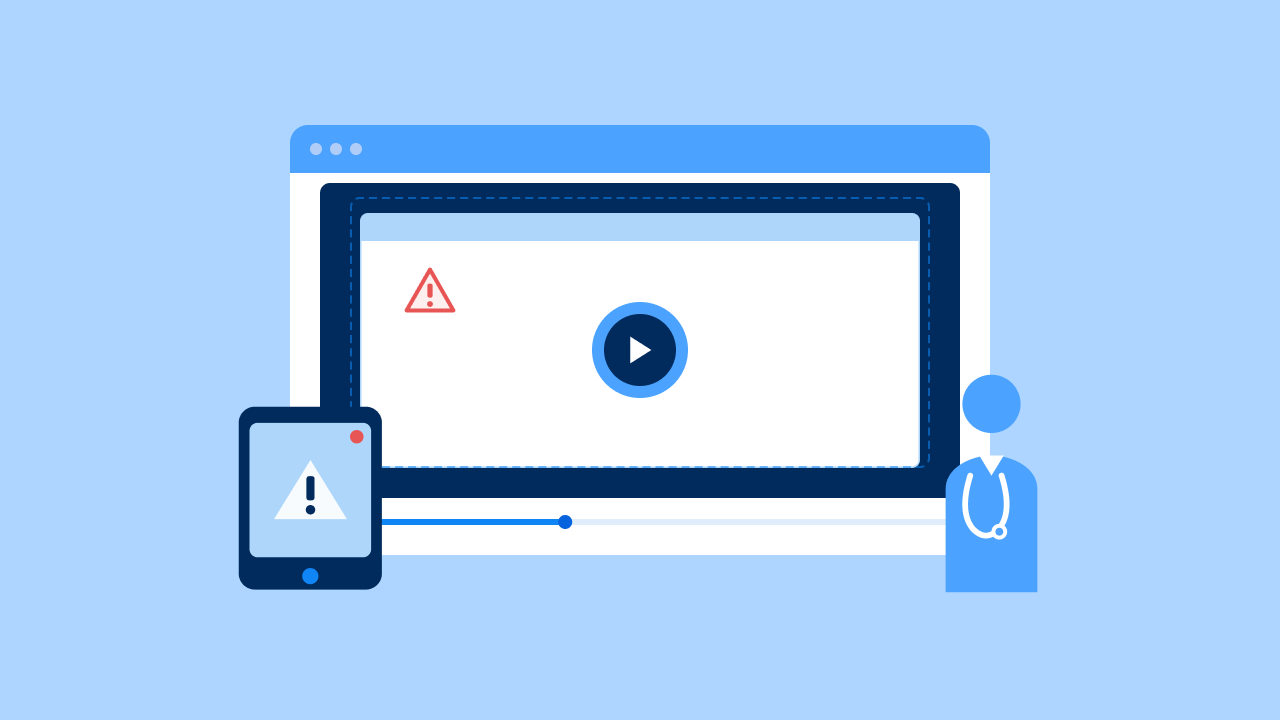
Every minute a clinician spends wrestling with a frozen EHR screen or a broken login flow is a minute they’re not spending on their core responsibilities. And every vague IT ticket that reads “the system isn’t working” launches a frustrating chain of back-and-forth messages that can drag resolution times from minutes into days. Healthcare IT troubleshooting with screen recording eliminates this cycle entirely — staff capture exactly what went wrong on their screen, share a secure link, and IT teams see the problem as clearly as if they were standing right there.
For healthcare organizations managing dozens of software systems across multiple departments and locations, this isn’t a marginal improvement. It’s a fundamental shift in how IT support operates. Teams that adopt screen recording for IT help desk workflows consistently report 60–80% reductions in ticket back-and-forth, faster mean time to resolution, and significantly less frustration on both sides of the support conversation.
In this guide, we’ll break down why traditional IT support workflows fall short in healthcare, how async screen recording solves the most painful bottlenecks, and how your team can implement this approach using HIPAA-compliant video tools for healthcare like Zight.
Why Healthcare IT Troubleshooting with Screen Recording Matters
Healthcare IT environments are uniquely complex. Unlike a typical corporate setting where IT manages a relatively uniform tech stack, healthcare organizations juggle electronic health record (EHR) systems, practice management software, telehealth platforms, medical device integrations, billing systems, secure messaging tools, and more — often from different vendors, running on different update cycles, with different user permission structures.
Now layer in the compliance dimension. Every IT interaction that touches systems containing protected health information (PHI) must be handled securely. IT teams can’t just hop on a consumer screen-sharing call or ask staff to email screenshots that might contain patient data. The tools and workflows have to be HIPAA-compliant from end to end.
This complexity creates a support environment where:
- Staff struggle to describe technical issues accurately. A nurse encountering an EHR error during charting doesn’t have the technical vocabulary to describe what happened in a way that’s immediately actionable for IT.
- IT teams waste hours on clarification. Without visual context, support staff must ask follow-up questions — What screen were you on? What did you click? What was the exact error message? — before they can even begin diagnosing the problem.
- Downtime compounds across the organization. When a software issue affects a department, every minute of unresolved downtime ripples into scheduling delays, workflow disruptions, and staff frustration.
- Compliance requirements limit tooling options. Many organizations default to slow, manual processes simply because they haven’t found a secure, compliant way to share visual context.
Healthcare IT support screen recording addresses every one of these pain points by giving staff and IT a shared visual language — one that’s fast, precise, and secure.
Common Challenges in Healthcare IT Support
Before we explore the solution, let’s get specific about the workflow problems that plague healthcare IT teams every day. These aren’t theoretical — they’re the daily reality for IT help desks supporting clinical and administrative staff.
Back-and-Forth Communication That Drains Productivity
The average IT support ticket in a healthcare organization goes through 3–5 rounds of communication before the IT team has enough information to begin solving the problem. A staff member submits a ticket saying “I can’t access the patient portal.” IT responds asking which browser they’re using, whether they’ve cleared their cache, what error message they see. The staff member responds hours later — they were in the middle of a shift. IT asks another clarifying question. And so it goes.
Each round of back-and-forth adds hours or even days to resolution time. Multiply this across dozens or hundreds of tickets per week, and you have an IT team that spends more time gathering information than actually solving problems. It’s an incredibly inefficient use of skilled technical staff.
The root cause is simple: text-based ticket descriptions are an inherently lossy way to communicate visual, sequential, context-dependent technical issues.
Misalignment Across Sites, Departments, and Shifts
Healthcare organizations rarely operate from a single location. Multi-site health systems, ambulatory networks, and organizations with remote administrative staff all face the same challenge: IT support teams can’t be physically present everywhere, and the people experiencing technical issues may be on a completely different schedule than the IT team.
A staff member at a satellite clinic encounters a software error at 7 PM. The IT help desk operates 8 AM–5 PM. By the time IT reviews the ticket the next morning, the staff member is back on shift and unavailable for a live troubleshooting call. The issue lingers for another day. In a synchronous-only support model, schedules and locations create natural bottlenecks that slow everything down.
This misalignment is especially painful when the same issue affects multiple sites differently, or when IT needs to coordinate with department-specific software administrators who have their own schedules and priorities.
Repetitive Explanations and Re-Training Cycles
Healthcare IT teams often find themselves solving the same problems repeatedly. A new EHR update changes a workflow, and suddenly 15 people across three departments submit nearly identical tickets. Each one requires individual response, individual walkthroughs, and individual follow-up. Or a recurring login issue affects a specific user role, and IT explains the same fix every time someone new encounters it.
Without a scalable way to document and distribute solutions, IT teams are trapped in a cycle of one-to-one support for issues that should be one-to-many. This isn’t just inefficient — it’s a morale problem. Highly skilled IT staff spending their days repeating the same instructions instead of working on infrastructure improvements and strategic projects.
How Async Video and Screen Recording Solve Healthcare IT Bottlenecks
Asynchronous screen recording fundamentally changes the support dynamic by replacing lossy text descriptions with rich, visual, time-stamped context. Here’s how this plays out in practice.
Staff Show the Problem Instead of Describing It
With a tool like Zight’s screen recorder, any staff member — regardless of their technical expertise — can capture exactly what’s happening on their screen. They click record, reproduce the issue, and stop recording. The result is a video that shows the exact sequence of actions, the exact error message, the exact screen state, and every piece of visual context IT needs to diagnose the problem.
No more “the system isn’t working.” Instead, IT sees a 45-second video showing that when the user clicks “Submit Order” in the EHR after selecting a specific form type, a timeout error appears with error code 504, and the page redirects to the login screen. That’s a ticket IT can resolve in one response instead of five.
IT Responds with Visual Solutions, Not Walls of Text
The efficiency gain works in both directions. Once IT diagnoses the issue, they can record their own screen showing the exact steps to fix it — clicking through menus, adjusting settings, demonstrating the correct workflow. Staff receive a video walkthrough they can follow step by step, pause and rewind as needed, and refer back to if the issue recurs.
This is dramatically more effective than a written response like “Navigate to Settings > User Preferences > Authentication, then toggle the SSO option and click Save.” Written instructions assume the user can find every element mentioned, that the interface hasn’t changed since the instructions were written, and that the user interprets every term correctly. A screen recording removes all ambiguity.
With Zight’s annotation features, IT staff can add arrows, highlights, and text callouts directly on screenshots and recordings to draw attention to specific buttons, fields, or settings — making instructions even clearer.
Async Eliminates Schedule and Location Barriers
Because screen recordings are asynchronous, the person experiencing the issue and the person solving it don’t need to be available at the same time. A staff member records the problem at 7 PM. IT reviews it at 8 AM and sends a recorded solution. The staff member watches it at noon during their break. The entire exchange happens without a single scheduled call or real-time interaction.
For multi-site healthcare organizations, this is transformational. IT teams can support staff across every location and every shift without being physically present or matching schedules. The geographic and temporal barriers that slow down synchronous support simply disappear.
Recordings Create a Searchable Knowledge Base
Every screen recording created during the support process becomes a reusable asset. When the same EHR glitch surfaces next month, IT doesn’t need to create a new response — they share the existing recording. Over time, organizations build a library of visual solutions that can be organized by system, department, or issue type.
This transforms IT support from a purely reactive function into a proactive, scalable knowledge operation. New IT team members can review past recordings to learn common issues. Staff can search for solutions before even submitting a ticket. The compounding value of a visual knowledge base is enormous.
Practical Use Cases for IT Help Desk Screen Recording in Healthcare
Let’s move from theory to specific, real-world applications. Here are the three most impactful use cases for screen recording in healthcare IT environments.
EHR Troubleshooting Video for Faster Resolution
EHR systems are the backbone of clinical operations — and the single biggest source of IT support tickets in most healthcare organizations. Common issues include:
- Pages timing out during data entry
- Forms not saving correctly or losing entered data
- Permission errors preventing access to specific modules
- Integration failures between the EHR and lab, pharmacy, or imaging systems
- Slow performance during peak usage hours
- Incorrect data displaying after system updates
Every one of these issues is difficult to describe in text and trivial to capture on video. An EHR troubleshooting video shows IT exactly what happened, in what order, on what screen, with what data visible (or not visible). IT staff can often identify the root cause within seconds of watching the recording — something that might take days of back-and-forth communication through traditional ticket systems.
For organizations using Zight, these recordings are shared via secure, expiring links with access controls — so even if the screen happened to capture sensitive system information, the recording remains protected within a HIPAA-compliant framework.
Staff Training and Onboarding
Healthcare organizations hire and onboard new staff continuously. Each new hire needs to learn how to navigate the organization’s specific software stack — which often includes customized EHR workflows, unique billing procedures, organization-specific communication tools, and department-level applications.
Traditionally, this training happens through live sessions, shadowing, or dense written documentation. All three approaches have significant limitations: live sessions require scheduling and a trainer’s time; shadowing is inefficient and inconsistent; written docs become outdated quickly and are hard to follow for visual software workflows.
Screen recording transforms training into a scalable, consistent, and always-available resource. IT teams and department leads can record:
- Step-by-step EHR navigation walkthroughs for specific roles
- How to set up and configure workstations
- Security and compliance procedures (password management, two-factor authentication setup)
- Common workflows in billing, scheduling, and practice management software
- How to use the organization’s communication and collaboration tools
New hires watch these recordings at their own pace, rewind confusing sections, and revisit them weeks later when they encounter something unfamiliar. The result: faster time to proficiency, fewer support tickets from new staff, and dramatically less trainer time required per hire.
Internal Documentation and Process Standardization
Healthcare organizations are constantly updating processes — driven by software updates, regulatory changes, new vendor integrations, or workflow optimization initiatives. Communicating these changes across a distributed workforce is one of IT’s most persistent challenges.
Screen recordings serve as living documentation. When a process changes, a quick 2-minute recording showing the new workflow replaces a 3-page written document that nobody reads. IT can record:
- Software update walkthroughs showing what’s changed and how it affects daily workflows
- New security procedures and compliance requirements
- Configuration changes that affect specific departments or user roles
- Troubleshooting guides for known issues after system migrations
These recordings can be distributed via email, embedded in internal wikis, or linked directly from IT ticket auto-responses. They ensure every staff member across every site receives the same accurate, visual explanation — eliminating the inconsistency that comes from verbal pass-down or department-level interpretation of written instructions.
Best Practices for Healthcare IT Screen Recording
Implementing screen recording in a healthcare IT environment requires thoughtful planning around security, workflow integration, and team adoption. Here are operational best practices to ensure your program succeeds.
1. Choose a HIPAA-Compliant Tool with a Signed BAA
This is non-negotiable. Any screen recording tool used in a healthcare environment must offer HIPAA-compliant infrastructure, including encryption in transit and at rest, access controls, audit logging, and a signed Business Associate Agreement (BAA). Consumer screen recording tools — even popular ones — do not meet these requirements.
Zight is purpose-built for this use case, offering AES-256 encryption, role-based access controls, automatic link expiration, and a signed BAA as part of its healthcare video communication solutions.
2. Establish Clear Recording Guidelines for Staff
Train staff on what to record and what to avoid. Best practices include:
- Focus on the workflow, not the data. When recording an EHR issue, staff should use test or demo environments when possible. If recording in a live environment is necessary, ensure PHI is minimized and the recording tool’s security controls are properly configured.
- Keep recordings concise. Most IT issues can be demonstrated in 30–90 seconds. Encourage staff to start recording just before reproducing the issue and stop immediately after.
- Include verbal narration. A brief spoken explanation (“I’m clicking Submit and getting this error”) adds valuable context without extending recording length.
- Close unnecessary tabs and applications before recording to reduce the chance of capturing unrelated sensitive information.
3. Integrate Screen Recording into Your Ticketing System
Screen recording delivers maximum value when it’s embedded in your existing IT support workflow — not bolted on as an afterthought. Configure your ticketing system to:
- Include a “attach screen recording” prompt in the ticket submission form
- Accept secure video links as attachments
- Tag tickets that include video for priority routing (since video-equipped tickets typically resolve faster)
- Link resolved tickets to their associated recordings for future reference
The goal is to make recording and sharing a screen capture as natural as typing a ticket description — and ideally, to make it the preferred method for reporting visual issues.
4. Build a Visual Solutions Library
Don’t let valuable recordings disappear into closed tickets. Create a structured library of solution recordings organized by:
- System (EHR, billing software, telehealth platform, etc.)
- Issue type (login, performance, integration, configuration)
- Department or user role
- Date created (so outdated recordings can be identified and refreshed)
Make this library accessible to both IT staff and end users. Many common issues can be self-resolved by staff who find the right video walkthrough — reducing ticket volume and freeing IT for more complex work.
5. Set Expiration and Access Controls on Every Recording
Healthcare IT recordings may inadvertently capture system configurations, user credentials on screen, or other sensitive operational information. Protect these recordings by:
- Setting automatic expiration dates on shared links
- Restricting access to authorized personnel only
- Using password-protected links for recordings shared outside the IT team
- Regularly auditing and purging recordings that are no longer needed
Zight’s access controls and link expiration features make it straightforward to enforce these practices without adding friction to the recording and sharing workflow.
6. Track Metrics and Demonstrate ROI
To build organizational support for screen recording adoption, track key metrics before and after implementation:
- Average ticket resolution time — expect 60–80% reduction for video-equipped tickets
- Number of back-and-forth messages per ticket — expect a drop from 3–5 to 1–2
- Ticket volume — should decrease as the solutions library grows and staff self-serve
- Staff satisfaction scores — both IT team and end users typically report higher satisfaction
- Training time per new hire — should decrease measurably as recorded content replaces live sessions
These metrics make the business case concrete and help justify ongoing investment in the tooling and processes.
Why Zight Is the Right Tool for Healthcare IT Screen Recording
Not all screen recording tools are built for healthcare. Most consumer and general-purpose tools lack the security infrastructure, compliance certifications, and workflow integrations that healthcare IT teams require. Zight is a HIPAA-compliant async video and screen recording tool for healthcare teams to communicate, train, and troubleshoot securely.
Here’s what sets Zight apart for IT help desk screen recording in healthcare:
- HIPAA-compliant infrastructure with a signed Business Associate Agreement (BAA)
- AES-256 encryption for recordings in transit and at rest
- Granular access controls — restrict who can view, download, or share recordings
- Automatic link expiration to prevent indefinite access to sensitive recordings
- One-click screen recording that any staff member can use without technical training
- Annotation tools for adding visual callouts, arrows, and highlights to screenshots and recordings
- Instant secure sharing via link — no file uploads, no email attachments, no compliance headaches
- Cloud-based organization for building and maintaining a solutions library
Zight is designed to slot into existing IT workflows with minimal disruption. Staff don’t need to learn a complex new system — they click record, capture the issue, and share. IT teams get the visual context they need to resolve issues faster, and the entire exchange stays within a HIPAA-compliant framework.
Conclusion: Transform Your Healthcare IT Support with Screen Recording
Healthcare IT teams are under immense pressure to support increasingly complex technology environments while maintaining strict compliance standards and keeping staff productive. The traditional model of text-based support tickets, live troubleshooting calls, and written documentation is simply not keeping up.
Healthcare IT troubleshooting with screen recording offers a fundamentally better approach. Staff capture issues visually in seconds. IT teams diagnose problems from a single recording instead of five email exchanges. Solutions are documented as reusable video assets that scale across departments, sites, and shifts. And the entire workflow stays secure and HIPAA-compliant.
The organizations that adopt this approach aren’t just resolving tickets faster — they’re building more efficient, more scalable, and less frustrating IT support operations from the ground up.
Ready to see how async screen recording can transform your healthcare IT support? Explore Zight for healthcare teams and discover how secure video workflows can help your organization resolve issues faster, train staff more effectively, and reduce IT support costs — all within a HIPAA-compliant framework.