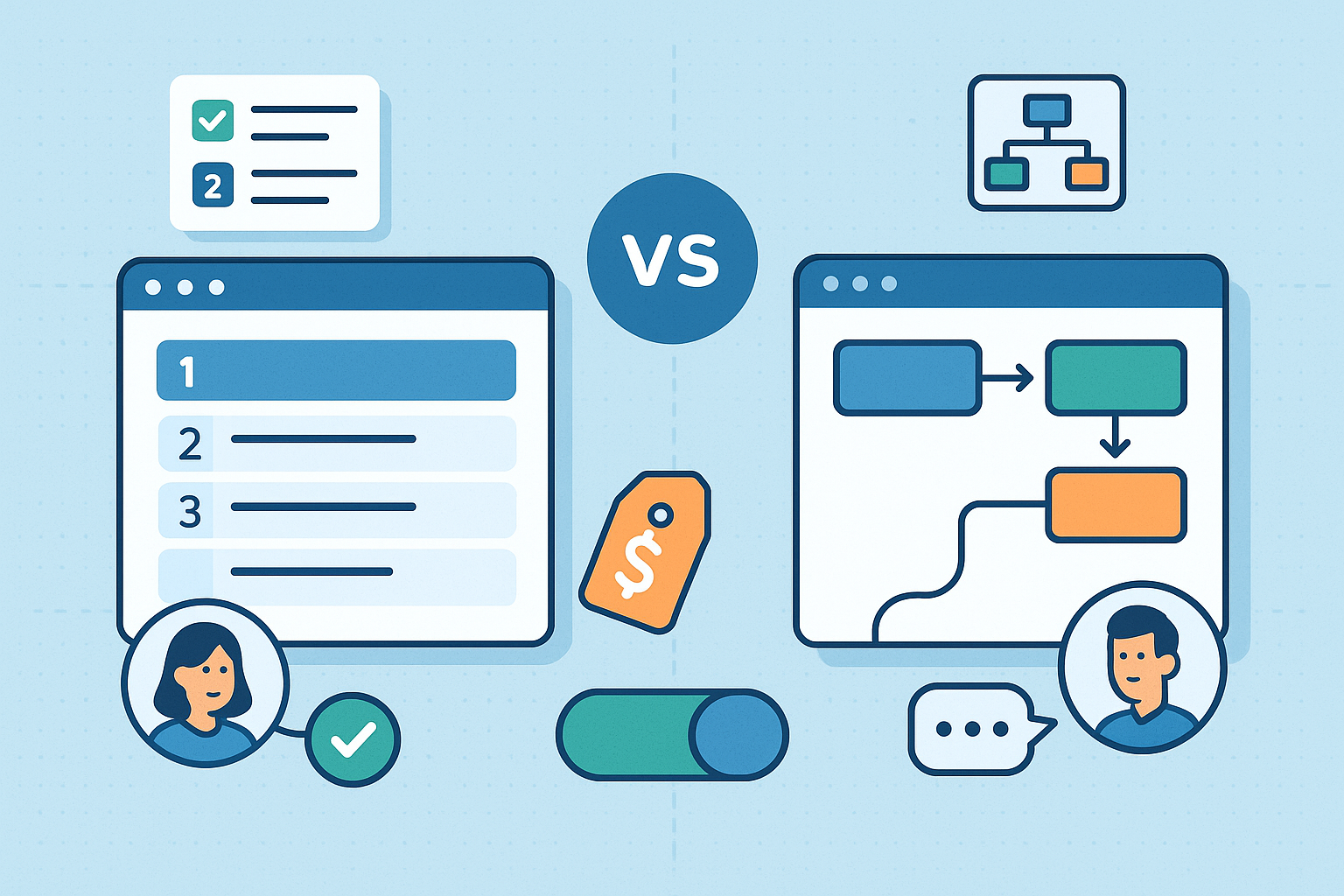
- Zight: Focuses on screen recordings, turning them into visual guides with screenshots, annotations, and video editing tools. It’s great for visual content like tutorials and training materials. Starts at $7.95/month.
- Scribe: Tracks browser actions to create process-driven guides with annotated screenshots and detailed instructions. Excellent for workflow documentation and compliance. Starts at $23/month for individuals.
| Feature | Zight | Scribe |
|---|---|---|
| Content Creation | Screen recordings with visuals | Browser activity tracking |
| Editing Options | Full video editing suite | Text and screenshot editing |
| Export Formats | PDFs, Zendesk articles | PDFs, HTML, Markdown |
| Platform Support | Mac, Windows, iOS | Chrome, Edge |
| Pricing | Starts at $9/month | Starts at $23/month |
Zight Overview
 Zight is a platform designed to simplify visual communication and streamline the process of creating step-by-step documentation. Trusted by over 5 million users globally, it combines screen recording, AI-driven automation, and seamless sharing tools to make documentation faster and easier. One standout feature is Zight’s automatic breakdown technology. While recording your screen, it detects clicks and actions, instantly transforming them into organized guides with matching screenshots. This means you no longer have to manually capture and arrange steps. After recording, simply click on “AI Summary” and choose “Step-by-Step Guide” to generate clear, editable documentation complete with inline visuals. Here’s what users are saying about Zight:
 “Zight allows me to put together training and troubleshooting materials, reduce in-person meetings and trainings, and AI helps me quickly organize videos and turn them into print user guides.”Zight is used across industries to create standard operating procedures, onboarding guides, bug reports, tutorials, and internal documents. These guides can be exported as formatted text, saved as PDFs, or even published directly to Zendesk as help center articles. With this comprehensive approach, Zight makes the documentation process both efficient and user-friendly.
- Edward Wikstrom, Director of Technology, St. Dominic High School
Zight Key Features
Zight supports the entire documentation process – from capturing content to distributing it. Its toolkit includes screen capture, video editing, AI transcription, and smart summaries. The platform also integrates with popular tools like Slack, Microsoft Teams, and Jira for instant sharing. Users can record unlimited videos in resolutions up to 4K, create GIFs, and even use webcam recordings for more personalized training materials. AI-powered features further enhance efficiency by generating smart titles, transcribing recordings, and creating meeting notes – all of which save time on post-recording tasks. For added customization, Zight includes built-in editing tools that let you trim, merge, and annotate recordings using arrows, text boxes, and highlights to create detailed, step-by-step instructions.Zight Platform Support and Pricing
Zight works across multiple devices, offering support for Mac, Windows, Chrome, and iOS. Its pricing plans cater to a variety of users:| Plan | Price | Key Features | Best For |
|---|---|---|---|
| Free | $0/year | Basic screenshot and recording tools, 15-second GIF creation, annotations, simple editing; access to last 50 uploads | Individuals testing the platform |
| Pro | $9/month | Unlimited uploads, unlimited recording time, 4K recording, advanced editing tools | Professionals and freelancers |
| Team | $11/month/user | Pro features plus basic analytics, user management, and team workspace | Small to medium teams |
| Enterprise | Custom Quote | Team features plus enterprise-grade security, SSO, and advanced analytics | Large organizations |
“Quality software product with amazing value for money and huge time-saver.”
- Megha M, Research Consultant
“I know this software doesn’t cost a lot, but I love how easy it is to use and I use it daily, in fact, multiple times a day. I can’t imagine my life without it.”
- Ken S, Account Manager
Scribe Overview
 Scribe, much like Zight, simplifies the process of creating documentation by turning everyday tasks into detailed step-by-step guides. It automatically records user actions – such as clicks, form inputs, and navigation – and generates annotated guides in real time. Its AI handles everything from crafting precise descriptions to annotating screenshots for each step, making documentation quick and efficient. The results speak for themselves. Scribe has been shown to dramatically cut the time spent on documentation. For example, Crosscard’s sales operations manager slashed documentation time by 93%, while Crexi’s team reduced client response times by 70%.
 “Scribe is the greatest software I’ve ever used. Documentation that used to take me multiple hours now take me 15-20 minutes.”Scribe also supports customization, allowing users to edit text, modify screenshots, redact sensitive information, and even add branding elements.
- Dave Garrigan, Senior Apple Technical Analyst
Scribe Core Features
Scribe builds on its automated capture system with a robust set of tools designed to streamline the creation of guides. The platform automatically creates step-by-step guides for both web and desktop applications by capturing on-screen activities like clicks and form interactions. These guides include detailed instructions paired with annotated screenshots. Users can personalize their guides with custom branding, additional text, and edits. Sharing is simple, with options for shareable links, embedded content, or exporting in formats like HTML, Markdown, or PDF. For added convenience, Scribe offers a Chrome extension, enabling users to document processes instantly without installing extra software. This ease of use encourages frequent adoption. On average, the AI automation can save users up to 20 hours per month. Some organizations have reported that Scribe speeds up documentation by 75% while reducing errors by 98%.Scribe Platform Support and Pricing
Scribe operates through browser extensions for Chrome and Edge, making it accessible across multiple operating systems. It also integrates with widely used tools like Confluence, Notion, Microsoft SharePoint, 360Learning, Airtable, Bigtincan, and ClickUp. Scribe offers several pricing tiers to suit different user needs:| Plan | Price | Key Features | Best For |
|---|---|---|---|
| Basic | Free | Works with web apps, basic customization, shareable links and embeds | Individuals exploring the platform |
| Pro Personal | $23/month (annual) or $29/month (monthly) | Web, mobile, and desktop support, branding options, screenshot editing, PDF/HTML/Markdown export | Professionals needing advanced features |
| Pro Team | $12/month per user (annual, 5-user minimum) or $15/month per user (monthly) | Includes Pro Personal features plus team collaboration and multiple workspaces | Small to medium teams |
| Enterprise | Custom pricing | Advanced tools like automatic redaction of sensitive data, enterprise-grade governance, SSO, and centralized management | Large organizations |
“Scribe helps me educate the team on new processes and drive consistency in a way that would have been impossible to do across a global team exclusively through live trainings.”
- Seth, Head of Global Sales Development at Talon.One
Feature Comparison
When deciding between Zight and Scribe for creating step-by-step documentation, understanding their strengths and differences can help you choose the right tool for your workflow. Both platforms automate documentation, but their methods for capturing, editing, and sharing content vary significantly. Let’s break it down. Content Creation Methods Zight transforms screen recordings into detailed visual guides, automatically breaking them into individual steps with corresponding screenshots. On the other hand, Scribe focuses on browser activity, capturing user actions like clicks, form inputs, and navigation in real time. AI-Powered Features Zight goes beyond basic documentation by offering AI-driven transcriptions in multiple languages and content summaries, adding another layer of automation. Scribe, while also AI-enabled, primarily focuses on generating step-by-step guides. Editing Capabilities Zight provides robust editing tools, allowing users to reorder steps, tweak content, and even edit videos. Its video editing features include trimming, cropping, adding filters, merging clips, and annotating screenshots [13, 20]. Scribe, meanwhile, offers tools for text editing, modifying screenshots, and redacting sensitive information, keeping its focus within a browser-based workflow. Integration Ecosystem Zight integrates with over 80 platforms, including Salesforce, HubSpot, Slack, Microsoft Teams, Asana, Monday.com, Jira, and Confluence. These integrations streamline workflows and enhance team productivity. Scribe, on the other hand, emphasizes embedding guides into knowledge bases and learning management systems, supporting tools like Confluence, Notion, and Microsoft SharePoint.Comparison Table
| Feature | Zight | Scribe |
|---|---|---|
| Content Creation | Converts screen recordings into visual guides | Captures browser activity in real time |
| Screenshot Capture | Automatic with annotation tools | Automatic with basic editing options |
| Editing Options | Full video editing suite; reorderable steps | Text and screenshot editing, redaction |
| AI Features | Transcriptions, summaries, step-by-step guides | Automated guide creation |
| Export Formats | Formatted text, PDFs, Zendesk articles | HTML, PDFs, Markdown, shareable links |
| Recording Types | Screen, webcam, GIF creation | Browser-based screen activity only |
| Platform Support | Mac, Windows, Chrome, iOS | Chrome and Edge extensions |
| Third-Party Integrations | 80+ platforms, including Salesforce, HubSpot, Slack | Focused on knowledge bases and LMS tools |
sbb-itb-5d91f01
Usability and Workflow Integration
Ease of Use and Getting Started
Both platforms are designed with user-friendliness in mind, but they take distinct approaches to simplify the documentation process. Zight specializes in visual communication, automatically converting screen recordings into step-by-step guides. As you record, the platform detects your clicks and actions, organizing them into structured, easy-to-follow instructions – no manual effort required. Once the guide is generated, users can tweak and reorder steps to refine their documentation, blending automation with flexibility. Scribe, on the other hand, captures user actions like clicks, form inputs, and navigation in real time, making it easier to document processes as they happen. With a user base of over 4 million spanning 600,000 organizations and a stellar 4.8/5 rating on G2, TrustPilot, Chrome Store, and Capterra, Scribe has proven to be accessible for users of all technical backgrounds. Impressively, 98% of Scribe users report reducing errors in their documentation, highlighting its reliability.Team Collaboration and Tool Integration
When it comes to collaboration and integration, both platforms shine but in slightly different ways. Zight positions itself as a visual communication hub, integrating seamlessly with tools like Slack, Microsoft Teams, Jira, and Confluence. This allows teams to share screen recordings, GIFs, and annotated screenshots directly within their existing communication channels, enhancing workflow fluidity. Scribe takes a more focused approach, targeting platforms where documentation is naturally housed. It connects with tools like Microsoft Teams and Confluence, enabling users to embed guides directly into these knowledge management systems. Each platform minimizes disruptions to existing workflows but does so in unique ways. Zight enhances communication by incorporating rich media elements into daily tasks, while Scribe focuses on capturing and standardizing processes that teams are already performing. Operations teams, in particular, find these tools invaluable. As Adahli Curry shared in a Chrome Store review:“Easy to use, intuitive, and a big time saver!! All around a no brainer if you are on any operations team that needs to create SOPs.”These seamless integrations pave the way for smooth documentation sharing, which we’ll delve into next.
Managing and Sharing Documentation
Building on streamlined collaboration and integration, efficient management and sharing take documentation to the next level.Organization and User Permissions
Managing documentation effectively starts with a solid organizational structure that can adapt to a team’s needs. Zight tackles this with its Collections feature, which allows users to group related guides for easier access, management, and sharing. This is especially useful for teams working on multiple guides tied to similar projects or workflows, as it simplifies finding and organizing relevant content. For larger organizations, Zight offers an additional layer of control through Groups, which helps manage team hierarchies and security settings. However, this feature is exclusive to Enterprise plans, potentially limiting its availability for smaller teams. On the other hand, Scribe centralizes all documentation within a unified dashboard, making it easy to access everything in one place. Its team-based system organizes documents by roles and projects, ensuring that the right people have access to the right information. This structure is particularly helpful for larger organizations where departments may need tailored access to specific documentation. Scribe also provides intuitive filtering options, allowing users to sort documents into categories like Shared, Private, or Saved. This setup makes it simple to locate specific guides, even in extensive document libraries, by offering immediate clarity on accessibility and ownership.Sharing Options and Usage Analytics
Both platforms excel in sharing capabilities but differ in their approach to distribution and access control. Zight offers two main sharing methods: share links, which create accessible pages that auto-expand in tools like Slack, and embed codes for integrating content directly into webpages via HTML iframes. This flexibility ensures teams can share documentation through their preferred communication channels without requiring recipients to leave their current platforms. Scribe, however, provides more detailed sharing options with four distinct permission levels. Users can invite team members with customizable view or edit rights, share URLs via email or chat, and embed content into other tools. One standout feature is the “Shareable with Link” option, which allows anyone with the link to view the document – even without a Scribe account. Scribe’s permission settings include “Not Shared” for private documents, “Shared with Team” with adjustable permissions, and “Organization” access for Enterprise users, which requires authentication. For email sharing, Scribe applies a “Restricted” setting by default to enhance security. When it comes to tracking performance, both platforms provide analytics tools to gauge how documentation is used. Zight offers metrics on views, engagement, and overall content performance. Users on Pro, Team, and Enterprise plans can see up to 200 logged-in viewers, while Enterprise users can export these analytics as CSV files for deeper insights. Scribe focuses on actionable data, showing who views and completes guides and tracking engagement over time. These insights help measure productivity improvements, such as users resolving questions 67% faster and teams reporting a 25% boost in productivity. The real-world impact of effective documentation sharing is evident in user feedback. Elizabeth Wood, Director of Strategy & Innovation, shared:“I’m obsessed with Scribe. It’s saving me so much time, my boss thinks I’m a genius, and I’m able to provide better support to my colleagues.”These analytics tools go beyond basic tracking. They help teams understand not just who is accessing their documentation, but also how well it meets their needs, paving the way for continuous improvement in knowledge sharing.
Conclusion
Both Zight and Scribe are excellent tools for creating step-by-step documentation, but they cater to different organizational needs and priorities. Zight is a standout choice for teams that rely heavily on visual communication. With its powerful video storage, advanced screen recording features, and support for multimedia-rich content like screenshots, videos, and GIFs, Zight is perfect for creating detailed visual guides. It also offers customizable annotations and thumbnails, making it especially useful for technical teams, customer support, and training departments that need to deliver polished and engaging visual documentation. On the other hand, Scribe shines when it comes to process documentation and workflow optimization. By significantly cutting documentation time and minimizing errors, Scribe boosts overall productivity. Its built-in redaction features make it an excellent fit for organizations with strict compliance requirements. In fact, many users have reported achieving 98% procedure compliance after adopting Scribe, highlighting its role in maintaining standardized processes. In summary, Zight is ideal for creating visually rich content such as bug reports, product demos, and customer support materials. Its Pro plan, priced at $7.95 per month, offers unlimited recording capabilities, making it a cost-effective solution for teams needing quick and comprehensive visual documentation. Meanwhile, Scribe is better suited for organizations focused on precise, process-driven guides, employee onboarding, and standardized procedures. Users have reported impressive results, including a 90% reduction in documentation time and a 93% decrease in time spent responding to customer inquiries. When deciding between the two, consider whether your team prioritizes visually engaging content or streamlined process documentation. Your choice should ultimately reflect your workflow and content needs.FAQs
How does Zight use AI to simplify creating step-by-step guides?
Zight uses AI to simplify the process of creating step-by-step guides. By transforming screen recordings into neatly organized documentation, it captures essential moments, generates screenshots, and arranges the content logically for easy understanding. This automated approach removes the hassle of manual editing, helping you save time while maintaining accuracy and a professional finish. It’s a quick and effective way to produce polished tutorials with minimal work.How does Zight’s integration with Slack and Microsoft Teams improve team collaboration?
Zight works seamlessly with Slack and Microsoft Teams, simplifying team communication by allowing users to share video recordings, annotated screenshots, and GIFs directly within these platforms. This eliminates the hassle of lengthy explanations and ensures everyone is on the same page during discussions. By incorporating AI-powered tools like summaries and transcriptions, Zight makes it easier to break down complex information. These features help teams stay aligned, make quicker decisions, and collaborate more effectively – all within the platforms they already rely on every day.What are Zight’s pricing plans, and what features are included in each?
Zight provides pricing options designed to suit various needs, starting at $7.95 per month. Here’s a breakdown of the plans:- Pro: Perfect for individuals, offering unlimited usage.
- Teams: Priced at $8.00 per user per month, tailored for seamless team collaboration.
- Enterprise: Custom pricing for larger organizations requiring advanced features.