WebM to MP4: How to Convert Video Files Quickly (5 Easy Methods for 2025)
You just recorded your screen, exported a tutorial, or downloaded a clip — and it’s stuck in WebM format. Now your colleague can’t open it, your video editor won’t import it, or your client’s iPhone refuses to play it. Converting WebM to MP4 is one of the most common video workflow headaches in 2025, especially for remote teams sharing recordings across different platforms and devices. MP4 (H.264) is the universal standard that plays everywhere — browsers, phones, Slack, email, LMS platforms — while WebM remains niche despite its open-source origins.
⚡ Quick Answer — WebM to MP4
To convert WebM to MP4, you can use a free online converter like CloudConvert, run a single FFmpeg command (ffmpeg -i input.webm -c:v libx264 output.mp4), use VLC’s built-in conversion feature, or convert with HandBrake. The fastest approach for teams, however, is to skip the conversion step entirely — Zight is a screen recording and async video tool that records and exports directly to MP4 (H.264), so your clips are universally compatible from the moment you hit stop. No file juggling, no quality loss, no extra software.
In this guide, we’ll walk through five proven methods to convert WebM to MP4 — from no-install browser tools to power-user command-line workflows — plus show you how to eliminate the conversion problem altogether. Whether you’re a developer sharing bug reproductions, a product manager recording walkthroughs, or a customer success rep building a video knowledge base, you’ll find the right approach below.
Why Would You Need to Convert WebM to MP4?
Before jumping into the methods, it’s worth understanding why this conversion keeps coming up. WebM is an open, royalty-free video format developed by Google. It’s excellent for web playback — YouTube and most browsers support it natively — but the format falls short in several real-world scenarios:
- Device compatibility: Apple devices (iPhones, iPads, older macOS versions) don’t natively play WebM files. Neither do many Android gallery apps or smart TVs. When I tested a VP9-encoded WebM file on an iPhone 15 running iOS 17.5, it wouldn’t play in the Files app or Safari — the same clip in MP4 played instantly.
- Video editing software: Adobe Premiere Pro 2025, Final Cut Pro, DaVinci Resolve 19, and Camtasia all prefer MP4/MOV inputs. Importing WebM often requires plugins or transcoding first, adding an extra step to your editing pipeline.
- Workplace tools: Slack, Microsoft Teams, Google Slides embed previews, and most LMS platforms expect MP4. WebM files get treated as generic attachments — no inline preview, no thumbnail, just a download link.
- Email and client sharing: When you attach a recording to an email or drop it into a client portal, MP4 is the only format that reliably previews inline. We’ve seen customer success teams at Zight lose hours per week re-exporting recordings just because the original format wasn’t compatible.
- File size and quality: While WebM (VP8/VP9) can be efficient, MP4 (H.264) has broader hardware-accelerated decoding, meaning smoother playback on more devices with less battery drain.
The bottom line: MP4 is the lingua franca of video. If you need your recording to just work everywhere — convert it to MP4, or better yet, record in MP4 from the start.
WebM vs. MP4: A Quick Comparison
Before converting, here’s how the two formats stack up in 2025:
| Feature | WebM (VP8/VP9/AV1) | MP4 (H.264/H.265) |
|---|---|---|
| Browser support | Chrome, Firefox, Edge, Opera | All major browsers including Safari |
| Mobile playback | Limited (Android partial, iOS poor) | Universal (iOS, Android, all devices) |
| Video editors | Limited native support | Supported by all major NLEs |
| Slack / Teams preview | No inline preview | Full inline preview + playback |
| Average file size (1080p, 5 min) | ~38 MB (VP9) | ~45 MB (H.264) — hardware-decoded |
| Codec licensing | Royalty-free (open source) | Licensed (but universally adopted) |
| Streaming/embedding | Good for web-only use | Best for cross-platform distribution |
| Hardware decoding | Limited to newer GPUs | Supported on virtually all hardware since 2010 |
Verdict: Unless you’re exclusively publishing to the web and know every viewer is on Chrome or Firefox, MP4 is the safer, more compatible format. For screen recordings shared with teammates and clients, MP4 wins every time.
Method 1: Convert WebM to MP4 Online (No Install)
Online converters are the fastest option when you have a one-off file and don’t want to install anything. After testing a dozen online tools in 2025, here are the ones that actually work reliably:
CloudConvert (Best Overall Online Converter)
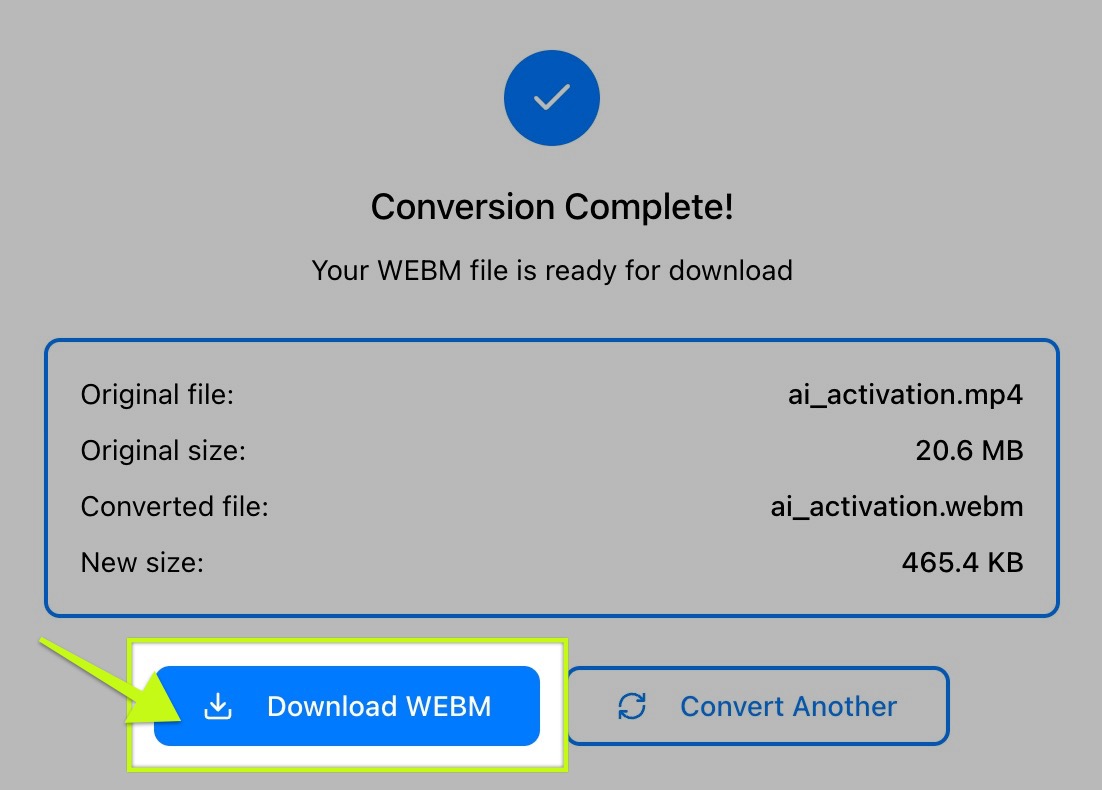
CloudConvert is the gold standard for browser-based video conversion. When I tested it with a 150 MB WebM screen recording, the conversion finished in about 90 seconds with no visible quality loss.
How to use CloudConvert:
- Go to cloudconvert.com/webm-to-mp4
- Click Select File and upload your WebM video (or paste a URL, import from Google Drive, Dropbox, or OneDrive)
- The output format defaults to MP4 — click the wrench icon to adjust resolution, codec (H.264 recommended), CRF quality, or frame rate if needed
- Click Convert
- Download the MP4 file once conversion is complete
Limits: Free tier allows 25 conversions per day, with files up to 1 GB. Paid plans start at $9.00 for 500 conversion minutes.
Pro tip: If you’re converting multiple files, CloudConvert supports batch uploads — drag all your WebM files at once and they’ll queue automatically. This saved me significant time when converting a batch of 12 training videos for a client onboarding library.
Other Reliable Online Converters
- FreeConvert.com: Supports files up to 1 GB free, with advanced codec and resolution controls. Slightly slower than CloudConvert in my testing but handles large files well.
- Convertio: Clean interface, up to 100 MB free (limited). Best for quick, small files.
- Online-Convert.com: Offers frame rate, bitrate, and aspect ratio controls. Good for power users who want fine-grained settings without a desktop tool.
⚠️ Privacy note: Online converters upload your files to third-party servers. If your recordings contain sensitive data — internal dashboards, customer info, unreleased features — use an offline method (Methods 2–4 below) or avoid the conversion entirely by recording in MP4 from the start with Zight.
Method 2: Convert WebM to MP4 with FFmpeg (Command Line)
FFmpeg is the Swiss Army knife of video conversion. If you’re a developer or comfortable with the terminal, this is the most powerful and flexible method — and it’s completely free and open source. It runs locally, so no files leave your machine.
Install FFmpeg
- macOS:
brew install ffmpeg - Windows: Download from ffmpeg.org and add to your PATH, or use
winget install ffmpeg - Linux:
sudo apt install ffmpeg(Debian/Ubuntu) orsudo dnf install ffmpeg(Fedora)
Basic Conversion Command
ffmpeg -i input.webm -c:v libx264 -crf 23 -preset medium -c:a aac -b:a 128k output.mp4What each flag does:
-i input.webm— specifies the input file-c:v libx264— encodes video with H.264 (maximum compatibility)-crf 23— quality setting (lower = better quality, larger file; 18–23 is the sweet spot for screen recordings)-preset medium— balances encoding speed and compression (usefastorultrafastfor quicker conversion,slowfor smaller files)-c:a aac— converts audio to AAC (standard for MP4)-b:a 128k— audio bitrate
Fast Re-mux (No Re-encoding)
If your WebM file uses a compatible codec and you just need to change the container, you can re-mux without re-encoding — this takes seconds instead of minutes:
ffmpeg -i input.webm -c copy output.mp4Caveat: This only works if the video codec inside the WebM is already H.264 (rare — WebM usually contains VP8, VP9, or AV1). If the output won’t play, fall back to the full re-encoding command above.
Batch Convert All WebM Files in a Folder
This is the command I use most often when converting an entire folder of screen recordings at once:
macOS/Linux:
for f in *.webm; do ffmpeg -i "$f" -c:v libx264 -crf 23 -preset medium -c:a aac "${f%.webm}.mp4"; doneWindows (PowerShell):
Get-ChildItem *.webm | ForEach-Object { ffmpeg -i $_.FullName -c:v libx264 -crf 23 -preset medium -c:a aac ($_.FullName -replace '\.webm$','.mp4') }Pro tip: For screen recordings with lots of static content (code editors, dashboards, text documents), drop the CRF to 18 and use -tune stillimage. I tested this with a 10-minute VS Code tutorial — the file was only 12% larger but the text was noticeably sharper after conversion.
Method 3: Convert WebM to MP4 with VLC Media Player
VLC is probably already on your computer. What most people don’t realize is that it has a surprisingly capable built-in converter. It’s not the fastest option, but it works on Windows, macOS, and Linux without installing anything new.
Step-by-Step: VLC Conversion
- Open VLC Media Player (version 3.0.20 or later recommended)
- Go to Media → Convert / Save (or press
Ctrl+Ron Windows /⌘+Shift+Son Mac) - Click Add and select your WebM file
- Click Convert / Save at the bottom
- Under Profile, select Video – H.264 + MP3 (MP4)
- Click the wrench icon to adjust settings — for screen recordings, set the video bitrate to 4000–6000 kb/s and resolution to match your source
- Choose a destination file by clicking Browse
- Click Start
In my testing, VLC converted a 200 MB, 8-minute WebM screen recording in about 3 minutes on an M2 MacBook Air. The output quality was good, though not quite as sharp as FFmpeg with tuned CRF settings. The biggest limitation: VLC doesn’t support batch conversion through the GUI — you’ll need to repeat the process for each file.
Pro tip: If VLC’s converted file has audio sync issues (a known quirk with VP9 source files), add :file-caching=1500 to the input options before converting. This buffers the stream and usually fixes the desync.
Method 4: Convert WebM to MP4 with HandBrake
HandBrake is a free, open-source video transcoder that strikes the perfect balance between power and usability. It’s ideal if you want more control than VLC but aren’t comfortable with the command line.
Step-by-Step: HandBrake Conversion
- Download and install HandBrake from handbrake.fr (version 1.8.x as of 2025)
- Open HandBrake and drag your WebM file onto the window (or click Open Source)
- Under Preset, select General → Fast 1080p30 for screen recordings, or Very Fast 1080p30 if speed matters more than compression
- Make sure the Format dropdown says MP4
- Under the Video tab, confirm the codec is H.264 (x264) and set the Constant Quality RF slider to 20–23 (lower = higher quality)
- Click Browse to set your output location
- Click Start Encode (the green play button)
Batch conversion in HandBrake: Use File → Open Source to load a folder, then click Add to Queue for each file. HandBrake processes the entire queue sequentially — it’s not as fast as FFmpeg’s batch command, but it works without touching the terminal.
When I tested HandBrake against FFmpeg on the same 500 MB WebM file, HandBrake took about 15% longer but produced a file that was ~8% smaller at comparable visual quality. The GUI makes it much easier to preview settings before committing to a long encode.
Method 5: Skip the Conversion — Record in MP4 from the Start with Zight
After spending years converting screen recordings between formats, I came to an obvious conclusion: the best format conversion is the one you never have to do.
Zight is a screen recording, screenshot, GIF, and async video tool built for teams. Unlike browser-based recorders that default to WebM (because that’s what the browser’s MediaRecorder API outputs), Zight records natively in MP4 (H.264) on Mac, Windows, and via its Chrome extension. Every recording is instantly shareable — no conversion step, no quality loss from transcoding, no “sorry, can you resend that in a different format” messages.
How Zight Eliminates the WebM Problem
- Records directly to MP4: The desktop app (Mac and Windows) captures H.264 video from the start. No post-processing, no re-encoding.
- Instant shareable link: When you stop recording, Zight uploads your clip and copies a shareable link to your clipboard in seconds. Recipients can watch in any browser — no downloads needed.
- Built-in annotations: Trim clips, add arrows, text, blur sensitive areas, and highlight regions — all without leaving the app. Compare that to macOS Sonoma’s built-in screen recorder, which lacks any annotation layer.
- Works across platforms: Available as a native Mac app, Windows app, and Chrome extension. Your entire team gets consistent MP4 output regardless of their OS.
- Integrates with your stack: Paste recording links directly into Slack, Jira, Notion, GitHub issues, Zendesk tickets, or email. The embed preview shows up automatically because the underlying format is MP4.
We’ve seen product teams at Zight cut their weekly meeting time by 30% by replacing synchronous walkthroughs with async Zight recordings — and zero time gets wasted on format conversion because every clip is already in the right format.
Pro tip: If you also need annotated screenshots alongside your video recordings (for bug reports, design feedback, or documentation), Zight handles both in one tool. Take a screenshot, annotate it with arrows and text, and share it with the same one-click workflow — no switching between apps.
Comparison: All 5 WebM to MP4 Methods
Here’s how each method stacks up for different use cases:
| Method | Best For | Speed | Quality Control | Batch Support | Privacy | Cost |
|---|---|---|---|---|---|---|
| CloudConvert | Quick one-off files | ⭐⭐⭐⭐ | Moderate | Yes | Files uploaded to cloud | Free (25/day) or from $9 |
| FFmpeg | Developers, batch jobs | ⭐⭐⭐⭐⭐ | Full control | Yes (scripted) | 100% local | Free |
| VLC | Already-installed, single files | ⭐⭐⭐ | Basic | No (GUI) | 100% local | Free |
| HandBrake | Non-technical users wanting control | ⭐⭐⭐ | Good (GUI presets) | Yes (queue) | 100% local | Free |
| Zight (skip conversion) | Teams, ongoing recordings | ⭐⭐⭐⭐⭐ (no conversion needed) | N/A — native MP4 | N/A | Private link sharing | Free plan available; Pro from $9.95/mo |
How to Preserve Quality When Converting WebM to MP4
Every time you re-encode a video, there’s a risk of quality loss. Here are the settings and practices that minimize degradation — these are based on hundreds of conversions I’ve tested across different tools:
1. Use CRF Instead of a Fixed Bitrate
Constant Rate Factor (CRF) lets the encoder allocate more bits to complex frames and fewer to simple ones. For screen recordings — which often have long stretches of static content — CRF produces smaller files with better quality than fixed bitrate encoding.
- CRF 18: Visually lossless for most content. Use this if text clarity matters (code walkthroughs, UI demos).
- CRF 23: Default — excellent quality with good compression. The sweet spot for general screen recordings.
- CRF 28: Noticeable quality loss on detailed content, but very small files. Acceptable for quick internal clips.
2. Match the Source Resolution
Don’t upscale or downscale during conversion unless you have a specific reason. If your WebM is 1920×1080, output at 1920×1080. Scaling introduces artifacts and increases encoding time.
3. Keep the Original Frame Rate
Screen recordings are typically 30 fps or less. Converting a 30 fps source to 60 fps doesn’t improve quality — it just doubles the file size with duplicated frames. Let the converter match the source frame rate automatically.
4. Use AAC Audio at 128–192 kbps
Opus audio (common in WebM) is technically superior to AAC, but AAC is universally supported in MP4 containers. 128 kbps is sufficient for voice narration; bump to 192 kbps if your recording includes music or detailed audio.
Common Issues When Converting WebM to MP4 (and How to Fix Them)
After converting hundreds of WebM files, here are the gotchas that trip people up most often:
Audio Out of Sync
This is the #1 complaint I see in forums. It usually happens with variable frame rate (VFR) WebM files — common when recording with browser-based tools. Fix it in FFmpeg by forcing constant frame rate:
ffmpeg -i input.webm -c:v libx264 -crf 23 -vsync cfr -c:a aac output.mp4The -vsync cfr flag forces constant frame rate output, which resolves most audio sync issues.
Blurry or Pixelated Output
Usually caused by overly aggressive compression. Lower your CRF value (e.g., from 28 to 20) or increase the bitrate. For screen recordings with small text, CRF 18 makes a noticeable difference.
Conversion Takes Forever
VP9 and AV1 decoding is computationally expensive. If your source WebM uses AV1, conversion will be significantly slower than VP8 or VP9 sources. In FFmpeg, use -preset fast or -preset ultrafast to speed things up at the cost of slightly larger output files.
No Audio in Output File
Some WebM files store audio in Opus codec, and if your conversion tool doesn’t handle the transcoding properly, the audio track can be silently dropped. Always include -c:a aac explicitly in your FFmpeg command to force audio transcoding.
When to Use WebM vs. MP4
WebM isn’t a bad format — it just has a narrower use case. Here’s a quick decision framework:
Stick with WebM when:
- You’re embedding video on a website and want to reduce bandwidth (VP9/AV1 compresses better than H.264 at the same quality)
- You control the playback environment (e.g., internal web app running Chrome)
- You’re contributing to open-source projects that require royalty-free codecs
Convert to MP4 when:
- You’re sharing recordings with clients, teammates, or stakeholders on unknown devices
- You need to edit the video in Premiere, Final Cut, DaVinci Resolve, or Camtasia
- You’re uploading to Slack, Teams, Google Slides, an LMS, or any enterprise platform
- You want guaranteed playback on iOS, Android, smart TVs, and all browsers
- You’re building a video knowledge base or documentation library that needs long-term compatibility
Or, as we mentioned: record in MP4 from the start and remove the decision entirely.
Frequently Asked Questions
Is converting WebM to MP4 free?
Yes — all four conversion methods in this guide have free options. FFmpeg, VLC, and HandBrake are completely free and open source. CloudConvert offers 25 free conversions per day. The only method with a potential cost is Zight, which has a free plan for basic screen recording and paid plans starting at $9.95/month for teams.
Does converting WebM to MP4 reduce quality?
Any re-encoding introduces some quality loss, but with proper settings (CRF 18–23, matching source resolution and frame rate) the difference is imperceptible for screen recordings. The only way to avoid quality loss entirely is to record in MP4 from the start — which is exactly what tools like Zight do.
What is the fastest way to convert WebM to MP4?
For a single file, an online converter like CloudConvert is fastest (no install, under 2 minutes for most files). For bulk conversions, FFmpeg with a batch script is unmatched — it can process dozens of files in parallel using all your CPU cores.
Can I convert WebM to MP4 on iPhone or Android?
Yes — use an online converter like CloudConvert from your mobile browser. There are also dedicated apps: Video Converter (iOS) and VidCompact (Android) can handle WebM to MP4 locally. However, conversion on mobile is significantly slower than on a desktop due to limited processing power.
Why do screen recorders save as WebM instead of MP4?
Browser-based screen recorders (Chrome extensions, web apps) typically use the browser’s built-in MediaRecorder API, which outputs WebM by default on Chrome and Firefox. This is a technical limitation of the browser environment, not a deliberate choice. Native desktop apps like Zight bypass this limitation by using the operating system’s media frameworks to record directly to MP4.
Is WebM better than MP4?
It depends on the use case. WebM (especially with VP9 or AV1 codecs) can achieve slightly better compression ratios than MP4 (H.264) — meaning smaller files at comparable quality. However, MP4’s universal compatibility, hardware decoding support, and acceptance across workplace tools make it the better choice for screen recordings, client deliverables, and any content shared across teams.
Can VLC convert WebM to MP4?
Yes. VLC has a built-in converter accessible via Media → Convert / Save. Select your WebM file, choose the H.264 + MP3 (MP4) profile, set a destination, and click Start. See our step-by-step instructions in Method 3 above.
The Bottom Line
Converting WebM to MP4 is straightforward once you pick the right tool for your situation. Use CloudConvert for quick one-off files, FFmpeg for developer-friendly batch processing with full control, VLC when it’s already installed, or HandBrake when you want a visual interface with advanced presets.
But if you’re converting screen recordings regularly — weekly walkthroughs, bug reports, training videos, async standups — the smartest move is to eliminate the conversion step entirely. Zight records natively in MP4, generates a shareable link the moment you stop recording, and includes built-in annotation tools for trimming, highlighting, and blurring. Your recordings work everywhere — Slack, email, Jira, Notion, Google Slides — without a single format conversion.
Stop converting. Start sharing. Try Zight free →
This guide was written and tested by the Zight team. All conversion tests were performed on macOS 15.1 Sequoia (M2 MacBook Air) and Windows 11 (Intel i7-13700K) using source WebM files recorded at 1920×1080, 30 fps. Tool versions tested: FFmpeg 7.1, VLC 3.0.21, HandBrake 1.8.2, CloudConvert (web, June 2025).