
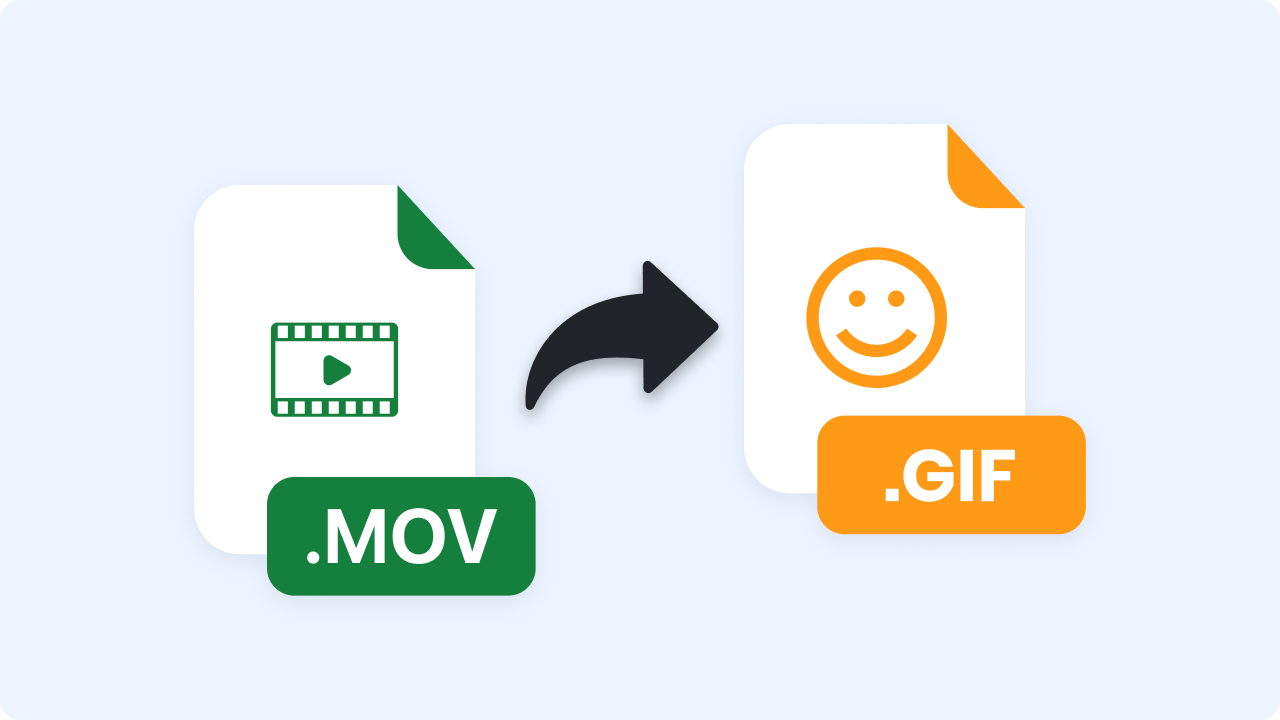
How to Turn Video Into GIF: 5 Fast Methods That Actually Work in 2026
You just recorded the perfect screen walkthrough, a hilarious Slack-worthy moment, or a quick product demo — and now you need to turn video into GIF so you can embed it in a support doc, paste it into a pull request, or drop it into a Notion page without forcing someone to click “play.” The problem? Most online converters compress your footage into a pixelated mess, cap your file at 100 MB, or plaster a watermark across the frame. After converting hundreds of screen recordings into GIFs for documentation, bug reports, and async updates, I’ve narrowed the process down to five reliable methods — including one that skips the conversion step entirely.
⚡ Quick Answer — TL;DR
To turn a video into a GIF, you can use a dedicated tool like Zight, which lets you record your screen and export directly as a GIF — no separate conversion step required. Alternatively, upload an MP4 to an online converter like EZgif, use FFmpeg on the command line, or convert inside Photoshop. Zight is a screen recording, screenshot, and async video tool for Mac, Windows, and Chrome that produces optimized GIFs in one click, making it the fastest option for anyone who regularly creates GIFs from screen recordings.
In this guide, I’ll walk through each method step by step, compare the trade-offs, and show you when each approach makes the most sense. Whether you’re a developer filing a visual bug report, a product manager writing release notes, or a customer success rep building a help center, you’ll leave here knowing exactly how to produce crisp, lightweight GIFs from any video.
Why Turn Video Into GIF in the First Place?
Before we dive into the how, let’s clarify the why — because understanding the use case helps you pick the right method.
- Inline playback everywhere. GIFs autoplay in GitHub comments, Jira tickets, Slack threads, email clients, and Notion pages — no video player required.
- Smaller cognitive load. A 5-second GIF showing a UI bug communicates what three paragraphs of text cannot.
- Universal compatibility. Every browser, every device, every OS renders a GIF. No codec issues, no “this video format isn’t supported” errors.
- Documentation longevity. GIFs embedded in wikis and docs stay visible for years without link rot from hosted video platforms.
The trade-off is file size — GIFs are uncompressed compared to modern video codecs, so a 30-second GIF can easily balloon to 20 MB+. That’s why the best workflow either records directly as GIF (keeping the clip short) or lets you trim before converting. Both of those are strengths of Zight, which I’ll cover first.
Method 1: Turn Video Into GIF With Zight (Fastest for Screen Recordings)
If you regularly need GIFs from screen recordings — bug reports, product walkthroughs, async feedback — Zight eliminates the conversion step entirely. Instead of recording a video, downloading it, uploading it to a converter, waiting, and downloading the GIF, you simply record as GIF from the start.
Step 1: Install Zight
Download the Zight desktop app for Mac or Windows, or install the Chrome extension. The menu bar icon (Mac) or system tray icon (Windows) gives you one-click access to all recording modes.
Step 2: Choose GIF Recording Mode
Click the Zight icon and select “Record GIF” from the dropdown. You’ll see a selection frame appear — drag it to cover the area of your screen you want to capture. In my testing, the selection frame snaps to window edges on macOS 14 Sonoma, which is a nice touch for capturing a single app window cleanly.
Step 3: Record and Stop
Hit the record button (or use the keyboard shortcut — on Mac it’s configurable in Preferences → Shortcuts). Perform the action you want to capture. When done, click the stop button or press your shortcut again. Zight processes the recording into a GIF automatically.
Step 4: Trim, Annotate, and Share
Once the GIF is generated, Zight uploads it to your cloud dashboard and copies a shareable link to your clipboard. From the dashboard, you can:
- Trim the beginning and end to remove dead frames (this alone can cut file size by 30–50%)
- Annotate with arrows, text, or highlights — something EZgif and most online converters don’t offer
- Download the raw .gif file for embedding
- Share via link — paste it in Slack, GitHub, Jira, email, or anywhere else
Pro tip: If you’ve already recorded a video (MP4 or MOV) with Zight’s screen recorder, you can still convert it to GIF from the Zight dashboard. Open the recording, click the download icon, and select GIF as the output format. This is handy when you realize after the fact that a GIF would have been better than a video.
The entire workflow — from clicking “Record” to having a shareable GIF link in your clipboard — takes under 15 seconds for a typical 5-second clip. That’s the advantage of having the recording tool and the GIF engine in the same app.
Method 2: Turn Video Into GIF Using EZgif (Free Online Converter)
EZgif is the most popular free browser-based tool for video-to-GIF conversion, and it deserves its reputation — it’s fast, requires no login, and handles most standard formats. Here’s how to use it:
Step 1: Go to EZgif.com
Navigate to ezgif.com/video-to-gif. You’ll see an upload form at the top of the page.
Step 2: Upload Your Video
Click “Choose File” and select your MP4, MOV, AVI, or WebM file. The maximum file size is 100 MB — if your video exceeds this, you’ll need to trim or compress it first. Click “Upload video!”
Step 3: Set Start Time, End Time, and Frame Rate
Once uploaded, EZgif shows a preview and conversion settings. Set the start and end time (in seconds) to isolate the exact clip you need. Reduce the frame rate (FPS) to keep the file size manageable — I’ve found that 10 FPS works well for UI demonstrations, while 15 FPS is better if there’s fast mouse movement. The default size is “original,” but you can scale down here too.
Step 4: Convert and Download
Click “Convert to GIF.” Processing takes 5–30 seconds depending on file size and server load. Once complete, you’ll see a preview of the GIF with options to optimize, crop, or resize it further. Click “Save” to download.
Where EZgif falls short: There’s no annotation support, no cloud hosting (you get a raw file), and the 100 MB upload limit means longer screen recordings won’t work without pre-processing. The interface is also heavily ad-supported, which can be distracting. But for a quick one-off conversion of a short clip, it’s solid and free.
Method 3: Convert Video to GIF With FFmpeg (For Developers)
If you’re comfortable with the command line and want maximum control over output quality and file size, FFmpeg is the gold standard. It’s free, open-source, and produces better-quality GIFs than most online tools because you can fine-tune the color palette.
Step 1: Install FFmpeg
On macOS: brew install ffmpeg. On Ubuntu/Debian: sudo apt install ffmpeg. On Windows, download the binary from the official FFmpeg site and add it to your PATH.
Step 2: Generate a Color Palette
GIFs are limited to 256 colors, so generating an optimized palette first dramatically improves quality:
ffmpeg -i input.mp4 -vf "fps=10,scale=640:-1:flags=lanczos,palettegen" palette.pngThis analyzes your video and creates a 256-color palette optimized for the specific content. The fps=10 flag sets the frame rate (adjust to your needs), and scale=640:-1 scales the width to 640 pixels while maintaining aspect ratio.
Step 3: Convert Using the Palette
Now apply the palette to create the GIF:
ffmpeg -i input.mp4 -i palette.png -lavfi "fps=10,scale=640:-1:flags=lanczos [x]; [x][1:v] paletteuse" output.gifStep 4: Trim (Optional)
To convert only a portion of the video, add -ss (start time) and -t (duration) before the input:
ffmpeg -ss 00:00:03 -t 5 -i input.mp4 -i palette.png -lavfi "fps=10,scale=640:-1:flags=lanczos [x]; [x][1:v] paletteuse" output.gifThis starts 3 seconds in and captures a 5-second clip. In my testing, a 5-second, 640px-wide GIF at 10 FPS using the two-pass palette method produces files around 1–3 MB for typical screen recordings — significantly smaller than what EZgif produces at the same visual quality.
Pro tip: If you’re doing this regularly, create a shell alias or a small bash script that wraps both commands. I use a script called togif.sh that accepts an input file, start time, duration, and width as arguments. Saves a ton of time.
The downside: This approach requires developer tooling, a terminal, and some familiarity with FFmpeg’s (notoriously complex) syntax. It’s not practical for PMs, designers, or customer success reps — which is exactly why Zight exists.
Method 4: Turn Video Into GIF in Photoshop
If you already have an Adobe Creative Cloud subscription, Photoshop can import video and export as GIF with precise frame-level control.
Step 1: Import the Video
Go to File → Import → Video Frames to Layers. Select your video file. In the dialog, choose “From Beginning to End” or set a custom range. Check “Limit to Every [X] Frames” to control frame rate — entering 3 means Photoshop imports every 3rd frame, effectively reducing the frame rate by a third.
Step 2: Resize the Canvas
Go to Image → Image Size and scale down to your target width (480–640px is usually plenty for web use). This is the single biggest lever for reducing GIF file size.
Step 3: Export as GIF
Go to File → Export → Save for Web (Legacy). Select GIF as the format. Adjust the color count (128 is a good balance between quality and size), dithering, and lossy compression. Click Save.
When to use this method: When you need pixel-level control over individual frames — removing a frame with sensitive data, adding a text overlay on a specific frame, or adjusting timing per frame. For everything else, it’s overkill. Photoshop also starts at $22.99/month, which makes it an expensive GIF converter if that’s all you need it for.
Method 5: Use macOS or Windows Built-In Tools + a Converter
If you don’t want to install anything new, you can use your OS’s built-in screen recording and then convert the output.
On macOS (Sonoma / Ventura)
Press ⌘ + Shift + 5 to open the Screenshot toolbar. Select “Record Selected Portion” or “Record Entire Screen.” Record your clip, then find the .mov file on your desktop. Upload it to EZgif or run it through FFmpeg to convert.
On Windows 11
Press Win + G to open the Xbox Game Bar. Click the record button to capture your screen. The output is an MP4 saved to Videos\Captures. Upload to a converter as above.
The built-in approach works, but it’s a two-step process every single time, and neither macOS nor Windows offers GIF as a native output format. You also lose annotation capabilities — macOS 14 Sonoma’s built-in recorder lacks the arrow, text, and highlight annotation layers that tools like Zight’s screenshot app provide. For one-off conversions it’s fine; for a regular workflow, it quickly becomes a time sink.
Method Comparison: Which Way Should You Turn Video Into GIF?
| Method | Best For | Cost | Max File Size | Annotations | Cloud Sharing | Speed (5-sec clip) |
|---|---|---|---|---|---|---|
| Zight | Screen recordings, async workflows | Free tier available; paid plans from $9.95/mo | No practical limit | ✅ Yes | ✅ Auto-uploaded | ~15 seconds |
| EZgif | Quick one-off conversions | Free | 100 MB | ❌ No | ❌ No | ~30–60 seconds |
| FFmpeg | Developers, batch processing | Free (open source) | Unlimited | ❌ No | ❌ No | ~20 seconds (after setup) |
| Photoshop | Frame-level editing, design teams | $22.99/mo | Unlimited | ✅ Full editor | ❌ No | ~2–5 minutes |
| OS Built-In + Converter | No-install situations | Free | 100 MB (via EZgif) | ❌ No | ❌ No | ~1–2 minutes |
The pattern I’ve noticed after testing all five: the number-one factor isn’t quality — it’s how many steps stand between you and a shareable GIF. Zight wins here because there’s no export → upload → convert → download → upload-again loop. You record, it’s a GIF, it’s on a shareable link. For teams that create GIFs daily (support teams documenting workarounds, PMs writing release notes, developers filing visual bug reports), that workflow compression saves hours per week.
Tips for Creating Better GIFs (Regardless of Tool)
After creating hundreds of GIFs for documentation and async communication, here are the patterns that consistently produce the best results:
1. Keep It Under 10 Seconds
GIFs aren’t videos. They loop, they autoplay, and they have no progress bar. If your GIF is longer than 10 seconds, it’s probably too long. Aim for 3–7 seconds: one clear action per GIF. If you need to show a multi-step process, create a series of GIFs rather than one long one.
2. Scale Down Before Converting
A 1920×1080 GIF is almost never necessary. Scale to 640px wide (or 480px for inline documentation). This alone can reduce file size by 70–80%. In Zight, you can choose your recording region to capture only the relevant portion of the screen, which achieves the same result without a resize step.
3. Reduce Frame Rate to 10–15 FPS
Most screen recordings don’t need 30 FPS in GIF form. Dropping to 10 FPS cuts the number of frames (and therefore file size) by two-thirds, and for UI demonstrations, the difference is barely noticeable.
4. Trim Aggressively
The first and last second of most screen recordings are wasted frames — you clicking the record button, moving your mouse to the starting position, or waiting for the stop. Trim those dead frames. In Zight, the trim tool in the dashboard makes this a two-click operation.
5. Use Annotations Instead of Longer Recordings
Instead of recording yourself slowly hovering over a button to draw the viewer’s attention, record a shorter clip and add an arrow annotation pointing to the element. This communicates the same thing in fewer frames. Zight’s annotation layer lets you do this after recording without re-creating the GIF.
When to Use GIF vs. Video vs. Screenshot
One thing I’ve learned is that not everything needs to be a GIF. Here’s a quick decision framework:
- Use a GIF when you’re showing a short action (click → result), a UI animation, or a visual bug that needs inline autoplay.
- Use a video when the content is longer than 15 seconds, needs audio narration, or requires the viewer to pause/rewind. Zight’s screen recorder handles this with webcam overlay and mic capture.
- Use a screenshot when the information is static — an error message, a settings panel, a design comp. Zight’s screenshot app captures and annotates these instantly.
The beauty of using Zight for all three is that your GIFs, videos, and screenshots all live in the same cloud dashboard with the same shareable link format. No juggling between tools.
Frequently Asked Questions
How do I turn a video into a GIF for free?
The easiest free option is EZgif.com — upload your MP4 or MOV file (up to 100 MB), set your trim points and frame rate, and download the GIF. If you need a more integrated workflow, Zight offers a free tier that includes GIF recording and conversion from screen recordings. For developers, FFmpeg is a powerful free open-source option that produces higher-quality GIFs through its two-pass palette method.
What is the best quality way to turn video into GIF?
The highest-quality method is FFmpeg’s two-pass palette approach, which generates an optimized 256-color palette specific to your video content before converting. For a no-code approach, Zight produces high-quality GIFs by recording directly in GIF format at the source, avoiding the quality loss that comes from video-to-GIF transcoding. The key quality factors are: using a custom color palette, keeping the width at 640px or below, and using at least 10 FPS.
How do I keep my GIF file size small when converting from video?
Three levers control GIF file size: dimensions (scale down to 480–640px wide), frame rate (use 10 FPS instead of 30), and duration (keep clips under 7 seconds). Trimming dead frames at the beginning and end is the easiest win — in practice, this alone cuts 20–40% off the file size. Reducing the color count from 256 to 128 is another effective optimization with minimal visual impact on screen recordings.
Can I turn a YouTube video into a GIF?
Yes, but you’ll need to download the video first (using a tool like yt-dlp) or record the portion you need with a screen recorder like Zight. Record just the section you want as a GIF using Zight’s GIF mode, and you’ll have a shareable link in seconds — without dealing with YouTube’s download restrictions or a separate conversion step. Always respect copyright when creating GIFs from content you don’t own.
Does converting video to GIF lose quality?
Yes, some quality loss is inherent because GIFs are limited to 256 colors and don’t support modern video compression. However, for screen recordings and UI demonstrations — which tend to have flat colors and sharp edges — the quality loss is minimal. Photographic or cinematic footage suffers more noticeable degradation. Using the FFmpeg palette method or recording directly as GIF in Zight minimizes this quality loss.
Start Creating GIFs Faster With Zight
If you’re reading this guide, you probably turn video into GIF more than once a month — and every extra step in that process costs you time and focus. Zight collapses the record → convert → annotate → share pipeline into a single tool. Record your screen as a GIF, trim the dead frames, add an arrow or highlight, and share a link — all without leaving the app.
We’ve seen teams at Zight use this workflow to cut bug report creation time from 5 minutes to under 30 seconds. Product managers embed GIFs in Notion release notes that auto-play inline. Customer success reps paste GIF walkthroughs directly into help center articles and Intercom conversations.
👉 Try Zight free and start recording GIFs from your screen in seconds — no conversion step, no watermark, no file size limits.
Based on testing by the Zight team. Last updated June 2024.



Leave a Reply