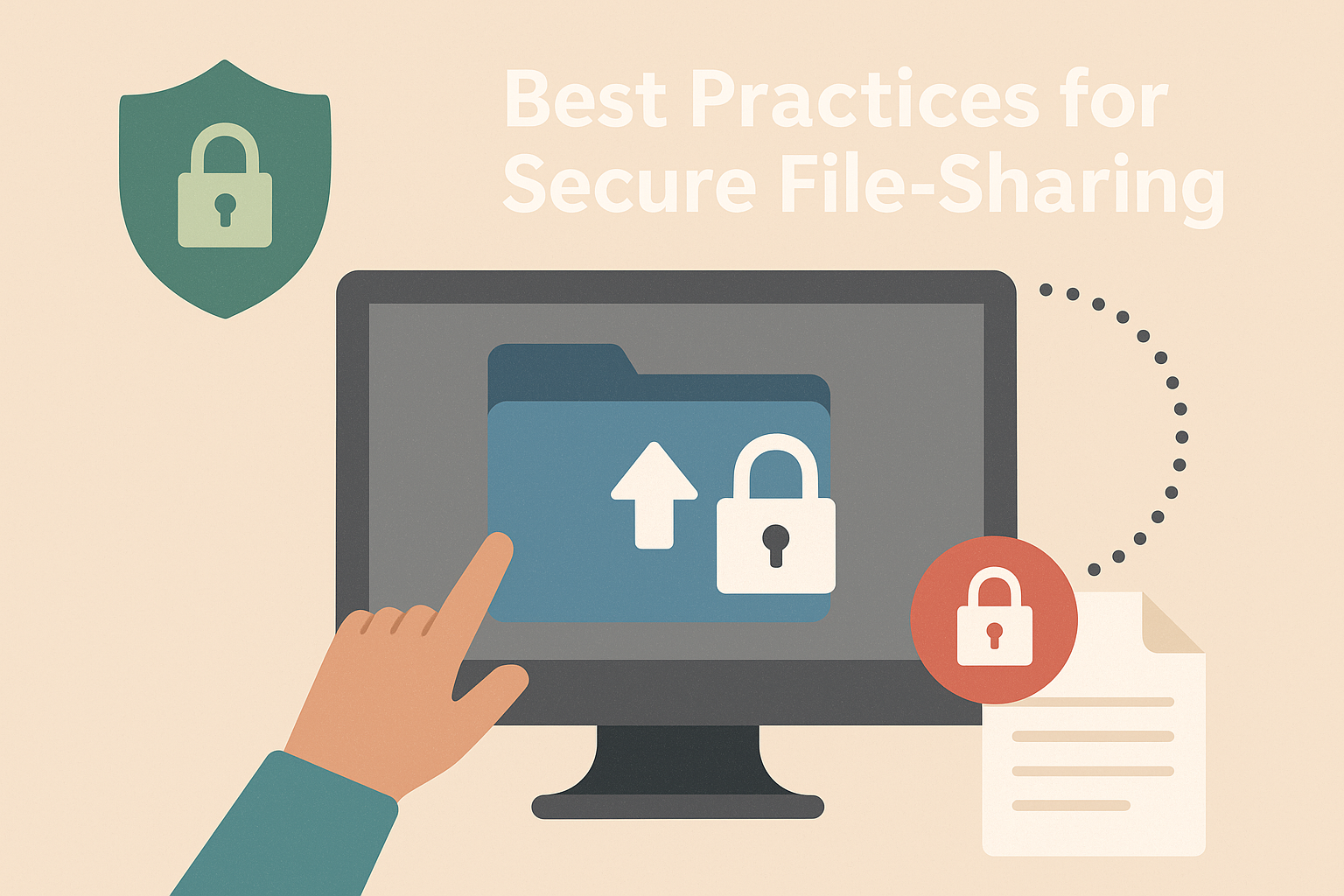
- Use encryption: Protect files with tools like AES encryption to keep data unreadable without a decryption key.
- Enable multi-factor authentication (MFA): Reduce hacking risks by requiring multiple verification steps.
- Apply least privilege access: Limit file access to only those who need it.
- Update software regularly: Patch vulnerabilities to prevent attacks.
- Monitor file activity: Track who accesses files and flag unusual behavior.
- Set temporary access links: Restrict file access with expiration dates or one-time downloads.
- Follow compliance rules: Align with regulations like GDPR or HIPAA to avoid fines.
Secure File Sharing: Essential Do’s and Don’ts for Data Protection | IT Tips, Tricks, & Hacks
Common Security Problems in File Sharing
File sharing introduces a range of vulnerabilities that can lead to serious consequences for both organizations and individuals. Recognizing these risks is a critical step toward strengthening defenses against cyber threats.Unauthorized Access and Data Breaches
Weak passwords, outdated software, and poor authentication practices are some of the biggest culprits behind unauthorized access. In fact, 49% of breaches involve the use of stolen credentials. This highlights how stronger authentication methods could potentially prevent nearly half of these incidents. Human error often makes matters worse. Employees might share files without proper access controls, inadvertently exposing sensitive information. On top of that, social engineering plays a role in 98% of cyberattacks, where attackers manipulate individuals into revealing login details or confidential data. Misconfigured systems – like default passwords or open network ports – create additional vulnerabilities. Web application attacks, which account for 26% of breaches, further emphasize the need for updated and properly configured systems.“Unauthorized access is defined as the act of gaining access to a computer system or physical location without proper authorization or permission.” – Bright SecurityThese access issues often pave the way for more complex challenges, including compliance violations and malware infections.
Compliance and Regulatory Risks
For industries like healthcare, finance, and legal services, insecure file-sharing practices can lead to hefty fines and legal troubles. When employees turn to unauthorized tools (a practice known as shadow IT), organizations lose control over sensitive data transfers. This lack of oversight makes it difficult to demonstrate compliance during audits. The financial penalties are only one side of the coin. Insecure file sharing also increases the risk of malware attacks, which can have devastating operational impacts.Malware and Ransomware Threats
File sharing is a prime channel for malware, including ransomware. Delivered primarily through phishing attacks, ransomware incidents occur every 11 seconds and cost organizations millions per event. Alarmingly, 71% of companies have faced ransomware attacks, with an average financial hit of $4.35 million per incident. In 2023, 10% of organizations were targeted by attempted ransomware attacks. The 2017 WannaCry attack serves as a stark reminder of the damage ransomware can cause. Exploiting outdated software, the attack disrupted operations worldwide, impacting hundreds of thousands of systems.“Ransomware has quickly become the most prominent and visible type of malware. Recent ransomware attacks have impacted hospitals’ ability to provide crucial services, crippled public services in cities, and caused significant damage to various organizations.” – Check Point SoftwareModern ransomware tactics have become even more aggressive. Attackers often employ double or triple extortion strategies, stealing data before encrypting it and then threatening to release the information if their demands aren’t met.
Lack of Tracking and Visibility
Many organizations struggle to monitor file-sharing activities across their networks. Without effective tracking systems, it’s hard to identify when files are shared inappropriately or accessed by unauthorized individuals. This lack of visibility makes incident response more challenging. When a breach happens, determining which files were compromised and tracing the data’s movement can be a time-consuming process. Insider threats add another layer of complexity – 10% of security incidents and 17% of data breaches are tied to social engineering tactics. The rise of remote work, with employees accessing files from home networks, personal devices, or public Wi-Fi, has only heightened these challenges.Basic Rules for Secure File Sharing
Protecting sensitive data during file sharing begins with a solid foundation of security practices designed to safeguard information at every stage.Encryption for Data Protection
Encryption is a critical tool in securing data, transforming it into an unreadable format that can only be deciphered with the correct decryption key. This ensures that even if data is intercepted or stolen, it remains inaccessible to unauthorized individuals.“Encryption is used to protect data from being stolen, changed, or compromised by scrambling data into a secret code that can only be unlocked with a unique digital key.” – Google CloudOne of the most trusted methods today is Advanced Encryption Standard (AES), which offers strong protection for both stored data and data in transit. For example, encryption safeguards files on your device from theft and ensures that any data sent via email or file-sharing platforms remains secure, even if intercepted. Encryption delivers four essential benefits: confidentiality (keeping data private), integrity (ensuring data hasn’t been altered), authentication (confirming the sender’s identity), and nonrepudiation (preventing denial of actions). For added security, encrypt sensitive files before sending them via email and use secure protocols like HTTPS and TLS/SSL for online communication. If you’re using remote file-sharing services, protocols such as IPSec, ISAKMP/IKE, or SSL/TLS are recommended for encrypted data transmission.
Using Least Privilege Access
The principle of least privilege is about granting users only the access they need to perform their jobs – nothing more. By limiting permissions, you reduce the risk of unauthorized access and minimize the damage a compromised account can cause. Maintaining data integrity is essential when handling digital media, and in situations where files like a damaged MOV file, MP4, or AVI become corrupted, knowing how to repair a MOV file safely can be a critical part of that process. For instance, removing local admin rights and restricting execution can mitigate 75% of Microsoft’s critical vulnerabilities.“When you limit user and application access to only the necessities, you reduce the risk of attackers gaining access to critical systems and files by compromising a low-level account, and you can easily contain the damage to the minimal area the account had privileges to.” – Copado TeamTo implement this, regularly review and adjust permissions to match current roles and responsibilities. Make limited access the default for all new accounts and grant higher privileges only when absolutely necessary, ideally on a temporary basis. With machine identities now growing at twice the rate of human identities, monitoring network activity for suspicious behavior is more important than ever. Regular audits, along with tools like just-in-time privileges (JIT) or one-time-use credentials, can further tighten security.
Using Multi-Factor Authentication (MFA)
Multi-factor authentication (MFA) adds an extra layer of security by requiring users to verify their identity in multiple ways before accessing file-sharing systems. This method drastically reduces the likelihood of unauthorized access – users with MFA are 99% less likely to be hacked, and it can block 99.2% of account-based attacks.“MFA prevents unauthorized access to your data and applications by requiring a second method of verifying your identity, making you much more secure.” – CISATo implement MFA effectively, integrate it into your existing systems without disrupting user workflows. Provide users with secure options like authenticator apps or hardware tokens, and pair MFA with strong password policies. Regularly updating and reviewing credentials further strengthens your defenses. For added flexibility, adaptive MFA can tailor security requirements based on risk factors like location, device type, or behavior patterns. This ensures heightened security in risky situations while maintaining ease of access for routine tasks.
Regular Software Updates and Patching
Keeping your file-sharing software up to date is crucial for addressing vulnerabilities that attackers might exploit. Software updates often include critical security patches that fix newly discovered weaknesses, and delaying these updates can leave your system exposed. Establish a routine update schedule for all platforms, operating systems, and security tools involved in file sharing. In enterprise settings, test updates in a controlled environment before rolling them out across your network. Web-based file-sharing tools, in particular, require close attention, as web application attacks account for 26% of breaches. Maintain an inventory of all software used in file sharing, including browsers, mobile apps, plugins, and integrated tools. Perform regular vulnerability scans to identify systems that need updates or patches. These proactive measures form the backbone of a secure file-sharing strategy.sbb-itb-5d91f01
Practical Methods for Secure File Sharing
To safeguard sensitive data during file sharing, it’s essential to combine strong security practices with specific tools and techniques. These methods help prevent unauthorized access and protect your information.Password Protection and Strong Passwords
Passwords act as the first line of defense against unauthorized access. The strength of your password can make or break your security efforts.“Creating and storing strong passwords with the help of a ‘password manager’ is one of the easiest ways to protect ourselves from someone logging into our accounts and stealing sensitive information, data, money or even our identities.” – CISALonger passwords are better. Aim for at least 12 characters, with 14 or more providing even greater security. Whenever possible, go for 16 characters or more for maximum protection. Combine uppercase and lowercase letters, numbers, and symbols to create a password that’s tough to crack. Avoid predictable choices like dictionary words, names, or common patterns. Instead, use a unique phrase that’s easy for you to remember but hard for others to guess. Each password should be unique – don’t reuse the same one across multiple platforms. Password managers can simplify this process by generating strong passwords and identifying weak or reused ones. Pairing strong passwords with multi-factor authentication adds an extra layer of security to your file-sharing activities.
Temporary Access Links
Strong passwords are just the start. Temporary access links offer another layer of control by limiting how long shared files can be accessed. These links are particularly useful for sensitive documents, such as contracts or proposals, as they help reduce prolonged exposure. One-time download links add even more control. Once the file is downloaded, the link becomes inactive, preventing further access or redistribution. Similarly, expiration dates for access links ensure they automatically become invalid after a set period. You can customize expiration times based on your needs – whether it’s a few hours for urgent files or several days for collaborative projects. This ensures legitimate users can access the data while permissions are automatically revoked when no longer necessary.Monitoring and Tracking File Access
After setting up access controls, real-time monitoring becomes critical for ongoing protection. To enhance protection against unauthorized file access attempts originating from malicious domains, implementing DNS security protocols helps detect and block suspicious network activity before it reaches your system. Audit logs and monitoring tools provide visibility into who is accessing your files and what actions they’re taking. Audit trails allow administrators to track activities like file access, editing, or downloads, offering a detailed record of interactions. Real-time monitoring can also flag suspicious behavior, such as unauthorized access attempts or unusual file modifications. By properly configuring file permissions, you can reduce unauthorized access by up to 35%. Advanced monitoring tools can further improve response times to security threats by up to 50%. Regularly auditing user accounts and permissions ensures that only authorized individuals have access to sensitive files. Automated alerts can notify administrators of potential security breaches, such as failed login attempts or bulk file changes. File integrity monitoring (FIM) tools add another layer of defense by establishing a baseline for each file and flagging any changes that deviate from this standard. This approach supports both active monitoring and post-incident investigations.Compliance Support and Data Location
Aligning your file-sharing practices with compliance standards is another key aspect of secure data handling. Monitoring file access helps ensure adherence to data privacy regulations. Governance tracking ensures that only authorized users can access sensitive files, supporting compliance with regulations like GDPR, HIPAA, and SOX. Detailed audit trails provide the documentation needed for compliance audits, demonstrating your commitment to protecting data. It’s also crucial to understand where your data is stored and processed. Some regulations require data to remain within specific geographic regions, while others mandate strict security standards for storage and processing. Adhering to these requirements helps you avoid penalties and maintain trust. Regular compliance assessments can identify gaps in your current practices and help you stay aligned with evolving regulations. This proactive approach not only minimizes risks but also reinforces confidence in your data management processes.Secure File Sharing with Zight
 Zight takes secure file sharing to the next level by integrating robust security measures into a platform designed for seamless collaboration. Trusted by over 5 million users worldwide, Zight addresses the challenges of secure file sharing without compromising ease of use.
 Enterprise-Grade Security Features
Zight is built on AWS, utilizing multiple layers of security to protect sensitive data. It employs 256-bit encrypted TLS 1.2 connections, leverages Amazon’s Key Management Services, and offers advanced features like SSO with SAML provisioning, domain lockdown, IP whitelisting, and document-sharing restrictions. Users can customize sharing options, including public, private, and password-protected settings, as well as data retention rules.“It has excellent security features. First, it was simple to set up storage on our company servers instead of the Zight cloud, meaning that all of our captures remain under our control. This allows for capturing more sensitive information securely. Second, it’s possible to set security on ANY capture to password-protect or otherwise restrict access to it.” – Karen Goeller, Software Delivery Leader, biBerk Business InsuranceZight also complies with GDPR and protects intellectual property. Its SOC 2 Type 2 compliance ensures that it meets the highest enterprise security standards[38,40].
Cross-Platform Access
Zight ensures secure collaboration across multiple platforms, including Mac, Windows, Chrome, and iOS. This accessibility allows teams to work securely from any device, with consistent enforcement of security protocols. Organizations can choose between storing content on Zight’s enterprise-grade cloud or deploying their own instance, simplifying access management while minimizing risks tied to fragmented security systems.Integrations for Secure Workflows
Zight integrates seamlessly with tools like Slack, Microsoft Teams, Zendesk, and Jira, embedding secure file-sharing capabilities into existing workflows. For instance, its Slack integration provides real-time notifications for views, comments, and mentions, ensuring file access is closely monitored. Similarly, the Jira integration enables developers to record screens directly within an issue, streamlining bug reporting while keeping sensitive data secure and traceable.AI-Powered Tools for Efficiency
Zight combines advanced security with AI-powered tools to enhance productivity. Features like video transcription, title generation, and summarization automate time-consuming tasks while maintaining strict security protocols. The AI-powered search feature helps users quickly locate files, reducing the chances of accessing outdated or incorrect versions. Additionally, automated transcription turns video content into searchable text, secured under the same protective measures as other shared files.“The AI features you guys built are amazing for my use case, as I send a lot of videos to my team. It makes it nicer for them on the receiving end.” – Daniel R. Odio, CEO, Storytell.ai
Conclusion
Secure file sharing is no longer just a technical concern – it’s a critical factor that directly affects a company’s reputation, compliance efforts, and bottom line. With the global average cost of a data breach climbing to $4.45 million in 2023, the financial risks of weak security practices are too substantial to ignore. The key to safeguarding file sharing lies in a multi-layered approach. This includes encryption, multi-factor authentication, strict access controls, and ongoing employee training. These measures address both the technical gaps and the human errors that often lead to breaches. As industry experts emphasize, a well-structured file sharing protocol is essential to prevent leaks, losses, and compliance violations. Modern businesses face growing risks as data sharing now spans numerous online tools and platforms. Companies like Zight illustrate how security doesn’t have to come at the expense of usability. By integrating enterprise-grade security features with tools like Slack, Microsoft Teams, and Jira, Zight ensures that robust protection aligns seamlessly with everyday workflows. Staying ahead of cyber threats requires constant vigilance. Regularly updating security protocols is essential to counter new risks while maintaining the smooth collaboration that businesses rely on. In today’s fast-paced environment, balancing security with productivity isn’t optional – it’s a necessity for protecting data integrity and supporting efficient teamwork.FAQs
What is encryption, and how can it make file sharing more secure?
Encryption transforms your data into a coded format, making it accessible only to authorized individuals. This process secures your files during transmission (in transit) and storage (at rest), protecting them from unauthorized access or interception. Here are a few key steps to ensure effective encryption:- Use reliable encryption protocols like AES 256-bit and SSL/TLS for maximum security.
- Activate end-to-end encryption to protect your data throughout the sharing process.
- Encrypt sensitive files before sharing them to add an extra layer of security.
- Opt for platforms that emphasize encryption and have strong data protection features.