

Behavior analytics is transforming how organizations manage Identity and Access Management (IAM). By analyzing user behavior, like login patterns and device usage, these systems create dynamic security measures that outperform static, rule-based IAM methods. Behavior analytics offers:
- Faster threat detection: Reduces detection time by up to 85%.
- Improved accuracy: Fewer false positives and better identification of risks.
- Streamlined compliance: Automates logs and flags violations in real-time.
- Enhanced user experience: Minimizes disruptions with adaptive authentication.
While traditional IAM systems rely on static rules and manual reviews, behavior analytics leverages AI to identify unusual activity and respond instantly. This shift is crucial for tackling modern cybersecurity challenges and meeting strict regulatory requirements. By 2025, 50% of large enterprises are expected to adopt behavior analytics for IAM, up from less than 5% in 2021.
For organizations, the choice between standard IAM and behavior analytics-driven IAM depends on balancing cost, complexity, and security needs. Behavior analytics offers advanced detection and compliance capabilities, though it requires a higher initial investment and ongoing system fine-tuning.
1. Standard IAM Policy Enforcement
Standard IAM policy enforcement relies on predefined rules and static access controls, such as Role-Based Access Control (RBAC) and Attribute-Based Access Control (ABAC), to assign permissions. In these systems, users authenticate with credentials, and access is granted or denied based on established policies. However, this approach does not account for real-time context or behavioral patterns.
Detection Speed
One major drawback of standard IAM systems is their reliance on static rules and periodic audits, which limits their ability to detect threats quickly. Unauthorized access or policy violations often go unnoticed until a scheduled review or when someone manually reports an issue. This reactive model can cause significant delays in identifying and addressing security incidents.
Without continuous monitoring, subtle risks like privilege escalation or lateral movement may persist undetected for long periods. These gaps can lead to severe data breaches. This challenge naturally ties into issues with accuracy.
Accuracy
The accuracy of standard IAM enforcement is hindered by its dependence on static rules. This can result in false positives, where legitimate actions are flagged as violations, and false negatives, where malicious activities evade detection.
Because these systems lack the ability to analyze context, they struggle to differentiate between normal and suspicious activities. For instance, a user accessing files late at night might simply be catching up on work, but a static system could flag this as a security concern. This inability to adapt to nuanced or emerging threats makes standard IAM less reliable for identifying complex or evolving risks.
Compliance Support
Standard IAM systems do offer compliance support through features like audit trails, access logs, and enforcement mechanisms. These tools help organizations meet regulatory requirements for frameworks such as HIPAA, SOX, and FISMA by documenting access events for audits and investigations.
However, their compliance capabilities are limited to basic logging and reporting. While organizations can generate reports to satisfy auditors, these systems lack advanced analytics or automation for proactive risk mitigation. This makes their compliance approach more about documentation than prevention.
User Productivity
Rigid controls and manual provisioning processes in standard IAM systems can hinder user productivity. For example, onboarding new employees often takes several days, and users frequently face delays when requesting access to resources, especially if approvals are required for each request. These inefficiencies can frustrate users and lead to workarounds that compromise security.
Although standard IAM systems are designed to streamline routine operations, such as provisioning and deprovisioning access when processes are clearly defined, their inflexibility creates challenges. They struggle to accommodate exceptions or dynamic access needs, which limits their effectiveness in more complex scenarios. This rigidity underscores the need for more dynamic and adaptive IAM solutions.
2. Behavior Analytics-Driven IAM Policy Enforcement
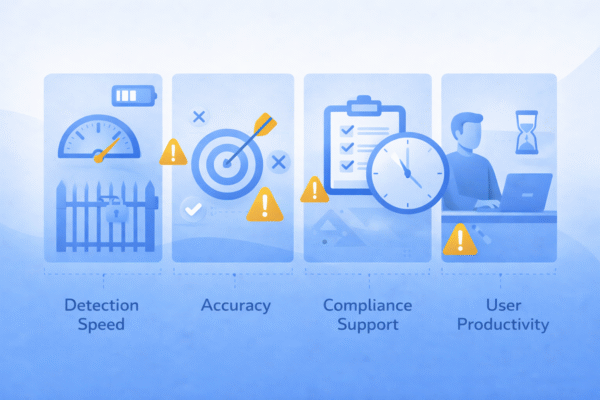
Traditional Identity and Access Management (IAM) systems often rely on static rules, which can leave gaps in security. Behavior analytics-driven IAM policy enforcement takes a more dynamic approach, using AI to monitor user activities and establish behavioral baselines. By examining patterns like login times, device usage, network locations, and access behaviors, these systems can detect unusual activity that might signal a security threat. Instead of relying on rigid rules, behavior analytics creates personalized, evolving profiles for each user. This allows for real-time detection of anomalies, enabling organizations to move from reactive security measures to proactive threat management. The result? Faster detection, improved accuracy, streamlined compliance, and minimal disruption for users.
Detection Speed
Behavior analytics ramps up threat detection by continuously monitoring user activity and flagging anomalies in real time. According to a 2023 report by Okta, organizations using these systems have seen an 85% reduction in threat detection times compared to traditional IAM methods. This is because automated analysis instantly compares current behaviors against established baselines, bypassing the delays of manual reviews or periodic audits. For example, if a user logs in from an unusual location at an odd time, the system raises an alert immediately.
Accuracy
Speed alone isn’t enough without precision. AI-powered behavior analytics improves accuracy by distinguishing between harmless variations and actual threats, cutting down on false positives. This means security teams can focus on real issues instead of chasing down every flagged anomaly. For instance, the system can tell the difference between a legitimate login from a new location due to business travel and a suspicious attempt from a compromised account.
Compliance Support
Meeting regulatory requirements is another area where behavior analytics shines. These systems automatically log access patterns and flag any violations as they happen, creating detailed audit trails. This not only records what resources were accessed but also provides context around the behavior, which is invaluable during compliance audits. Whether it’s HIPAA, FISMA, or SOX, continuous monitoring helps organizations stay compliant without manual oversight.
User Productivity
Adaptive authentication ensures that legitimate users can work without unnecessary interruptions. Extra verification steps are only triggered for unusual behavior, keeping the process smooth for most users. On top of that, predictive access management simplifies workflows by automatically granting permissions based on behavioral context and revoking them when they’re no longer needed. This reduces the delays and inefficiencies tied to manual access requests, allowing users to stay productive while maintaining security.
Pros and Cons
When comparing the two main Identity and Access Management (IAM) approaches, standard IAM policy enforcement and behavior analytics-driven IAM, it’s clear that each has its own set of strengths and challenges. Understanding these trade-offs can help security teams choose the right strategy to meet their organization’s specific security and operational needs.
Standard IAM policy enforcement offers simplicity and predictability. Its rule-based framework ensures consistent security measures that are easy to implement, understand, and audit. However, this approach struggles to identify sophisticated threats that don’t fit within predefined rules, leaving potential gaps in protection.
On the other hand, behavior analytics-driven IAM addresses these limitations by using intelligent automation and adaptive controls. In fact, Gartner predicts that by 2025, 50% of large enterprises will have integrated advanced behavioral analytics into their identity management systems, a significant jump from less than 5% in 2021. While this growth highlights its effectiveness, it also reflects the complexity of implementing such systems.
The resource demands for these approaches vary significantly. Standard IAM systems are more cost-effective upfront and require less technical expertise for ongoing maintenance. In contrast, behavior analytics-driven IAM requires a larger initial investment, continuous fine-tuning, and specialized staff training. Additionally, the extensive monitoring involved in behavior-based systems can raise privacy concerns, prompting organizations to update their policies and address employee apprehensions about surveillance.
Here’s a side-by-side comparison of the two approaches:
Behavior analytics-driven IAM systems also excel in reducing the mean time to detect identity-based threats, by up to 80% compared to traditional methods. This is largely thanks to continuous learning algorithms that can distinguish between normal user behavior and actual security threats.
For industries governed by strict compliance regulations, the choice of IAM system is particularly critical. Standard IAM provides clear audit trails that fulfill basic regulatory needs, while behavior analytics-driven IAM offers richer, context-aware evidence that proves invaluable during investigations. Given the potential for non-compliance penalties to reach millions under regulations like PCI DSS, the advanced compliance features of behavior analytics systems are becoming increasingly appealing.
Workforce dynamics also play a key role in selecting an IAM approach. Remote and hybrid work environments benefit greatly from adaptive authentication, which adjusts to changing access patterns. However, if the system fails to establish accurate behavioral baselines, legitimate users may face unexpected access issues, potentially disrupting productivity despite the system’s broader advantages.
Conclusion
Behavior analytics is reshaping Identity and Access Management (IAM) by boosting threat detection, improving compliance processes, and increasing operational efficiency.
AI-powered IAM systems offer faster threat detection and help identify complex attacks that traditional rule-based systems often miss, such as insider threats and advanced persistent attacks. These systems don’t just stop at detection, they also simplify compliance by automating the creation of detailed access logs and providing context-rich evidence, which is invaluable during audits or regulatory investigations. Considering the significant risks tied to regulatory non-compliance, investing in advanced IAM capabilities can often pay for itself by reducing these risks.
By cutting down on false alerts and automating monitoring tasks, behavior analytics lets security teams focus on real threats. This shift allows organizations to move from a reactive approach to a proactive stance in managing cybersecurity risks. Gartner’s forecast that 50% of large enterprises will adopt advanced behavioral analytics in their IAM systems by 2025 underscores the growing importance and maturity of this technology in tackling today’s complex threat landscape.
For organizations looking to strengthen their IAM strategy, behavior analytics offers a clear path forward. Start by applying it to high-risk areas and gradually expand its use to balance complexity with security gains. The benefits are clear: better threat detection, smoother compliance, and improved operational efficiency make behavior analytics-driven IAM a necessary step for staying ahead in modern cybersecurity.
Now is the time to integrate behavior analytics into your IAM strategy and stay ahead of the constantly evolving threat landscape.
FAQs
How does behavior analytics enhance threat detection in IAM systems compared to traditional methods?
Behavior analytics plays a key role in boosting threat detection within identity and access management (IAM) systems. By examining patterns in user activity and spotting unusual or risky behavior, it uncovers potential threats that traditional methods might overlook. This real-time analysis allows for quicker, more precise responses to security issues.
With this approach, IAM policies can stay dynamic and responsive, minimizing vulnerabilities while strengthening overall security.
What challenges should organizations consider when adopting behavior analytics for IAM policy enforcement?
When implementing behavior analytics for IAM policy enforcement, organizations face several challenges worth addressing.
One of the primary hurdles is handling the sheer complexity of the data these systems produce. The volume of behavioral data can be overwhelming, and making sense of it often requires specialized tools and skilled personnel. This can increase operational workloads and demand significant resources.
Another critical concern is protecting user privacy. Monitoring user behavior must be done thoughtfully, ensuring compliance with privacy regulations while maintaining respect for individual privacy. Clear communication with employees about these systems and their purpose can go a long way in easing any apprehensions.
Finally, integration and scalability are key considerations. These systems must work seamlessly with existing IAM tools and processes while being flexible enough to accommodate future organizational changes or growth. Proper planning can help ensure smooth implementation and long-term success.
How does behavior analytics in IAM help meet compliance requirements like HIPAA and SOX, and what are its key advantages over traditional IAM systems?
Behavior analytics takes Identity and Access Management (IAM) to the next level by tracking and evaluating user actions to spot anything unusual or potentially risky. This method doesn’t just react to threats, it actively works to prevent them. By doing so, it helps organizations comply with regulations like HIPAA and SOX, ensuring that access policies are enforced using real-time data. The result? A significant reduction in the chances of data breaches or unauthorized access.
Unlike traditional IAM systems that depend on fixed rules, behavior analytics adds a dynamic, responsive layer of security. It identifies threats by analyzing behavioral patterns, making security measures more adaptable and effective in addressing compliance and safeguarding sensitive information.