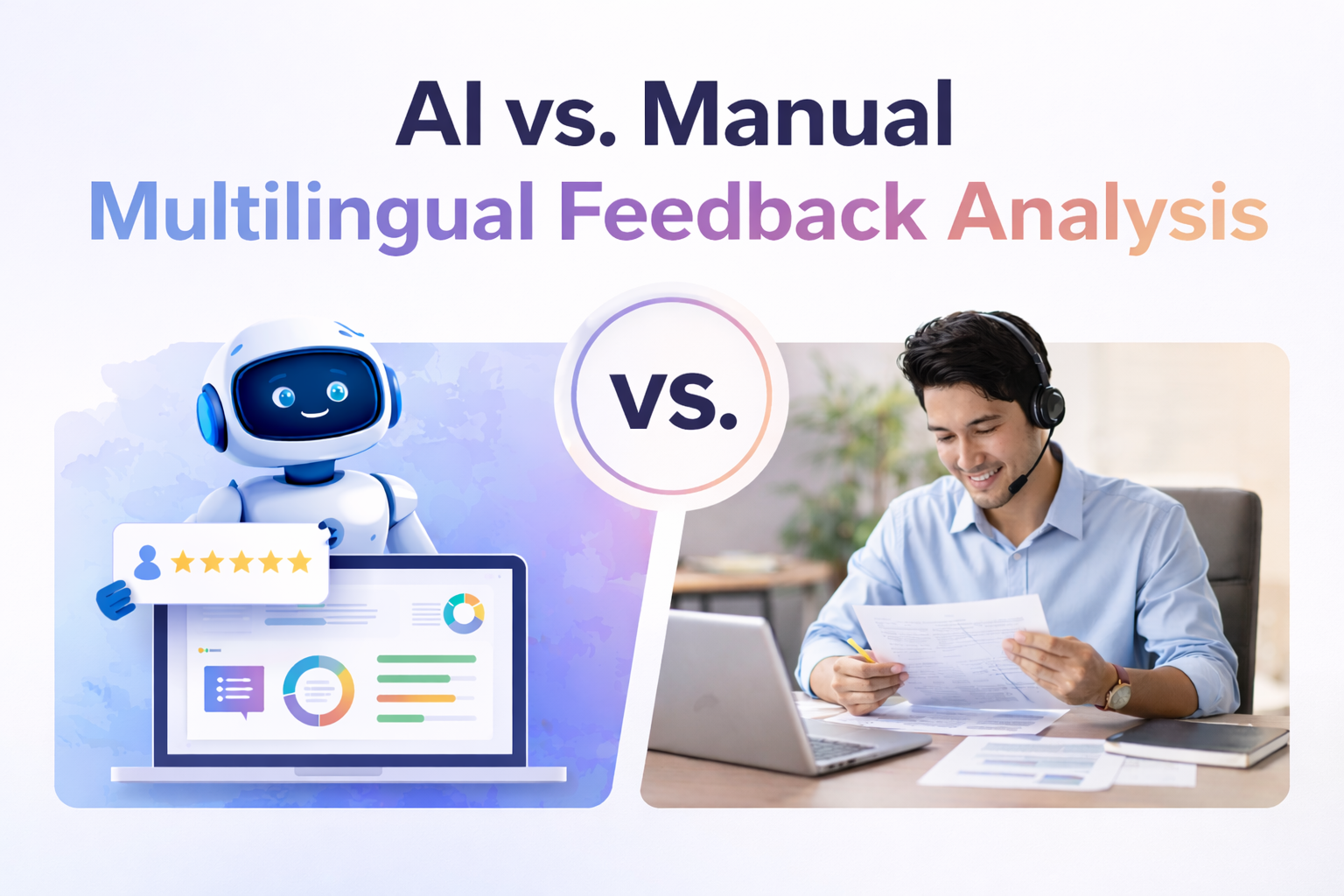
- Manual Analysis: Best for small-scale, nuanced feedback; slower and costlier.
- AI Analysis: Ideal for large-scale, real-time insights; struggles with subtle context.
- Hybrid Approach: Combines AI’s speed with human expertise for balanced results.
How Manual Multilingual Feedback Analysis Works
Manual multilingual feedback analysis relies on expert linguists, translators, and cultural analysts to uncover actionable insights. While it demands significant human effort, this approach offers a depth of understanding and cultural sensitivity that automated systems often fail to achieve. The process involves specialists working either in sequence or simultaneously, depending on the organization’s setup. Native speakers or highly skilled linguists handle the initial translation and interpretation, while analysts focus on categorizing feedback and extracting meaningful insights. Here’s a closer look at the key steps involved.Steps in Manual Analysis
The process starts with data collection and organization. Teams gather feedback from various sources, like customer surveys, social media posts, product reviews, and support tickets, and sort it based on language and region. This step helps define the scope of work and allocate resources efficiently. Next is translation and cultural interpretation. Native speakers translate the feedback into a common language (often English), ensuring that cultural nuances and regional expressions are preserved instead of being lost in a direct translation. Once translated, the feedback undergoes sentiment analysis and categorization. Analysts manually review each piece of feedback to classify its sentiment, positive, negative, or neutral, and group it by topic, such as product features, customer service, or pricing. This step requires a strong grasp of the business context and the subtleties of cultural communication. The process then moves to pattern identification and insight extraction. Analysts look for recurring themes across languages and regions, identifying trends that reveal broader issues or opportunities. They compile concise reports that highlight key findings, regional differences, and actionable recommendations. Finally, quality assurance and validation take place. Multiple reviewers verify translations and sentiment classifications to ensure consistency and accuracy, particularly in capturing cultural nuances and maintaining uniform interpretations across languages.Benefits of Manual Analysis
Manual analysis shines in its ability to detect subtle cues, sarcasm, and implied meanings, which automated tools often overlook. It’s especially effective at adapting to new slang and emerging cultural trends, offering detailed insights that explain not just what customers are saying, but also the reasons behind their feedback. This level of detail can be invaluable for businesses looking to make informed decisions.Drawbacks of Manual Analysis
However, manual analysis has its challenges. One major drawback is the time required to process large volumes of multilingual feedback. Depending on the complexity and team size, the process can take weeks or even months, delaying responses to pressing issues or opportunities. Additionally, the high costs involved in hiring skilled linguists and analysts for multiple languages can be a significant barrier. As feedback volumes grow, these costs increase proportionally. Inconsistencies between analysts can also arise, as different individuals may interpret the same feedback differently, affecting the reliability of results. Manual analysis often requires sampling instead of reviewing all feedback, which can lead to missed insights. Finally, it struggles to meet real-time demands, making it difficult to address customer concerns or respond to trends promptly. These limitations highlight the need to explore AI-driven alternatives for more scalable and time-sensitive solutions.How AI-Driven Multilingual Feedback Analysis Works
AI-driven multilingual feedback analysis makes processing customer insights faster and more efficient by leveraging machine learning and natural language processing (NLP). Instead of spending weeks manually sifting through feedback, AI systems can analyze thousands of multilingual comments, reviews, and messages in just minutes, providing consistent results across various languages at the same time. This technology combines several AI tools into one seamless process. It uses machine translation, sentiment analysis, and pattern recognition to process feedback in dozens of languages, identifying emotional tones and uncovering trends in a unified workflow. What sets modern AI apart is its ability to go beyond literal translations. It captures context and adapts to cultural expressions. For example, while a direct complaint in American English might be obvious, a subtle critique in Japanese is also flagged as negative feedback on service speed, demonstrating the system’s ability to interpret nuances across languages.AI Workflow and Features
The analysis begins with automatic language detection and preprocessing. The system identifies the language of each feedback entry and prepares it for processing by cleaning up formatting, removing spam, and standardizing the text structure. This happens in real time, as feedback flows in from various channels. Next comes real-time translation and sentiment scoring. The AI translates content while preserving emotional tone and cultural meaning, then assigns sentiment scores on a scale from -1.0 (very negative) to +1.0 (very positive). Advanced systems can even detect mixed sentiments within a single comment, recognizing when feedback contains both praise and criticism. The system also performs automated categorization and theme extraction. Feedback is grouped into predefined categories like product quality, customer service, or pricing. At the same time, the system identifies new themes that may not fit into existing categories, ensuring a balance between consistency and adaptability. One of the most powerful features is cross-language pattern analysis. This allows the AI to detect common complaints or trends across regions, even when customers use entirely different words or cultural references. For example, it might identify that customers in Germany, Brazil, and Japan are all unhappy with the same product feature, a level of global insight that would be nearly impossible to achieve manually.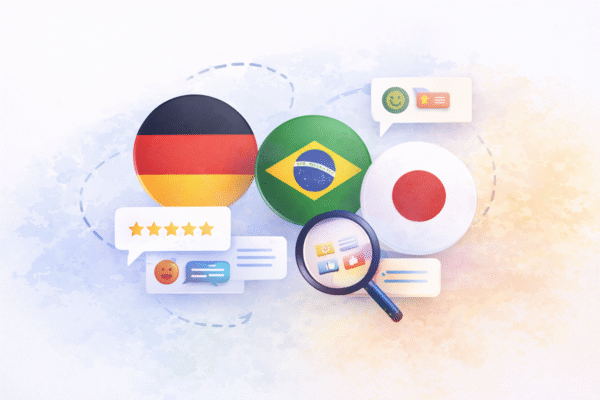 Finally, automated reporting and visualization generates dashboards and reports that highlight key findings, trending topics, and regional differences. These reports update continuously, offering up-to-the-minute insights that help businesses respond quickly to feedback. This real-time capability underscores both the advantages and challenges of using AI for multilingual feedback analysis.
 Benefits of AI-Driven Analysis
The speed and scalability of AI are game-changers. While a human analyst might process 100-200 pieces of feedback per day, AI can handle over 10,000 multilingual comments in the same timeframe. This is particularly valuable during high-pressure moments like product launches, crises, or seasonal peaks when feedback volumes skyrocket. AI also ensures consistent analysis standards, eliminating the variability that comes with human interpretation. By applying the same criteria across all languages and time periods, AI makes it easier to track trends and compare performance across regions. Another major advantage is cost efficiency. After the initial setup, AI systems can manage additional languages and larger feedback volumes without significantly increasing operational costs. This makes comprehensive multilingual analysis feasible for businesses that might otherwise lack the resources for large manual analysis teams. AI systems work around the clock, processing feedback from diverse sources as it comes in. For instance, a customer complaint posted at midnight can be flagged and categorized before the next business day begins, enabling faster responses and quicker issue resolution.Drawbacks of AI-Driven Analysis
Despite its strengths, AI-driven analysis has its limitations. Translation accuracy can falter with complex grammar, idioms, or regional dialects. For example, a phrase like “it’s not my cup of tea” might be translated literally, losing its intended meaning of personal preference. Cultural nuances are another challenge. AI often misses subtle cues that human analysts would catch, such as indirect criticism common in many Asian cultures. Polite but strongly dissatisfied feedback might be classified as neutral, leading to misinterpretation. Context dependency is also an issue. Without enough background information, AI may misclassify feedback. For instance, a comment about “slow performance” could refer to product speed, customer service, or delivery delays, but AI might struggle to determine the correct context. Training data bias can skew results. If AI models are trained predominantly on data from specific regions or demographics, feedback from underrepresented groups or emerging markets may be misinterpreted due to differing language patterns. AI also struggles with sarcasm and mixed emotional signals. A comment like “Great, another software update that breaks everything” is clearly sarcastic and negative, but some AI models might focus on the word “great” and misclassify the sentiment. Finally, the accuracy of AI analysis depends heavily on the quality of its input data. Poorly formatted text, incomplete submissions, or spam can distort insights, and AI systems may not always filter out irrelevant or misleading content effectively.Manual vs AI-Driven Analysis: Side-by-Side Comparison
As discussed earlier, manual and AI-driven analysis each have their own strengths and limitations. By comparing these methods across key performance areas, you can determine which approach best aligns with your needs, resources, and timelines.Speed and Processing Power
When it comes to speed, the difference is stark. Manual analysis depends entirely on human effort, limiting how much data can be processed at once. This makes it challenging to handle large volumes, especially during sudden spikes in feedback. In contrast, AI-driven systems are built for scale. They can process massive datasets simultaneously, delivering insights almost in real time. These systems adapt to fluctuating workloads without requiring additional team members or extended processing times, making them ideal for handling high feedback volumes efficiently.Accuracy and Quality
Accuracy is where the debate gets interesting. Manual analysis shines in its ability to interpret subtle nuances, such as regional slang, irony, or culturally specific expressions. Human analysts can pick up on these details, providing a rich understanding of the context. AI systems, on the other hand, excel in consistency. They apply uniform criteria to every piece of feedback, eliminating the variability that can arise when different analysts interpret data differently. However, AI might struggle with the complexities of informal language or cultural subtleties, areas where human expertise is invaluable.Cost and Resource Requirements
The costs associated with these methods vary significantly. Manual analysis requires ongoing investment in staffing, training, and scaling efforts as feedback volumes grow. This can make it a costly option over time, especially for large-scale operations. AI-driven systems, while requiring a higher upfront investment for software, integration, and customization, tend to have stable operational costs regardless of volume. For smaller teams or businesses with limited budgets, manual methods might remain a more practical choice, but AI offers long-term cost efficiency for larger-scale operations.Analysis Depth and Features
Each method brings unique strengths to the table. Manual analysis provides deep, contextual insights and can uncover emerging trends that don’t fit neatly into predefined categories. This human touch is crucial for understanding complex emotional cues and subtle shifts in sentiment. AI-driven analysis, on the other hand, is unparalleled in its ability to detect patterns and trends across vast datasets. It can identify recurring issues across different regions and languages, offering a global perspective that might be difficult to achieve manually. However, its focus on broad trends can sometimes miss the finer contextual details that human analysts excel at interpreting. This comparison highlights the strengths of both approaches and suggests that a hybrid model, combining the best of both worlds, could be the most effective solution.When to Use Manual vs AI-Driven Analysis
Deciding between manual or AI-driven feedback analysis depends on factors like the volume of feedback, business goals, available resources, and the level of detail required. Each approach has its strengths, and understanding these can help you make the right choice. Below, we break down when to opt for manual methods versus AI-driven tools for the best results.Best Use Cases for Manual Analysis
Manual analysis works best when dealing with smaller volumes of feedback that require a deep understanding of context. This is particularly important for high-value clients, complex issues, or sensitive, emotionally charged interactions. It’s also ideal for industries with strict regulations or when working with niche languages and newer markets, where human judgment is crucial for interpreting cultural subtleties and ensuring compliance. In cases where feedback originates from emerging markets, manual analysis can fill gaps left by limited AI training data, offering insights grounded in local context. During product development, the qualitative depth provided by manual review can uncover specific areas for improvement, making it an invaluable tool for refining products and services.Best Use Cases for AI-Driven Analysis
While manual analysis provides depth, AI shines in handling large-scale, fast-paced environments. AI-driven tools are excellent for processing high volumes of feedback in real time, especially when dealing with multilingual datasets. These systems create a unified view of customer sentiment across global markets, making them indispensable for identifying trends, recurring issues, and new patterns. When speed and scalability are critical, AI delivers consistent results with standardized reporting and quick turnarounds. Platforms like Zight incorporate AI tools for transcription, summaries, and translations, simplifying the process of managing multilingual feedback on a global scale. This makes AI-driven analysis a go-to solution for businesses prioritizing efficiency and broad reach.Combining AI and Manual Analysis: The Hybrid Approach
Pairing AI’s speed with the nuanced understanding of human analysts creates a powerful way to gain deeper insights from multilingual feedback. This hybrid approach combines AI’s ability to scale with the contextual and cultural sensitivity that only humans can provide. Instead of treating these methods as competitors, businesses are finding that blending the two delivers better results across key performance areas. By leveraging the strengths of each method, this integrated strategy addresses their respective limitations, ultimately offering the best of both worlds.How to Combine AI and Human Expertise
A tiered workflow works best: AI takes care of the heavy lifting, like processing and categorizing data, while humans focus on complex cases and quality assurance. This division ensures efficiency without sacrificing accuracy, especially when dealing with diverse languages and cultural contexts. Here’s how it works:- AI handles the first pass: AI systems quickly analyze and categorize feedback based on sentiment, topic, and urgency. They can process thousands of multilingual responses in minutes, flagging patterns and highlighting items that need human attention. AI also standardizes language variations and translates content into a common language for easier human review.
- Humans step in for the critical stuff: Analysts focus on high-priority cases flagged by the AI, such as mixed sentiment feedback, comments with cultural references, or input from VIP customer segments. They also validate AI classifications through sample reviews, ensuring the system stays accurate over time.
- Quality control is key: Regular reviews of AI outputs by human analysts provide feedback that helps refine the algorithms. Over time, this continuous learning loop improves the AI’s ability to handle industry-specific terms, cultural subtleties, and emerging trends in customer language.